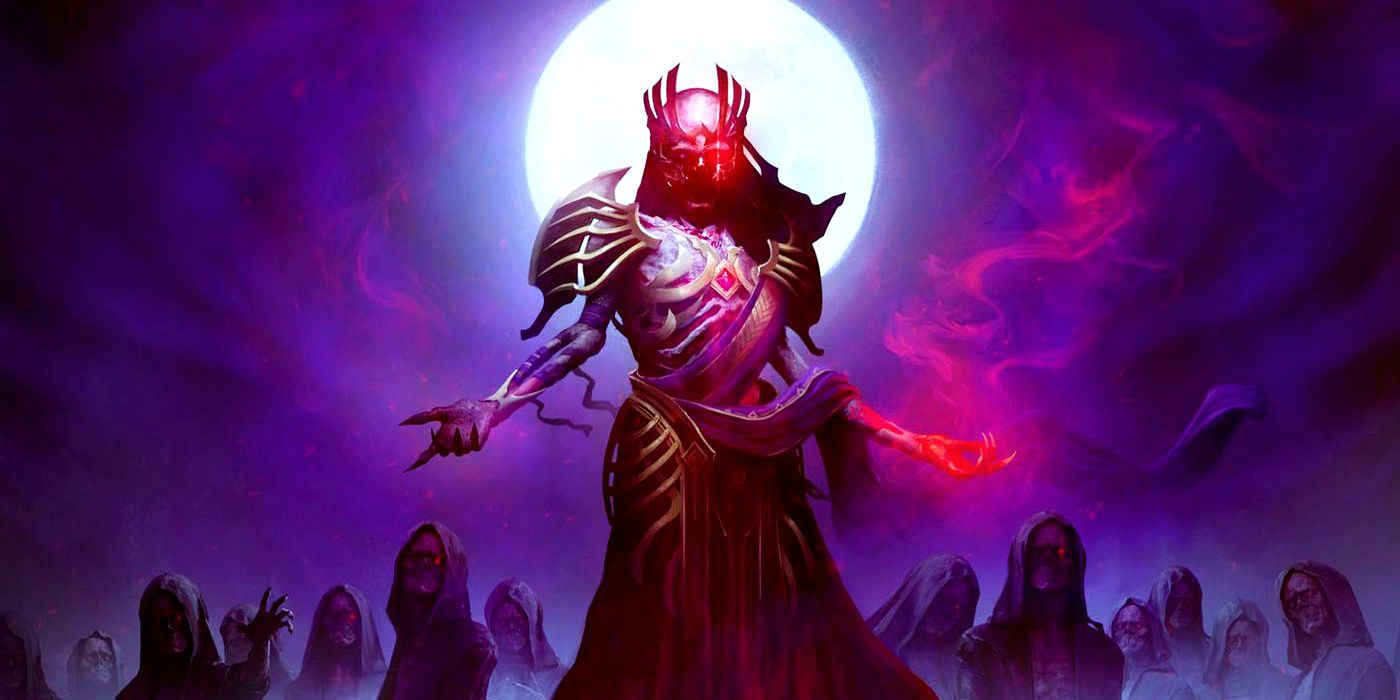
Vecna: Eve Of Ruin Fixes Everything Wrong With One Classic D&D Campaign
Summary Vecna: Eve of Ruin pays homage to DnD's history by adapting a classic dungeon.
Tomb of Horrors is an iconic DnD dungeon, but it doesn't hold up to modern design philosophy.
The Tomb of Wayward Souls in Eve of Ruin is a much better reimagining of the dungeon, keeping its high difficulty but introducing more interesting elements.
The epic Dungeons & Dragons module Vecna: Eve of Ruin is a tribute to 50 years of tabletop RPG history, but it also highlights how much adventure design has improved, especially with its homage to the infamous Tomb of Horrors. As DnD evolved from its wargaming roots in Chainmail, the focus on individual heroes undertaking fantastic quests emerged. Dungeon exploration was the primary mode of play, hence the game’s name. Multimedia adaptations like the movie Honor Among Thieves, the long-running Legacy of Drizzt novel series, and even works like Critical Role, showcase modern DnD’s emphasis on storytelling and roleplaying.
[Warning: Spoilers for Tomb of Horros & Vecna: Eve of Ruin.
Some view Tomb of Horrors as DnD’s deadliest challenge, but this presents the module in an overly favorable light. DnD co-designer Gary Gygax ran Tomb of Horrors at gaming tournaments, purportedly to humble overconfident players who felt their characters were incapable of defeat. While many stories about the adventure may be apocryphal, it does seem reasonable that the module would have led to the deaths of characters that could handle a more reasonable challenge with ease. Gygax supposedly described Tomb of Horrors as a “thinking person’s module,” but the dungeon is not one where calculated, rational thinking leads to certain success.
Tomb of Horrors made its debut in 1975 at a convention, and its 1e Advanced Dungeons & Dragons version was published in 1977. Gygax stated he designed the dungeon to foil specific players in his regular gaming group, including his son Ernie Gygax's wizard Tenser. It was designed for a high probability of character death, to which Gygax said, "I admit to chuckling evilly as I did so."
Related How To Do a Vecna Eve Of Ruin Run In DnD Dungeons & Dragons Vecna Eve of Ruin celebrates the TTRPG’s 50th anniversary, and brings back some of the best villains from previous modules.
Vecna: Eve Of Ruin Contains A Tomb Of Horrors Homage
The Tomb Of Wayward Souls Is A Better Version Of The Classic Dungeon
Close
Meticulous caution can initially help the party in Tomb of Horrors, including staples such as searching every surface for traps and secret doors, and liberally making use of 10-foot poles and summoned monsters to expose other hazards. Other segments of the dungeon eschew all logic and reason, depending on lucky guesses and feats of intuition that are essentially second-guessing the mind of Gary Gygax more than that of Acererak the lich. The adventure follows the old-school design paradigm where heroes are given little motivation to enter the dungeon beyond the lure of treasure and a desire to overcome brutal challenges.
Your browser does not support the video tag.
Conversely, Vecna: Eve of Ruin offers excellence in high stakes, high-level DnD adventuring. There is a real sense of urgency to the module, since the Archlich Vecna plans to rewrite the multiverse itself. Players interact with many interesting NPCs, ranging from card sharks in the casinos of Hell to some of DnD’s most legendary wizards. Social interaction is a higher priority than it was in old-school modules, and the acquisition of personal secrets in Eve of Ruin has a mechanical impact at a later point in the adventure. Tomb of Horrors included only one NPC for heroes to talk to.
Tomb of Horrors has been adapted to subsequent editions of Dungeons & Dragons, and its more recent revisions typically eschew some of the instant kill traps and puzzles. The 5e DnD version in Tales of the Yawning Portal does still feature several instant death traps with no saving throw, however.
Some veteran fans praise the freedom involved with early DnD adventures, which were devoid of “railroading,” despite the lack of urgency or storytelling in most modules. Eve of Ruin offers vital choices for players that can have a significant impact on the course of the adventure. These are meaningful decisions based on in-character roleplaying, not the random guesses an adventure like Tomb of Horrors asks players to make. The seventh chapter of Eve of Ruin takes place in DnD’s classic Greyhawk setting and contains an homage to Tomb of Horrors with its similarly designed dungeon called Tomb of Wayward Souls.
Tomb of Wayward Souls Illustrates How D&D Has Evolved
Tomb Of Horrors Is A Relic Of The Past, But Vecna: Eve Of Ruin Is A True Epic
While the Tomb of Wayward Souls is a segment of Eve of Ruin that embraces its throwback vibe, it effortlessly outdoes the classic module. The puzzles follow a more coherent logic, and it makes use of modern mechanics like Perception checks and saving throws for traps and hazards, where the original required specific player actions and featured instant death traps. The adventure’s modernized Tomb of Horrors is larger in size and complexity, and contains one of Eve of Ruin’s best magic items, where the original offered little in the way of useful loot until the very end of Acererak’s dungeon.
Related Vecna: Eve of Ruin Sees The Return Of More Than One Classic D&D Villain Vecna takes top billing in the new D&D campaign Vecna: Eve of Ruin, but he isn't the only iconic villain with an interesting part to play.
Tomb of Wayward Souls offers more opportunities for interaction than its inspiration, and its Treant has more characterization than the lone Siren trapped in the original Tomb of Horrors. The final boss, Rerak, a false lich created by Acererak, can be reasoned with, as players might detect its reluctance to battle through passive Insight. The stakes of Tomb of Wayward Souls are clearly higher, since it holds a piece of the Rod of Seven Parts, a relic required to save the multiverse from Vecna. Rerak remains one of Vecna: Eve of Ruin’s strongest monsters, on par with the original’s Demilich.
The lore surrounding Acererak, the Demilich who served as the boss of Tomb of Horrors, has been expanded through subsequent adventures, such as 5e DnD's Tomb of Annihilation. In the original adventure, players only knew that Acererak was an ancient Demilich who hoarded treasures and enjoyed deathtraps.
The original Tomb of Horrors could be completed in several hours at DnD tournaments, and its Tales of the Yawning Portal 5e DnD version can be finished in a few sessions. The scope and scale of an epic module that covers levels 10 through 20 obviously goes beyond this, but the contrasting design philosophy is a better comparison. Tomb of Horrors was directly referenced in the novel Ready Player One and is held in high regard by some old school enthusiasts. Vecna: Eve of Ruin is a truly epic Dungeons & Dragons adventure, illustrating the game’s evolution for the better.




COMMENTS