All 15 Godzilla Villains Explained
Summary Not all of Godzilla's foes are villains, Mothra and Baragon have been allies in past battles against Godzilla.
Godzilla's most infamous foe, King Ghidorah, has fought him more times than any other villain in the franchise.
SpaceGodzilla remains one of the most powerful adversaries Godzilla has faced, only appearing in a single film due to his immense power.
In Toho’s movies, Godzilla has a deep catalog of villains. Beginning in the 1960s, the King of the Monsters has fought off over a dozen villainous kaiju. Some have become popular enough to appear in multiple movies, while others have only been used once. Godzilla has been fighting with other monsters since 1955’s Godzilla Raids Again when he went up against Anguirus. Not all Godzilla movies, however, are about good versus evil. There are times when he gets into brief fights with other monsters, who later become allies. Examples of this include Anguirus, Rodan, and Kumonga.
It’s also important to remember that not all of Godzilla’s foes are villains, per se. There are occasions when it’s Godzilla who’s the real antagonist. That’s why creatures like Mothra and Baragon cannot be counted as Godzilla villains, even though they’ve both fought him. They've also been allied with Godzilla, much like King Kong and Godzilla have both been on opposite sides of a conflict and on the same side. On the other hand, there’s a multitude of creatures in the franchise who can only be classified as enemies of Godzilla. Here’s every Godzilla villain in Toho’s kaiju library.
Your browser does not support the video tag.
King Ghidorah
The first time Godzilla battled a true villain on the big screen was in 1964’s Ghidorah, the Three-Headed Monster. Introduced as an alien creature sent to conquer the world, Ghidorah was driven off by the combined efforts of Godzilla and Rodan, who received some assistance from Mothra. Ghidorah returned a few more times in the Showa series, but was always defeated by Godzilla and at least one of his allies.
It wasn’t until 1991’s Godzilla vs. King Ghidorah that the two monsters were able to have a fair, one-on-one fight. In Godzilla: Final Wars, he was completely reimagined as Monster X, who transformed into Keizer Ghidorah. Commonly regarded as Godzilla’s greatest villain ever, Ghidorah has fought Godzilla more than any other villain, with his most recent appearance being in the MonsterVerse’s Godzilla: King of the Monsters.
Related 8 Monsterverse Questions Finally Answered By Godzilla x Kong The Monsterverse had slowly been sowing the seeds for many mysteries which were finally explained in detail in Godzilla x Kong: The New Empire.
Kamacuras
Kamacuras first appeared in 1967's Son of Godzilla. Not as large as other kaiju, the monsters are giant praying mantis. They were originally normal insects but were mutated by experiments to control the weather by the United Nations at Solgell Island. The kamacuras caused the egg of the kaiju Minila to hatch early, and they went after the egg. Godzilla becomes the movie's hero as a result, intent on protecting the hatching baby from the kamacuras. Over the course of the movie, Godzilla killed two of them, while the third was disposed of by Kumonga, the giant spider kaiju.
Godzilla had to fight another in Godzilla: Final Wars. The kamacuras is also canon in the Godzilla anime projects. It is not, however, one of the kaiju that can be utilized in Legendary's MonsterVerse so far.
Ebirah
In the low-budget 1966 movie Ebirah, Horror of the Deep, Godzilla battled Ebirah, a giant crab monster who lived in the ocean and attacked any ships that drew near it. Like many of the kaiju in the 1960s movies, Ebirah was a crustacean who became mutated due to the effects of nuclear runoff from a nearby island. The Red Bamboo, a terrorist group whose activity created Ebirah, were the only ones whose ships were safe from the creature thanks to them creating a substance they released from their ships to repel him.
In combat, the creature relied mostly on its claws and wasn’t able to do much against Godzilla once they were ripped off. It’s been said that Toho’s original intention for the movie was for Ebirah to fight King Kong, not Godzilla. That particular project, however, was never completed, and the battle against Godzilla was drafted instead.
Gabara
Gabara, a giant green monster, stands out as a Toho kaiju that doesn’t actually exist in Godzilla canon. That’s because his only role was in All Monsters Attack, a movie that centers on a young boy’s dreams of adventuring on Monster Island with Godzilla’s son. Gabara was a manifestation of the boy’s fears about a bully at his school who was also nicknamed Gabara. The boy dealt with this fear by dreaming about Gabara being defeated by Godzilla.
Though Gabara is an amphibian and supposedly based on a toad, the design for the kaiju also looks to take inspiration from the Japanese spirits called Oni. The horns on his head resemble those associated with the Oni. his electrical power is also similar to the Oni being able to control lightning and thunder. The Oni design has also been used in modern media. Teen Wolf featured the Oni as villains in a season that pulled from both Japanese and Korean folklore. Zuko's Blue Spirit mask in Avatar: The Last Airbender is also inspired by the Oni.
Hedorah
Hedorah, also known as the Smog Monster, was an alien blob that fed on pollution. The threat that Hedorah represented was a direct result of humanity’s mistreatment of the Earth. He posed a unique challenge to the King of the Monsters in Godzilla vs. Hedorah. Godzilla had trouble beating him, as the toxic chemicals in his body did significant damage to his skin. Plus, Hedorah held up well against all of Godzilla’s attacks, including his atomic breath.
Hedorah started with the appearance of a tadpole, but grew in size the more it fed on the planet's pollution. His name comes from the Japanese word hedoro, which is in reference to sludge or slime. It's fitting since the monster is associated with pollution in Godzilla's canon.
The origin story has changed for the monster depending on the Godzilla timeline being depicted. While most stories stick to the idea of Hedorah being an organism from space, one novel, GODZILLA: Monster Apocalypse, changed Hedorah to a colony of microorganisms found in a waste disposal area which were converted to a biological weapon. That's in keeping with so many of Godzilla's enemies being created by humans disturbing the environment.
Gigan
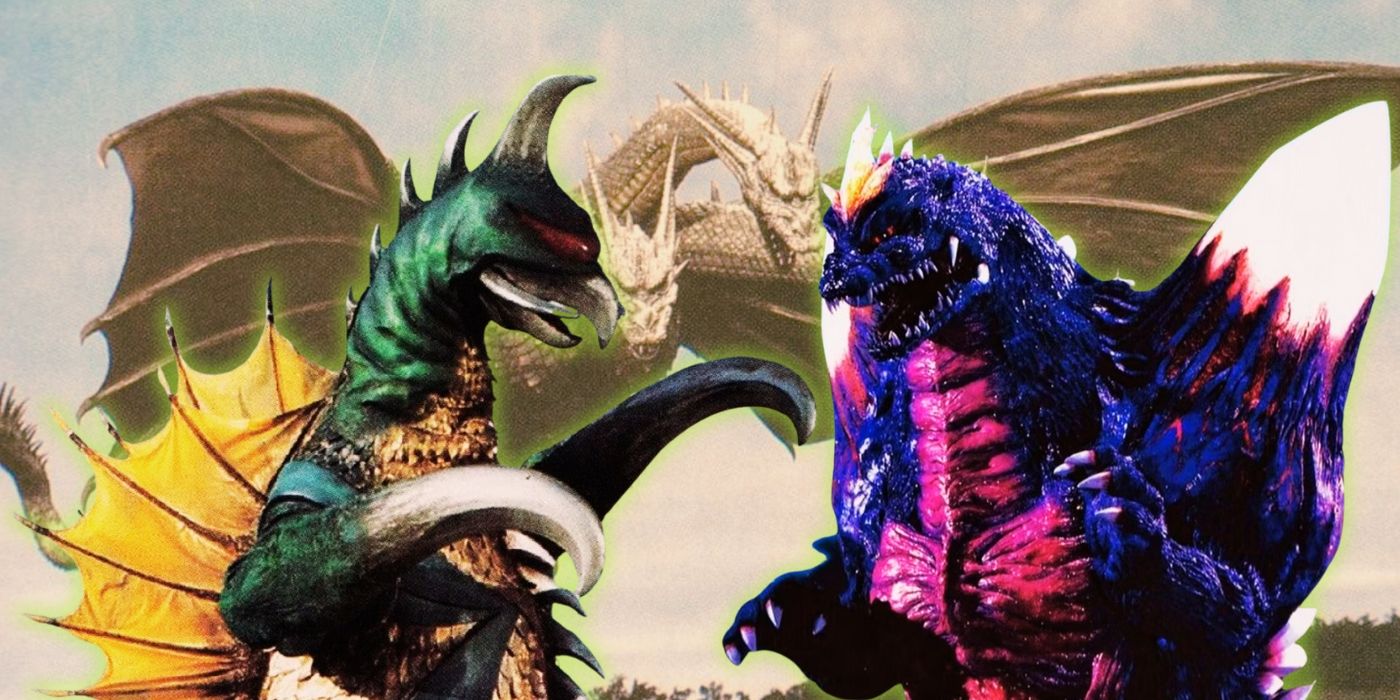
Gigan, a cyborg alien with hooks for hands, became the first monster to make Godzilla bleed in Godzilla vs. Gigan. In fact, in that 1972 movie, he gave Godzilla what was arguably the most gruesome beating he’s ever received, which is a big part of why he’s considered one of Godzilla’s greatest enemies. That being said, he’s never been a singular antagonist in a Toho movie. He’s always an ally of other monsters, such as Ghidorah and Megalon.
In his original appearance, Gigan is actually sent to Earth by King Ghidora to help conquer the planet. When he returns to the planet again, it's to aid the Nebulan aliens' allies in another fight. Gigan is more often used as a soldier by someone else than he is his own villain against Godzilla. Because Gigan has so often been controlled by others, there have been a handful of instances in which Gigan has also been used to help Godzilla, but those are rare.
Related Godzilla Minus One Theory Reveals The Movie Secretly Set Up One Of Godzilla's Strongest Villains A Godzilla Minus One theory suggests the movie's ending lays the groundwork for one of Godzilla's strongest villains to appear in a sequel.
Megalon
In 1973's Godzilla vs. Megalon, Godzilla and Jet Jaguar teamed up for an exciting showdown with the duo of Gigan and Megalon. Megalon was a giant cockroach-like monster who could burrow underground with his hands, which functioned like drills. He was also worshiped as a deity by the same people who called on him to help them in his only movie appearance in the franchise so far.
Megalon is associated with Seatopia in classic Godzilla lore. Seatopia is a massive underground kingdom that is disturbed by nuclear testing, which falls right in line with the Godzilla franchise's commentary on environmental meddling. Megalon is worshiped by the people and when their home is in danger from the testing, he's called on by the Seatopians to fight for them. In fact, Jet Jaguar is initially controlled by them as well, but is able to break free and ally with Godzilla against Megalon and Gigan.
Mechagodzilla
As his name implies, Mechagodzilla is the robotic counterpart of the King of the Monsters. Armed with a deadly arsenal of missiles and laser cannons, the mechanical kaiju is one of the most dangerous enemies Godzilla has ever faced. In Godzilla vs. Mechagodzilla and Terror of Mechagodzilla, he was portrayed as a villain created by aliens to help them take over the Earth. In each of his appearances that followed, Mechagodzilla has been utilized as a weapon of humanity meant to protect them from Godzilla.
Though not part of the Toho timeline of Godzilla films, Mechagodzilla has appeared in Legendary's MonsterVerse. He's become one of the most popular Godzilla villains because he speaks to the idea that perhaps the kaiju aren't always the bad guys in the movies, but instead, the human beings trying to manipulate the events surrounding the kaiju are. With humans putting Mechagodzilla into action, that theme stays in place.
Titanosaurus
Unlike most Godzilla villains, the 1975 Terror of Mechagodzilla’s Titanosaurus wasn’t an evil beast bent on destruction. In the beginning of the movie, he was described as a peaceful, aquatic creature. That didn't last once the scientist who discovered the dinosaur while doing his research was laughed out of the academic community and decided to get revenge on those who had wronged him.
The scientist had been experimenting with ways to control sea life, and when aliens approached him, he offered up his discoveries, including Titanosaurus, to them. After being mind-controlled by aliens, Titanosaurus joined forces with Mechagodzilla and helped him oppose Godzilla. Despite the odds, Godzilla managed to survive against both monsters. After his defeat, the creature never returned to the Godzilla universe. He has, however, appeared in comic books inspired by the Godzilla universe and been in some of the video games surrounding the character.
Biollante
In 1989's Godzilla vs. Biollante, a terrifying new villain was born from the DNA of a rose, a dead girl, and Godzilla. She wasn't the first monster to be created by humans in the Godzilla universe, but she was the first to be plant-based. At the time, Biollante was the largest monster he had ever encountered. The creature — who dwarfed even Godzilla himself — was an enormous plant monster whose long, vine-like tendrils could be used to subdue her enemies.
Interestingly, Biollante also maintained the consciousness of the young girl whose DNA was used to create her. The young girl was the daughter of the scientist in charge of the genetic modification project. She does exist in the manga and anime adaptations of Godzilla but has not appeared in a live-action project since, which is a shame since she's a fan-favorite monster.
SpaceGodzilla
Powered by the large crystals on his shoulders, SpaceGodzilla is an evil kaiju who was created when Godzilla’s cells were mutated by the energy from a black hole. Some long-time Godzilla fans have actually speculated that those mutated cells might have actually come from the same Godzilla DNA used to create Biollante, that it's Biollante's cells scattered in space that are responsible for the creation of SpaceGodzilla.
After coming to Earth, SpaceGodzilla captured Godzilla’s son and became embroiled in a heated battle with the Japanese military, a robot called Moguera, and of course, the monster he originated from. Due to the vast amount of power he carried, SpaceGodzilla is the only Toho villain that Godzilla was never able to beat without help. SpaceGodzilla is so powerful that he's only appeared in a single movie.
Battra
Godzilla vs. Mothra saw the first and only appearance of Battra, Mothra’s evil counterpart. It was explained in the movie that while Mothra is a protector of humanity, Battra hates humans and sees them as a threat to the planet. Battra was specifically created as a counterpart to Mothra when the Earth (a feeling and sentient living being in early Godzilla lore) felt that it was in danger from humanity.
Mothra actually fought and defeated Battra 12,000 years before the events of Godzilla vs. Mothra. Battra had been sealed away in the Arctic before his release here. After battling Godzilla, Battra realized that he couldn’t win without forming an alliance with Mothra. In the end, Battra helped Mothra take down Godzilla, but lost his life in the process. With Mothra being such a favorite character with such rich lore, it's surprising that Battra hasn't resurfaced outside of the comics and video games since his first movie appearance.
Related Every Time Mothra Has Died In Godzilla Movies Death and rebirth is a recurring theme for Mothra that goes all the way back to the 1960s. Here's every time Mothra has died in the Godzilla movies.
Destoroyah
Godzilla vs. Destoroyah, the final installment in the Heisei series of movies in 1995, revealed that there was a side-effect of the military using the Oxygen Destroyer to kill the Godzilla decades earlier in 1954. The Oxygen Destroyer mutated a group of crustaceans into Destoroyah, an incredibly powerful and destructive being. Because Destoroyah was made of a group of crustaceans, they could reform and change their appearance, which they did, until becoming the winged monster that finally fights Godzilla.
Destoroyah is seen as one of the malicious foes in Godzilla's rogues gallery because he appears to enjoy causing pain rather than simply acting on instinct or someone else's control. Certain shots of the movie even make it appear as though the kaiju is laughing at both Godzilla and his son's injuries. Godzilla, who was leaking radiation and near the end of his life, barely managed to finish off Destoroyah before using what was left of his life-force to save his son.
Orga
In the first film in the Millennium series, Godzilla 2000, the titular monster crossed paths with what appeared to be an alien spaceship. After absorbing some of Godzilla’s DNA, the spaceship morphed into Orga, a fearsome, hulking creature. Orga began to transform as a result of Godzilla's DNA in his system, but couldn't become a fully formed or defined monster. Orga attempted to become a clone of Godzilla, but was destroyed before the transformation was complete.
Orga was destroyed in one of the most gruesome ways of the franchise. Godzilla actually allowed Orga to begin swallowing him in a fight - head first, of course. Once his head was far enough inside Orga, Godzilla created a shockwave that tore Orga apart from the inside out. Since then, Orga has also appeared in the anime and comic book continuities of Gozilla's stories, but not the live-action movies.
Megaguirus
Like Orga, Destoroyah, Battra, and a few others, Megaguirus was a one-and-done villain. In Godzilla vs. Megagurius, a swarm of giant prehistoric dragonflies known as the Meganulas stole some of Godzilla’s power, and gave it their queen. Thanks to Godzilla’s energy, the dragonfly grew and became Megaguirus. She was intent on stealing the rest of Godzilla's power for herself, which is what led to her rampage through Japan. She actually sought out Godzilla to fight him, but he destroyed her with his atomic breath.
While Megaguirus only appeared as the villain in one movie, she did appear in footage Godzilla Final Wars. That movie, which acted as a 50th anniversary celebration for the franchise, featured numerous kaiju simply in stock footage to indicate that they did exist in this movie's timeline of events as an alien race gained control of most of the kaiju on Earth and set out to control it, with Godzilla, of course, tasked with saving the planet.
So many of Godzilla's fiercest enemies only appeared for one appearance on the big screen, but with Toho still continuing to expand the franchise, audiences may just see these Godzilla villains again in the future.




COMMENTS