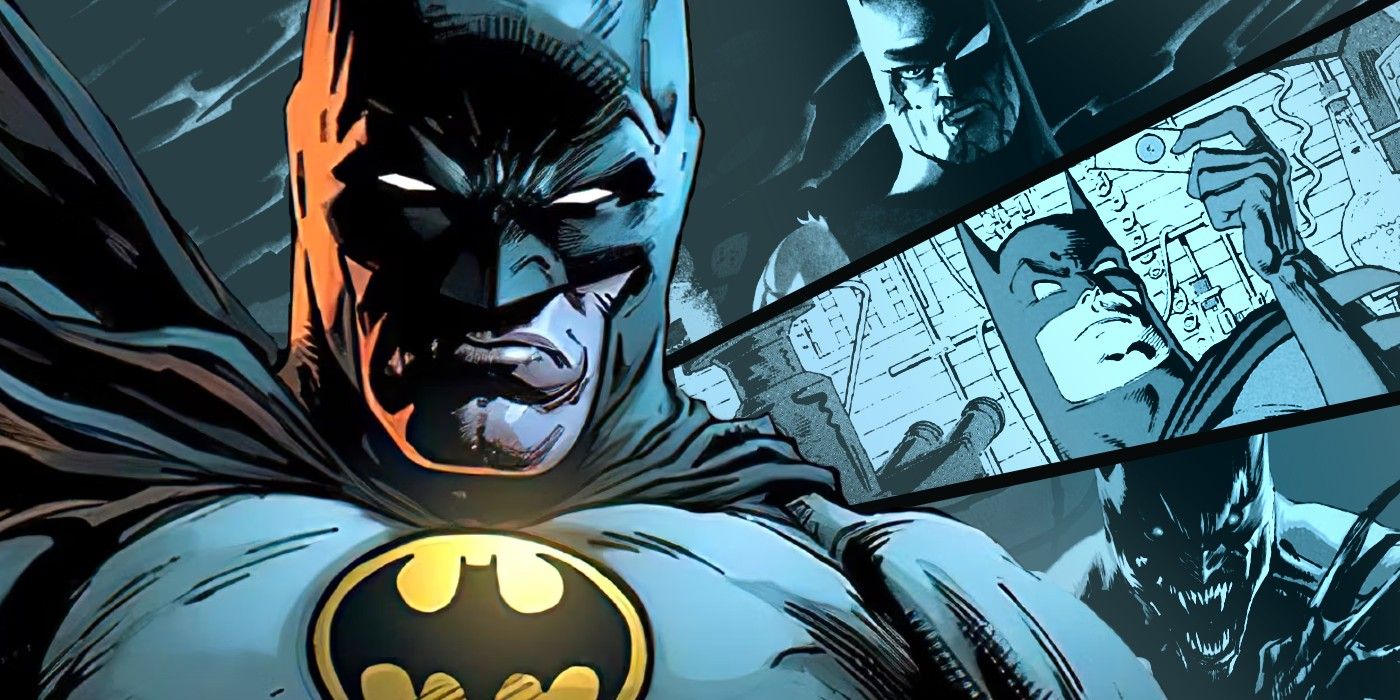
Batman Begins: A Beginner’s Guide To Batman Comics (Best Reading Order)
Summary Start with Batman: Year One (1987) for the definitive origin story and insight into characters like James Gordon and Catwoman.
Explore Batman's early rogues gallery in Batman: The Man Who Laughs to witness the iconic first meeting between Batman and the Joker.
Dive into the impactful storylines of A Lonely Place of Dying (1989) and Knightfall (1993) to understand the evolution of Batman and his allies.
For over 80 years, Batman has been a comic book icon, but finding a good place to start reading can be daunting. The reading order for Batman comics changes depending on how readers want to approach the history of The Dark Knight. Some start with his very first appearance back in 1939's Detective Comics #27, while others start with the more recent or most iconic Batman tales, like The Dark Knight Returns.
As a new version of the Dark Knight heads to theaters in Batman: The Brave and the Bold, new fans will be looking to the comics to explore the character and his extended family. Since searching through over 80 years of continuity is difficult without a handy chronological road map, we're here to help.
Batman: Year One (1987)
Frank Miller, David Mazzucchelli
While Batman's mythology had been developed for many years prior to Frank Miller and David Mazzucchelli's Batman: Year One four-issue storyline from 1987, it has become the definitive origin story for Bruce Wayne's evolution into the Dark Knight.
Year One also details future police commissioner James Gordon's first year in Gotham as well as other Gotham City characters like the Falcones and Catwoman. Year One also partially inspired Christopher Nolan's Batman Begins, making it a must-read for fans of the previous film franchise.
Related The 30 Greatest Batman Villains Of All Time The owner of the greatest rogues' gallery in comics, The Dark Knight has dealt with a rough crowd over the years. Here are the best Batman villains.
Batman: The Man Who Laughs (2005)
Ed Brubaker, Patrick Zircher
Batman: Year One serves as a perfect introduction to Batman and his mission in Gotham City. But Year One primarily focuses on Batman facing off against mobsters such as Carmine Falcone and Sal Maroni. This was long before any of Batman's more colorful villains appeared in Gotham, but Batman: The Man Who Laughs by Ed Brubaker and Patrick Zircher.
This comic showcases the first canon meeting between Batman and the Joker. This meeting would be referenced several times over the years, most notably in Scott Snyder and Greg Capullo's Death of the Family, which had Joker repeating some of his earliest crimes, such as trying to poison the Gotham City water supply, which was first seen here.
Batman: Year Two (1987)
Mike W. Barr, Alan Davis, Todd McFarlane
Batman: Year Two may not have the same name recognition as its predeccesor, but it nevertheless had a major influence on the entire mythos of Batman. This 1987 story continued to retell the origin of Batman after the history revising events of Crisis On Infinite Earths.
The story pitted him against The Reaper, forcing Batman into a position of potentially having to use guns, which he swore never to do. The Reaper provided some visual influence on The Phantasm from the animated movie The Mask Of The Phantasm.
The Long Halloween (1996)
Jeph Loeb, Tim Sale
Jeph Loeb and Tim Sale teamed up for a few connected series that explored the early days of Batman's mission in Gotham City while also exploring his allies and enemies in 1996's The Long Halloween and 1999's Dark Victory.
The Long Halloween featured important moments in the development of Batman's rogue's gallery as he investigated the mysterious Holiday Killer, while Dark Victory serves as a direct sequel and highlights the new partnership between Batman and Dick Grayson/Robin.
Dark Victory (1999)
Jeph Loeb, Tim Sale
Batman: Dark Victory was the sequel to The Long Halloween. While the first Batman comic book story arc dealt with how his rogues' gallery developed after he started his war on crime, this sequel dealt with him taking Dick Grayson under his wing and turning him into the new Robin.
This was around the third or fourth year of Batman's battle to protect Gotham City, and he had to solve a series of murders while also stopping a mob war between Two-Face and what was left of the Falcone crime family. For fans who want to follow the career or Robin, there is a Robin: Year One series that follows Dark Victory.
Robin & Batman (2022)
Jeff Lemire, Dustin Nguyen
After reading Dark Victory, the perfect next step would be Robin & Batman by Jeff Lemire and Dustin Nguyen. This story follows the early days of Dick Grayson's time as Robin, including absolutely beautiful watercolor painting that captures the series' fantastical/dream-like energy. The story also provides a fascinating connection between Dick and Killer Croc, having them both grow up in the same circus.
While everyone knows Dick Grayson as Nightwing, few people are as familiar with his Robin days, and this short comic, coming in at only three issues, provides the perfect glance into the early days of the boy who came to define the role of Robin.
The War Of Jokes And Riddles (2017)
Tom King, Mikel Janin
Another story that deals with Batman's second year as a crime fighter is The War Of Jokes And Riddles from 2017. This story, from writer Tom King, author of The Vision, one of the comics that inspired WandaVision, pits the Joker and Riddler against each other. The eight-part story is told in flashbacks as Batman waits for Catwoman's answer to his proposal for marriage.
Son of the Demon (1987)
Mike W. Barr, Jerry Bingham
One of Batman's greatest enemies is Ra's al Ghul AKA the Demon's Head, the centuries-old leader of the League of Assassins whose relationship with Batman is unlike any of his other villains, as Ra's originally chose Batman to be his successor.
While the origins of Ra's al Ghul weren't revealed until 1999's Birth of the Demon by Denny O'Neil and Norm Breyfogle, it was 1987's Son of the Demon by Mike W. Barr and Jerry Bingham that explored his complicated relationship with Talia al Ghul that would go on to have a major impact on Batman's mythology
Arkham Asylum: A Serious House on Serious Earth (1989)
Grant Morrison, Dave McKean
Released in 1989 by Grant Morrison and Dave McKean, Arkham Asylum: A Serious House on Serious Earth took Batman, and fans, inside the iconic hospital and showcased many of the inmates who had taken over the institution.
This Batman story was a perfect example of how all Batman's villains were mirror versions of the hero himself and showed how they possibly only exist because he is there as well. For fans of the videogames, this is the comic book that also influenced that franchise.
The Killing Joke (1988)
Alan Moore, Brian Bolland, John Higgins
When it comes to Batman, it isn't just about the one hero fighting crime in Gotham City. He has an entire supporting cast, and it is important to see how they all fit together in the puzzle. In Batman: Year One, the story mostly followed Jim Gordon arriving in Gotham and dealing with the new Batman fighting crime.
In The Killing Joke, Gordon is pushed to the limit when Joker shoots and paralyzes his daughter Barbara, who is also Batgirl. This entire act of violence was just to try to drive Gordon over the edge, and it was all he could do to not kill Joker, and a lot of that was thanks to his reliance on Batman as a confidant.
The Second Robin, Jason Todd
Batman #408-425 (1987)
The first appearance of the Jason Todd that everyone would come to know and love was seen in Batman: #408 by Max Allan Collins and Chris Warner. This would follow the majority of Jason's time as Robin from issues 408 to 425, with Death in the Family starting in Batman #426.
It's important to see Jason as Robin before his death, otherwise his loss doesn't mean anything. While Jason is often remembered as the "angry" Robin, readers can see that definitely wasn't the case by simply taking the time to read these pivotal moments in Jason's history before he became the Red Hood.
Death In The Family (1988)
Jim Starlin, Jim Aparo, Mike DeCarlo, Adrienne Roy
Batman's extended family includes a number of costumed allies that play a large role in his storylines over the years, and there are a couple of essential storylines that not only affected the Bat-Family but also had a lasting impact on Batman, both released in 1988.
A Death In The Family and The Killing Joke showcased the tragic loss of Robin and Batgirl, respectively, at the hands of Batman's greatest enemy. Batman would stay in a dark place until 1989's A Lonely Place of Dying introduced Tim Drake as the new Robin, launching a new era for the dynamic duo.
A Lonely Place Of Dying (1989)
Marv Wolfman, Jim Aparo, George Perez
A Lonely Place Of Dying is a 1989 crossover between the Batman titles and The New Teen Titans that introduced the third version of Robin Tim Drake. This follows the grisly death of the second Robin, Jason Todd, at the hands of the Joker in A Death In The Family.
Batman hadn't recovered from the violent loss of Jason Todd, becoming more careless, which merits the concern of Nightwing, the first Robin. During a battle with Two-Face, Tim Drake deduces Batman's true identity and appoints himself the new Robin. That was groundbreaking, sending Batman and his allies into a lawless Gotham City - shut off from the rest of the world - it was the prequel that set the table for the story. This was Cataclysm, and it is hard to get into No Man's Land without reading what came before.
Knightfall (1993)
Batman #492-500, Detective Comics #659-666
Even 30 years after its first publication, Knightfall remains one of the most impactful stories in the Dark Knight's career. Bane stages a breakout at Arkham Asylum, unleashing all the villains on Gotham City. Batman struggles to maintain order, but Bane proves to be too much, and after a confrontation with Batman in the Batcave, Bane breaks his back.
But Gotham still needed a protector. Enter Jean-Paul Valley, who became Azrael and donned the mantle of Batman, and defeated Bane. However, Azrael was unstable and violent, and after he crossed the line and let someone die, Bruce Wayne came back to reclaim the mantle.
Cataclysm/No Man's Land (1998)
In the mid-1990s. DC Comics began challenging the status quo of most of its iconic heroes. In the epic events Cataclysm and No Man's Land, they challenged the status quo of Gotham itself. In Cataclysm, a major earthquake rocks Gotham, causing mass destruction. Then, in No Man's Land, the government cuts Gotham City off from the rest of the country, declaring it lost.
While Gotham would eventually rebuild, Cataclysm and No Man's Land remain some of Batman's best stories, and certain elements would inform Christopher Nolan's The Dark Knight Rises.
Batman: Hush/Under The Red Hood (2002)
Batman's past would come back to haunt him a number of times in storylines like 2002's Batman: Hush or 2005's Under The Red Hood, both of which were adapted into feature-length direct-to-video animated movies.
Hush introduced a brand-new villain who manipulated some of Batman's biggest enemies into taking down the Dark Knight in an extremely personal attack that explored Bruce Wayne's past while the return of the villainous Red Hood (a former costumed identity of The Joker) completely shook up Batman's world and re-examined one of his most tragic moments.
Batman And Son - Batman, Inc.
Grant Morrison, Andy Kubert
When Grant Morrison took over the core Batman titles, they took inspiration from classic stories to help bring them into modern continuity while further developing Batman and his family with the introduction of his son Damian Wayne in 2006's Batman And Son. Damian Wayne has proven popular with fans, and will make his live-action debut in Batman: The Brave and the Bold.
2008's Batman R.I.P. and Final Crisis led to huge changes and a brand-new Batman and Robin following 2009's Battle For The Cowl. 2010's Batman Incorporated further evolved Batman's organization before the entire DC Universe was rewritten by the Flashpoint event.
The New 52 Era (2011)
Scott Snyder, Greg Capullo
While Batman and his related characters weren't given a full reboot like the rest of the DC Universe, the New 52 did serve as a good jumping-on point for new readers while still embracing most of Batman's established history.
Scott Snyder and Greg Capullo introduced readers to the mysterious Court of Owls before an epic showdown with the Joker in Endgame. Batman's early days were also given a modern overhaul in Zero Year while the Super Heavy storyline introduced yet another brand new armored Batman.
DC Rebirth (2016)
Tom King, David Finch, Mikel Janin
Tom King took over Batman following the 2016 DC Rebirth event that provided a soft reboot to the DC Universe, which led to Batman teaming up with Barry Allen/The Flash to investigate during The Button storyline.
Batman and Catwoman's romantic relationship that was first made official in Hush would be further developed over the course of his run. His rivalry with Bane would also be taken to new levels with City of Bane which would lead to one of the biggest tragedies in Bruce Wayne's life that the Bat-Family is still recovering from in current issues.
Dark Nights: Metal (2017)
In 2017, DC introduced one of the most dangerous and exciting Batman villains in history with The Batman Who Laughs. This happened in Dark Nights: Metal. The six-issue miniseries that started it all saw Batman discover a dark multiverse that exists under the core of the main DC Universe.
This is where The Batman Who Laughs came from, which was that world's Bruce Wayne, driven mad by Joker's laughing gas. If fans ever wanted to see what an evil Batman looked like, it happened here and since he was Bruce Wayne, he was also someone that the Caped Crusader couldn't beat without going to his worst enemy - his world's Joker.




COMMENTS