20 Criminal Minds Episodes Based On Real Cases
Summary Criminal Minds episodes draw inspiration from real-life serial killers and true crime, adding chilling realism to the show's stories.
The rebooted Criminal Minds: Evolution continues to use real cases as inspiration, prompting the creation of the docuseries The Real Criminal Minds.
From the Zodiac Killer to the Lipstick Killer, the show incorporates infamous and lesser-known cases, delving into the dark and disturbed minds of serial killers.
Criminal Minds episodes based on real cases ensured the show covered some disturbing crimes of any weekly procedural drama on network television. Criminal Minds focuses on the FBI's Behavioral Analysis Unit (the BAU) and the UnSubs (Unidentified Subjects) they hunt down. The show's serial killers are often incredibly dark and disturbed, with their sinister acts made all the more chilling in the Criminal Minds episodes based on real cases — as many are. From infamous names like the Zodiac Killer to more obscure cases like the 1940s Lipstick Killer, Criminal Minds often delves into true crime for inspiration.
While Criminal Minds ended in 2020 after its 15th season, Paramount Plus brought the show back with the rebooted Criminal Minds: Evolution. Like the show's original run, Evolution has also drawn on true crime to inspire its stories. While the UnSubs in Criminal Minds are all fictional, many of their circumstances and crimes are based on real people and actual events — a fact Paramount+ capitalized on by ordering The Real Criminal Minds, which is a docuseries about these real-life serial killers (via Deadline).
Related All 15 Seasons Of Criminal Minds, Ranked Worst To Best Criminal Minds follows the FBI’s Behavioral Analysis Unit as they hunt murderers across the country, but not every season is at the same standard.
20 "Children of the Dark" (Season 3, Episode 4)
Gary & Ervin Robles Are Based On Two Notorious Serial Killers
Close
"Children of the Dark" provides a disturbing exploration of the psychological trauma that fuels such gruesome acts. While not directly mentioned or referenced in the episode, "Children of the Dark" draws inspiration from the notorious serial killers Leonard Lake and Charles Ng. The episode follows a duo, Gary and Ervin Robles, who break into suburban homes, murder the parents, and leave the children alive. Like Lake and Ng, the Robles brothers are a serial killing team, family annihilators, and robbers.
Their partnership mirrors the infamous duo in several ways: both pairs included a Caucasian male and a partner of a different race, and both had at least one member who was abused by parental figures (Ng was abused by his father, while Gary and Ervin were abused by their foster parents). Additionally, just like Lake and Ng, one Robles team member assumes a victim's identity before getting arrested.
Related 10 Star Trek Actors Who Were On Criminal Minds Star Trek and Criminal Minds may take place in vastly different universes, but several Trek stars have appeared on the dark crime drama.
19 "The Perfect Storm" (Season 2, Episode 3)
The Criminal Minds Episode Takes Inspiration From Paul Bernardo & Karla Homolka
Close
Inspired by the notorious "Ken and Barbie Killers" Paul Bernardo and Karla Homolka, Criminal Minds weaves a chilling tale in "The Perfect Storm." The episode's unsubs, Amber and Richard Canardo, share eerie similarities with Bernardo and Homolka. Both pairs are serial killers, rapists, and abductors who target women, luring them in with the ruse of asking for directions. Like the "Ken and Barbie Killers," the Canardos recorded their heinous acts of rape before strangling their victims and dumping their naked bodies in convenient locations.
Amber Canardo, one of Criminal Minds' most memorable unsubs, plays a manipulative role, using her charm to draw in unsuspecting victims, while Richard becomes the dominant aggressor during their attacks. The BAU team finds disturbing footage revealing the torment inflicted on their victims, mirroring Bernardo and Homolka's recorded crimes. The episode delves into Amber's troubled past, revealing a history of trauma that transformed her into a remorseless killer. The twisted dynamic between dominant and submissive partners in crime is highlighted as Amber manipulates Richard to fulfill her sadistic desires.
18 "The Boys of Sudworth Place" (Season 9, Episode 7)
Glen Westbrook & Jerry Sandusky Have Many Similarities
Close
"The Boys of Sudworth Place" presents a disturbing story inspired by the crimes of Jerry Sandusky. Glen Westbrook is strikingly similar to Sandusky; both were widely regarded as upstanding individuals, married with children and worked at youth facilities. Their public personas masked their predatory behavior, as both were pedophiles who targeted boys attending their facilities. They used child-grooming tactics to make the boys vulnerable before molesting them repeatedly. The episode follows the BAU as they investigate Westbrook's heinous crimes.
Despite being confronted with accusations, he maintains his innocence, denying all wrongdoing. His façade of respectability allowed his crimes to remain undetected for over a decade. The BAU uncovers the extent of Westbrook's abuse, revealing how he manipulated and exploited the trust of vulnerable children. "The Boys of Sudworth Place" serves as a chilling reminder of the evil that can hide behind a charming exterior and the devastating impact such predators can have on their victims.
Related Why Thomas Gibson Was Fired From Criminal Minds FBI Agent Aaron Hotchner actor Thomas Gibson was abruptly fired from Criminal Minds after 12 seasons in the show's main cast - here's why.
17 "There's No Place Like Home" (Season 7, Episode 7)
James Heathridge Draws Inspiration From The Notorious Jeffrey Dahmer
Close
In "There's No Place Like Home," Criminal Minds introduces James Heathridge, an unsub who appears to be based on the infamous Jeffrey Dahmer, who is directly mentioned in the episode. Both Heathridge and Dahmer were serial killers and abductors with similar victim profiles, targeting Caucasian teenage boys with high-risk lifestyles. Heathridge lured his victims to his trailer with promises of beer and sex, much like Dahmer would attract his victims to his apartment. Once there, he incapacitated them by spiking their drinks with tranquilizers.
After murdering his victims, Heathridge dismembered their bodies post-mortem and kept body parts as grisly trophies, echoing Dahmer's gruesome practices. Furthermore, Heathridge being molested by someone living in the same trailer park as him could be a nod to claims that Dahmer was molested by a neighbor during childhood. The BAU races against time to stop Heathridge before he claims more lives, revealing the dark roots of his behavior and the trauma that shaped him.
16 "Seven Seconds" (Season 3, Episode 5)
Criminal Minds' Richard Jacobs Has Many Similarities To Richard Allen Davis
Close
In "Seven Seconds," the BAU faces a race against time to find Katie Jacobs, a young girl who has gone missing during a family gathering at a mall. The investigation reveals that Richard Jacobs abducted Katie and intended to kill her to prevent her from identifying him. His wife, Linda Jacobs, acted as his accomplice, helping to cover up the crime. "Seven Seconds" draws inspiration from the real-life case of Richard Allen Davis, the infamous abductor and murderer of 12-year-old Polly Klaas.
In the episode, Dr. Reid even directly references Davis, noting how he killed Klaas to prevent her from identifying him. Both Davis and Jacobs were pedophilic abductors who targeted young girls and had female accomplices who helped cover up their crimes. The episode highlights the chilling parallels between Jacobs and Davis, revealing how manipulation and control can distort family dynamics and lead to devastating outcomes.
15 "Blood Hungry" (Season 1, Episode 11)
UnSub Eddie Mays Is Based On Richard Trenton Chase
This great episode of Criminal Minds based on a real case from the show's first season is "Blood Hungry," which sees the team hunting a killer who is eating the organs of his victims — a sinister act that takes inspiration from the real-life case of Richard Chase. Chase killed several people within a month in the 1970s in California, drank their blood, and ate their remains. In real life, Chase was the serial killer known as "The Vampire of Sacramento." Chase was a cannibal and necrophilic who killed six people before his arrest.
Serial killer Richard Chase operated from 1977 to 1978, and he died in 1980 when he took his only life shortly following his capture. The Criminal Minds episode doesn't go into all the gruesome details of the real-life case, but it does draw inspiration from it. Reid mentioned Chase and said he was driven to kill by the belief aliens had invaded his body, and the UnSub, Eddie Mays, credited Chase as the inspiration for his killing spree. Just like Chase, Mays attempted suicide, but in the show, the BAU managed to stop him.
14 "25 To Life" (Season 6, Episode 11)
Wrongly Convicted Man Donald Sanderson Is Based On Jeffrey MacDonald
One of the more tragic cases that inspired a Criminal Minds episode is that of Jeffrey MacDonald. In real life, former medical doctor and U.S. Army captain Jeffrey MacDonald was convicted of killing his pregnant wife and two daughters in 1970. He maintained his innocence, claiming that four men broke into the house and murdered his family. He is still incarcerated at the Federal Correctional Institution in Cumberland, Maryland.
Two Criminal Minds episodes are based on real cases, referencing Jeffrey MacDonald. Season 6's "25 To Life" sees the team interviewing a man convicted of killing his wife and daughter but claims that he's innocent and intruders murdered his family named Donald Sanderson. MacDonald inspired the character of Donald Sanderson. The difference is that the FBI proved his innocence in the episode, and it showed he was telling the truth. Hotch also mentions MacDonald when dealing with an UnSub in "Magnificent Light."
13 "Hostage" (Season 11, Episode 14)
UnSub Michael Clark Thompson Is Based On The Ariel Castro Kidnappings
The Criminal Minds season 11 episode "Hostage" is eerily similar to the real-life case of Ariel Castro kidnapping multiple women and holding them prisoner, and there's even a quote that refers to Castro by name in the episode. Castro held three women captive for almost ten years, severely beating them and raping them multiple times. One woman did give birth, and others suffered miscarriages. He held them captive from 2002 until 2013, when one of the girls escaped with her daughter and got to the police. One month into his life sentence, Castro died by suicide.
Castro was an influence on five episodes. These Criminal Minds episodes based on real cases portray the gruesome details similar to how it happened in real life. The closest comparison came in season 11 with "Hostage," where Michael Clark Thompson shared a lot of similarities to Castro, including abducting three girls, and his arrest came thanks to one of the girls escaping.
12 "The Company" (Season 7, Episode 20)
Criminal Minds Takes On The Kidnapping Of Colleen Stan
"The Company" was based on the kidnapping of hitchhiker Colleen Stan by couple Cameron and Janice Hooker. The couple kept her locked up for 23 hours each day, and she was sexually abused during the one hour she was allowed out. Stan agrees to be their slave after the couple convinces her of an evil organization called The Company that would torture her and her family if she didn't agree.
This Criminal Minds episode closely mirrors the actual case but with a critical difference. In the show, The Company is portrayed as a real organization, although not one that the kidnappers knew much about. UnSub Malcolm Ford uses the same sort of sensory deprivation box to keep their abductee submissive. In addition to the Criminal Minds episodes based on real cases, this real-life kidnapping was the basis for two movies—The Poughkeepsie Tapes in 2007 and Girl in the Box on Lifetime in 2016.
Related 15 Best Shows Like Criminal Minds From Dexter to NCIS, here are our top recommendations for other shows Criminal Minds fans are sure to love.
11 "Alpha Male" (Season 12, Episode 15)
Spree Killer Elliot Rodger Was The Basis For A Chilling Criminal Minds Episode
Not all Criminal Minds episodes based on real cases are inspired by serial killers. Season 12's "Alpha Male" was based on the case of Elliot Rodger, a spree killer who murdered six people and injured 14 others in Santa Barbara, California. Rodgers was notably infamous for dubbing his actions a "day of retribution" in a video released online. The 22-year-old carried out this destructive act by shooting, stabbing, and attacking his victims with a vehicle before taking his own life. This is also known as the 2024 Isle Vista killings, Rodger cited the inability to find a girlfriend as his motivation.
The Criminal Minds episode follows an UnSub perpetrating several misogynistic attacks by throwing acid at women because he's upset about not being in a relationship. While searching for their UnSub, the team mentioned Rodger, and he was clearly the inspiration for Alan Crawford, the killer in the Criminal Minds episode. The fictionalized version of the case even involves Crawford writing a manifesto and attacking smaller targets before the actual killing spree.
10 "The Big Wheel" (Season 4, Episode 22)
UnSub Vincent Rowlings Is Based On The Lipstick Killer
The season 4 Criminal Minds episode "The Big Wheel" featured a serial killer who sent a videotape to the BAU with a hidden message, begging them to help stop him from murdering again. This was Vincent Rowlings, a man who watched his father murder his mother when he was a child, and he now kills women who look like his mother. He was based on The Lipstick Killer, who showed up in the 1940s and killed three women before he was stopped.
The real Lipstick Killer was William Heirens, a serial murderer active in 1946. Unlike the killer in the Criminal Minds episodes based on real cases, Heirens later recanted his admission of guilt and claimed he never killed anyone. Despite this, he remained imprisoned in Illinois until his death after serving 65 years behind bars.
9 "Omnivore" (Season 4, Episode 18)
Multi-Episode UnSub George Foyet Is Based On The Zodiac Killer
Close
One of the most terrifying killers on Criminal Minds is George Foyet, who fans knew for his long-running storyline as the Boston Reaper. He was a serial killer who murdered his parents and then went on to claim multiple victims throughout the 1980s. This was one of Hotch's first cases, and the early killings were based on the Zodiac Killer, which remains a cold case (although, thankfully, the Zodiac Killer isn't currently active). In Criminal Minds, the killer returned many years later to torment Hotch and even killed his wife.
Of course, the most significant difference between the Boston Reaper in Criminal Minds and the Zodiac Killer is that the latter was never caught. To this day, no one knows who the Zodiac Killer was, although there are many theories about their identity. Criminal Minds isn't the only show or movie to take inspiration from the Zodiac Killer either, as there have been many based on one of history's most notorious uncaught serial killers.
8 "Riding The Lightning" (Season 1, Episode 14)
One Of The Show's Only Heroic UnSubs Is Based On Fred And Rose West
One of the best episodes of Criminal Minds based on a real case came with "Riding the Lightning" in Season 1. This episode saw the BAU head to a prison to interview a husband and wife serial killer couple who are preparing for their execution. However, what made this episode hit home was that the wife was not guilty, but had taken the wrap to protect her child — a rare heroic moment on Criminal Minds by an UnSub.
This Criminal Minds episode is based on a real case — albeit loosely — from the UK, that of Fred and Rose West. The real-life couple killed dozens of young British girls. Fred was found guilty and died in prison, but claimed he acted alone. Despite this, Rose was also sentenced to life in prison. The most significant difference is that the UnSub was innocent in the Criminal Minds episode but asked to be allowed to be executed so her child would never learn who she and her serial killer husband were. In real life, most believe that Rose was guilty.
Related Why Criminal Minds Ended After Season 15 (Was It Canceled?) After 15 successful seasons, Criminal Minds ended on CBS. Despite its long time on the air, the reason for its cancelation remains intriguing.
7 "Natural Born Killer" (Season 1, Episode 8)
UnSub Vincent Perotta Is Based On Richard Kuklinski
"Natural Born Killer" was a Season 1 episode that had the BAU starting to investigate a case of a mob hit on an Organized Crime Unit. The team then realizes the UnSub is a serial killer connected to dozens of murders who targeted the OCU. The episode is based on the real-life serial killer Richard Kuklinski. Kuklinski was the serial killer known as The Iceman. His signature was putting his victim's bodies into freezers, and he killed anywhere between seven and 250 people because he often exaggerated his criminal career after he was arrested — even claiming he killed Jimmy Hoffa.
Vincent Perotta, the killer in the episode, shared a lot in common with Kuklinski. They were both hitmen and gangsters who came from abusive backgrounds. Neither liked killing women, and both wanted to kill their dads (which Perotta did). Perotta also left one victim alive for rats to eat him, which is something Kuklinski claimed he once did as well.
6 "To Hell... And Back" (Season 4, Episode 25)
The Bizarre Season 4 UnSubs Are Based On Robert Pickton
"To Hell" and "And Back" are the final two scary Criminal Minds episodes based on real cases of Season 4 and feature the serial killers known as the Turner Brothers, who lead the BAU from Detroit to Canada. These killers were brothers Mason and Luvas and were part of one of Criminal Minds' weirdest cases, as they eliminated the bodies by feeding them to his pigs. These serial killers were based on the Canadian known as the Pig Farmer Killer — Robert Pickton.
Robert Pickton was suspected of killing over 30 people, although how and why he did it remains unknown. He was only tried for six murders because the other cases couldn't be proven, though he confessed responsibility for 49. The jury returned a second-degree murder verdict, and he ended up sentenced to life in prison. There were 20 other murders discovered, but none were tried after his sentencing.
5 "Unfinished Business" (Season 1, Episode 15)
UnSub The Keystone Killer Is Based On BTK
"Unfinished Business" was another season 1 Criminal Minds episode based on a real case. It presented the BAU with the Keystone Killer, a serial killer in Philadelphia who was out of action for 18 years and then showed back up to torment the retired FBI agent who worked his case. While some compared the Keystone Killer to the Zodiac Killer, the more apt comparison is the BTK Killer, Dennis Rader, who also took a significant break in his spree.
Dennis Rader killed 10 people from 1974 until 1991 and sent taunting letters to the media and police bragging about the crimes. He started sending letters again in 2004, which finally led to his arrest in 2005, 31 years after his first murder. Both Rader and Walter Kern (the actual name of the UnSub) were in the Air Force, had jobs as alarm installers, and had the same trait of sending letters to the police. Ultimately, Kern was one of the most interesting serial killers on Criminal Minds.
4 "The Thirteenth Step" (Season 6, Episode 13)
Sydney & Ray Are Based On Caril Ann Fugate & Charles Starkweather
"The Thirteenth Step" came out in Season 6 and featured a pair of serial killers, a young couple who went on an interstate killing spree. Adrianne Palicki starred in Criminal Minds as Sydney, a girl who fell for a local guy named Ray and killed his girlfriend before hitting the road with him. These UnSubs in Criminal Minds were based on the real-life serial killers Charles Starkweather and Caril Ann Fugate. In real life, Starkweather was the aggressor at the start, killed Caril's family, and the two went on a killing spree, with a total of 11 victims.
Of the Criminal Minds episodes based on real cases, this one seemed almost more attuned to Oliver Stone's retelling of the story in Natural Born Killers than the actual killings. Another movie was based on the murders in Badlands. One of the most significant differences between the Criminal Minds episode and real life was that Caril Ann Fugate was only 14 in real life. Also, both died in the episode, while in real life, Starkweather was executed, and Fugate only served 17 years before being released from prison.
Related 7 Criminal Minds Characters That Can Still Return In Evolution Season 2 As the BAU delves deeper into the mystery of Gold Star in Criminal Minds: Evolution season 2, several original characters can return and help them.
3 "Our Darkest Hour" (Season 5, Episode 23)
Tim Curry's Criminal Minds Character Is Based On Richard Ramirez
Close
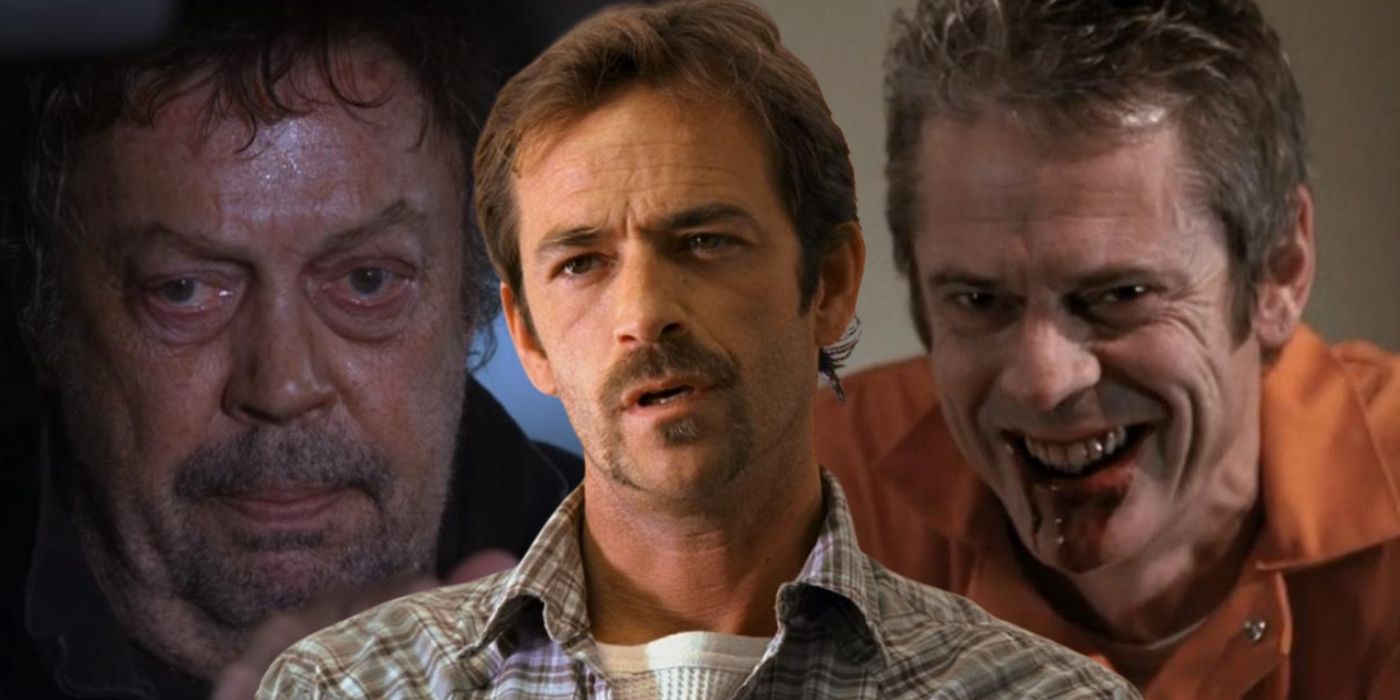
"Our Darkest Hour" was the season finale of Criminal Minds season 5. This episode saw the BAU called to Los Angeles to face a serial killer who began pursuing victims during rolling blackouts, making him even more dangerous. This twisted Criminal Minds suspect was Billy Flynn, also known as the Prince of Darkness (Tim Curry). The Tim Curry Criminal Minds episode isn't only regarded as one of the best but was also inspired by a real case — Richard Ramirez, also known as the Night Stalker, a serial killer convicted of 13 murders in the '80s.
Ramirez killed all his victims in 1984 and 1985, often to support his drug addiction. He was also found to have murdered a nine-year-old girl, although this was not discovered until 2009, when his DNA matched a sample from the crime scene. He also left symbols at scenes indicating he was into Satanism while also reportedly telling his victims to "swear on Satan" while killing them. Police finally arrested him after he left a survivor, who identified him. He died while on Death Row, while in Criminal Minds, Morgan gunned down Billy Flynn.
2 "Minimal Loss" (Season 4, Episode 3)
Benjamin Cyrus And His Cult Are Based On David Koresh
Close
In Season 4, Criminal Minds had the BAU head out to take on a cult leader in Benjamin Cyrus, played by Luke Perry. A hostage situation resulted in a state police raid, causing everything to fall apart. This was one of the best Criminal Minds episodes and was based on David Koresh, the Branch Davidians, and the Waco Siege from 1993, a tragedy that saw 86 lives lost. Cyrus was so popular that the character was a plot device in a Reid-centric episode years later.
Several Criminal Minds episodes based on real cases draw inspiration from Waco. Benjamin Cyrus was not only based on David Koresh but the actual Brand Davidians were referenced in the episode, as they were in two previous season episodes as well ("The Tribe" and "Identity"). Both cases included the cult leaders believing they were in the right and the FBI siege that left countless people dead on both sides. One big difference is that Koresh died by suicide, and Morgan killed Cyrus.
1 "The Tribe" (Season 1, Episode 16)
Jackson Cally's Cult Is Based On The Manson Family
The 16th episode of Season 1 was "The Tribe." The BAU headed out to New Mexico to investigate a group of college students found dead and tortured and found a cult that was working to turn people against the Native Americans in the area. This cult was led by Jackson Cally, who wanted to start a race war. Out of all the Criminal Minds episodes based on real cases, this was the most famous, based on the Charles Manson Family, and specifically, the Helter Skelter scheme, where the cult tried to start a race war in the late '60s.
Charles Manson was often used as an inspiration for Criminal Minds episodes based on real cases. Still, it was "The Tribe" that delivered an UnSub closest to the cult leader's murderous family. In this, Cally has his "tribe" kill people on his orders, and one by one, Hotch and the police stop them and end up arresting Cally and his remaining followers. This is also similar to Charles Manson, who lived to serve out his remaining days in prison.





COMMENTS