Disappearance At Clifton Hill Ending Explained: Is Alex Alive?
The ending of Disappearance at Clifton Hill is a shocking finale for the psychological thriller that completely alters the viewing experience second time around. Disappearance at Clifton Hill is a 2020 Canadian thriller from Albert Shin. The movie follows Abby, played by Tuppence Middleton of Downton Abbey, a middle-aged woman who returns to her hometown near Niagra Falls after the death of her mother to claim her inherited motel/casino. Years earlier, Abby witnessed the abduction of a young boy and the event has haunted her since. When she goes home, Abby begins an investigation to discover what happened those years ago.
Though Disappearance at Clifton Hill has some familiar story beats with characters who fit perfectly into standard archetypes, the last third of the film breathes fresh air into what was mostly a traditional noir. The film earned a 76% on Rotten Tomatoes, with much of the praise going toward the performances and the ending of the movie. It may be a smaller film, content with only a handful of characters, but it's an entertaining whodunit. The ending of Disappearance at Clifton Hill is crucial to better understanding and even enjoying the movie but the multiple reveals may leave some viewers confused.
What Happens In Disappearance At Clifton Hill's Ending
The Film Ends On An Incredibly Strange Note
Close
When Abby returns to her hometown near Niagra Falls, she begins researching the missing "one-eyed boy", the wounded child she saw in the woods back in her childhood. After she meets conspiracy theorist Walter, played by filmmaker David Cronenberg, Abby begins to suspect that the boy she saw is the same as a boy named Alex, who the news reported as taking his own life around the same time. She believes that he did not take his own life and instead, the powerful local family, the Lakes, are actually responsible for the boy's murder. Her snooping leads her to Beverly (Elizabeth Saunders) and Gerry (Maxwell McCabe-Lokos) Mole.
When she tracks the elderly couple to their home, she discovers the evidence she needs to prove they and the patriarch of the Lake family, Charles III (Eric Johnson), are responsible. All at once, the picture of what happened becomes clear. Alex's magician parents did not care for him, seeing him only as a commodity. He was abused by Charles III and Charles II hired the Moles to kill him, in order to keep his son's activities quiet. Abby reveals all this to the police and the right people are arrested, though Charles III insists on his innocence, as any megalomaniac would.
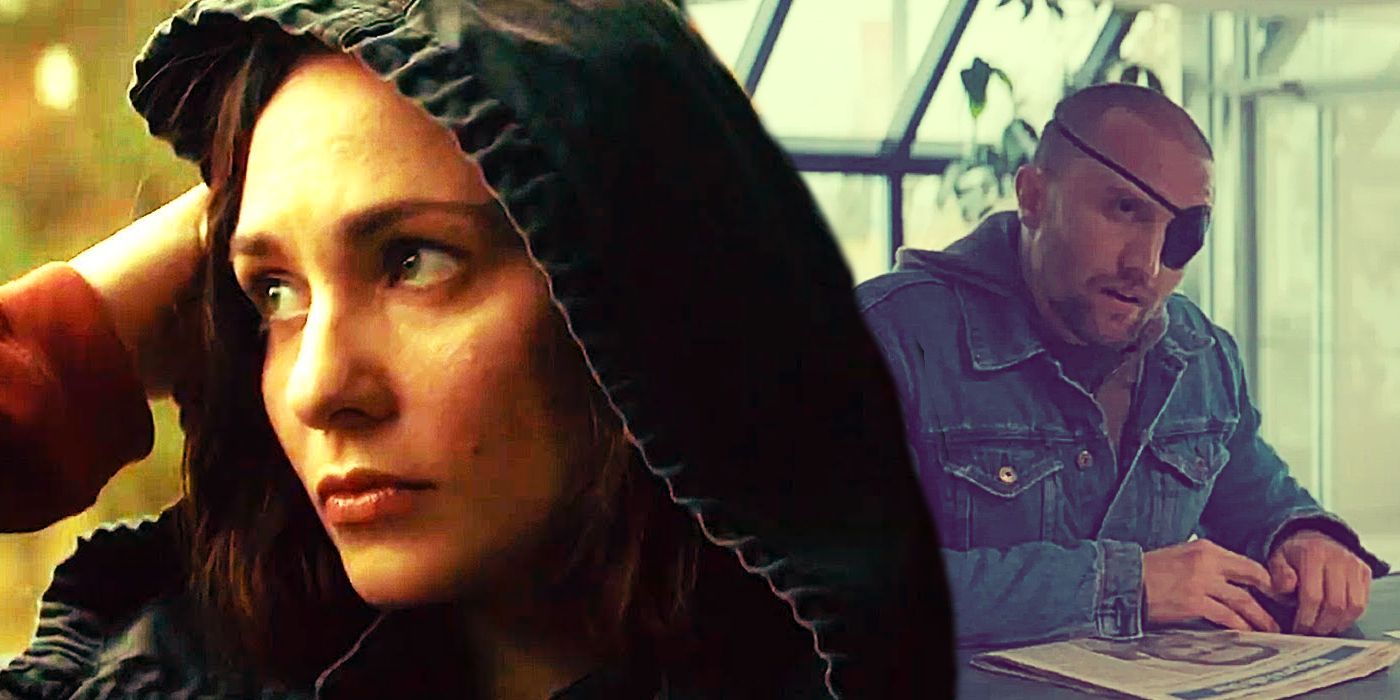
However, at the very end of the movie, an adult man with an eye patch arrives at Abby's motel. He looks at Abby and asks if they've met before, to which Abby responds no. The man glances down at a newspaper with a headline regarding Charles III proclaiming his innocence and the man says Charles III is not lying, and he actually saved that boy's life. He walks out and Abby looks at herself in the mirror as a smile slowly forms across her face.
Alex Moulin Did Not Throw Himself Over The Falls
His Death Was A Murder
The mystery that Abby wants to get to the bottom of in Disappearance at Clifton Hill is what happened to Alex, a boy that Abby assumes is the same boy she saw in the woods when she was a child. An investigation determined that Alex jumped off a cliff just around the same time Abby ran into the one-eyed boy. However, Abby suspects that it is not the whole story. Her suspicions are confirmed when she finally confronts Gerry, and he admits that it was he and his wife who threw Alex off the cliff. Alex's cause of death was murder, not suicide.
Bev And Gerry Mole Worked For The Moulins
The Pair Were Working For Charles III
Bev and Gerry Mole become prime suspects in Abby's amateur operation because Abby discovers that they worked for the Moulins, Alex's family. The Moulin family was a popular magic act and the Moles worked as their animal trainers. Late in the film, Abby meets with the Moulins, expecting them to be happy someone is trying to find out what happened to their son. Instead, the Moulins tell Abby about the time they forced Alex to confront one of their tigers, a test to see if their boy was ready to perform. Alex's eye is scratched out, much to their disappointment. Alex, realizing he will be tested again, runs.
The Moulins send the Moles to retrieve their son, but they have a different plan. The rest of the story is confessed by Gerry to Abby. Alex suffered abuse from his parents and from Charles III. Charles II hires the Moles to kidnap Alex and anonymously blackmail the Moulins with evidence that they hurt their son. The Moulins pay a large ransom, but Charlie III insists the Moles kill Alex anyway, by tossing his body over the waterfall cliff, leading to the report that the young boy took his own life.
Abby Is A Compulsive Liar
An Unreliable Narrator Makes Everything Questionable
The audience is told throughout the Disappearance at Clifton Hill that Abby has struggled with problems her whole adult life. However, her sister Laure (Hannah Gross) treats her much more suspiciously than would be expected. It's not clear why Laure behaves so antagonistically towards Abby until a flashback reveal towards the end of the film. It's shown that for most of Abby's adult life, she has compulsively lied. She is shown doing so to a social worker, her mother, and her sister over and over, and the audience suddenly realizes that perhaps Abby has been an unreliable narrator for most of the film.
In fact, the reason that Abby's inherited motel/casino is in such disrepair is that her mother was forced to use the money for upkeep to pay for Abby when her cons were exposed. With this knowledge, everything that has taken place over the course of the film and the events that come after, are put in a different light.
The Man At The End Is Alex Moulin
Alex's Survival Is Confirmed
The final reveal in Disappearance at Clifton Hill is quite shocking even if it's not fully explained. Abby is victorious. She finds out what happened to Alex and puts the Moles and Charlie III away for good, exposing their crimes to the world. However, as she's working the front desk of her motel, a man with an eye patch walks in and asks if they know each other. She says no, and he offhandedly mentions that Charles III is innocent. The implication is clear, that man is Alex. His eyepatch, recognition of Abby, and insider knowledge of Charles III all point to the fact that Alex survived.
Charles Lake III Did Not Assist In Alex's Murder
The Abuse Might Not Have Happened At All
With the understanding that Alex has survived, his certain knowledge that Charles III is innocent must mean that he knows something Abby and the audience don't. Because of Abby's penchant for fabricating lies and the uncertainty of what exactly happened 25 years ago in the woods, the real fate of Alex has to be inferred by his survival and loyalty to Charles III. It's already shown that the Moles are dangerous people. Bev chains her husband Gerry to the wall and there are blackmail photos of Alex's injury in their home. The Moulins happily tell Abby about the tiger and Alex. For the most part, Abby has the story correct.
However, there are two crucial details that Abby has wrong. Alex was not killed, and Charles III did not abuse him. The man with the eye patch says that Charles III saved that boy, not that he killed him. At some point during the abduction, Charles III came to the rescue of Alex and saved him from the Moulins and the Moles, perhaps using his family's wealth to get him out of town. Abby only presumed Charles III abused Alex, making assumptions with little evidence. In fact, Alex may be back in town in order to testify and clear Charles III's name.
Why Does Abby Smile At The End Of Disappearance At Clifton Hill?
Abby May Enjoy The Chaos She's Caused
After Abby speaks with the one-eyed man, who is probably Alex, she is shaken and walks into the bathroom. There she stares at herself in the mirror, maybe considering if she accidentally sent the wrong person to jail. Right before the film ends, her frown slowly curls into a smile. This implies that Abby, in some way, takes pleasure in the chaos she has caused and is not at all upset that an innocent man sits accused of a horrendous crime. Just like the lies Abby frequently concocted throughout her life, Abby once again finds herself in the middle of another lie, a fascinating story that she herself created.
The Real Meaning Of Disappearance At Clifton Hill's Ending
The Movie Is A Message Against The Sensationalization Of Crime
The ending of Disappearance at Clifton Hill is not just an indictment on the protagonist but on anyone who has ever relished in a sensational crime without understanding the full context. It's no coincidence that Abby finds kinship with a conspiracy theorist in her search for what really happened to Alex. Abby is not interested in finding the truth or righting a wrong, she is looking for a juicy story with an incredible twist. When Alex shows up and reveals that Abby got it wrong, far from being upset, Abby is excited, glad to be even deeper into a strange and disconcerting lie.
Disappearance at Clifton Hill points out that many audiences would probably behave similarly if they heard about the situation described in the film. True crime fiends and lovers of pulp fiction would more likely be excited to hear that a violent and terrible crime also has a huge twist, such as the victim surviving. Disappearance at Clifton Hill turns the camera around in the ending, shining a light on how voyeurism can be damaging just as often as it is titillating.
How The Disappearance At Clifton Hill Ending Was Received
The Final Moments Didn't Win Over Critics
The Disappearance at Clifton Hill is a divisive movie, and seems to have critics and audiences split when it comes to opinions. As evidenced by the 78% critic score vs. only a 31% audience score on Rotten Tomatoes, The Disappearance at Clifton Hill is one of several movies that was given much more praise in reviews than many general viewers felt it deserved. However, it's also not the case that acclaim from critics was unanimous. There were several who agreed with the majority of general audience members and their complaints about Clifton Hill. What's more, the ending was among the most cited negatives.
Many critics felt The Disappearance at Clifton Hill ending didn't really tie the rest of the story together well enough. While all are aware that it's a deliberately surreal and ambiguous movie, many reviews still point out that the ending needed to be tighter and more explanatory than it actually was for the story to feel satisfactory. None suggested that complete exposition of the truth was needed. It's simply that the end of The Disappearance at Clifton Hill didn't contain nearly enough, which a rebalance between explanation and storytelling in the final moments would have fixed.
Writing for The Guardian, critic Peter Bradshaw echoes the general sentiment towards The Disappearance at Clifton Hill ending in his review:
"It’s a pretty bizarre film, a thriller that appears partly to be composed of delusions and hallucinations, building to a shaggy-dog ending that wraps things up, though in a faintly exasperating way."
Other critics have had similar complaints. Another example comes from Roger Ebert critic Nick Allen. Allen's review is even less forgiving than Bradshaw's, and when it comes to the ending, this review of The Disappearance at Clifton Hill labels the surreal ambiguity as nowhere near satisfying enough to carry the story:
"The narrative gets twists from this shiftiness, but the characters are underwritten, and the movie’s slippery nature (down to its final scene) feels more like a gimmick."
Outside of the negative reviews, the end of The Disappearance at Clifton Hill ending isn't mentioned much as a selling point. Those who praised the movie focused on the cinematography, performances of the cast (even if the characters themselves weren't liked), and the overall tone of the film, rather than the narrative or final scenes. As The Shelf's review by Victor Stiff puts it:
Disappearance at Clifton Hill kept me hooked even though I never cared about what was happening. I know that statement is strange praise. There are hints of a great neo-noir fighting to break out of Shin’s latest feature, but these glimpses only tease us. The captivating genre flick the plot hints at never fully takes form. What we do get, however, is a mediocre thriller with a killer vibe.




COMMENTS