Far Side's Most Confusing Comic Has an Incredibly Simple Explanation
Summary Even in the absurdity of The Far Side, Gary Larson's captions were never total nonsense, but one mix-up left readers beyond confused.
A printing error by the Citizen-Journal led to a seemingly meaningless combination of image and text, sparking a deluge of reader mail.
Larson's work aimed to provoke a reaction from his readers, from laughter to confusion, highlighting the unique contract between artist and audience.
The Far Side, Gary Larson's long-running absurdist comic strip, was known for testing the limits of sense and reason in order to get a reaction out of its reader – whether it was a chuckle, or a shout of dismay. However, Larson's captions were never total nonsense, and as The Prehistory of the Far Side revealed, an accidentally swapped caption once left readers beyond confused.
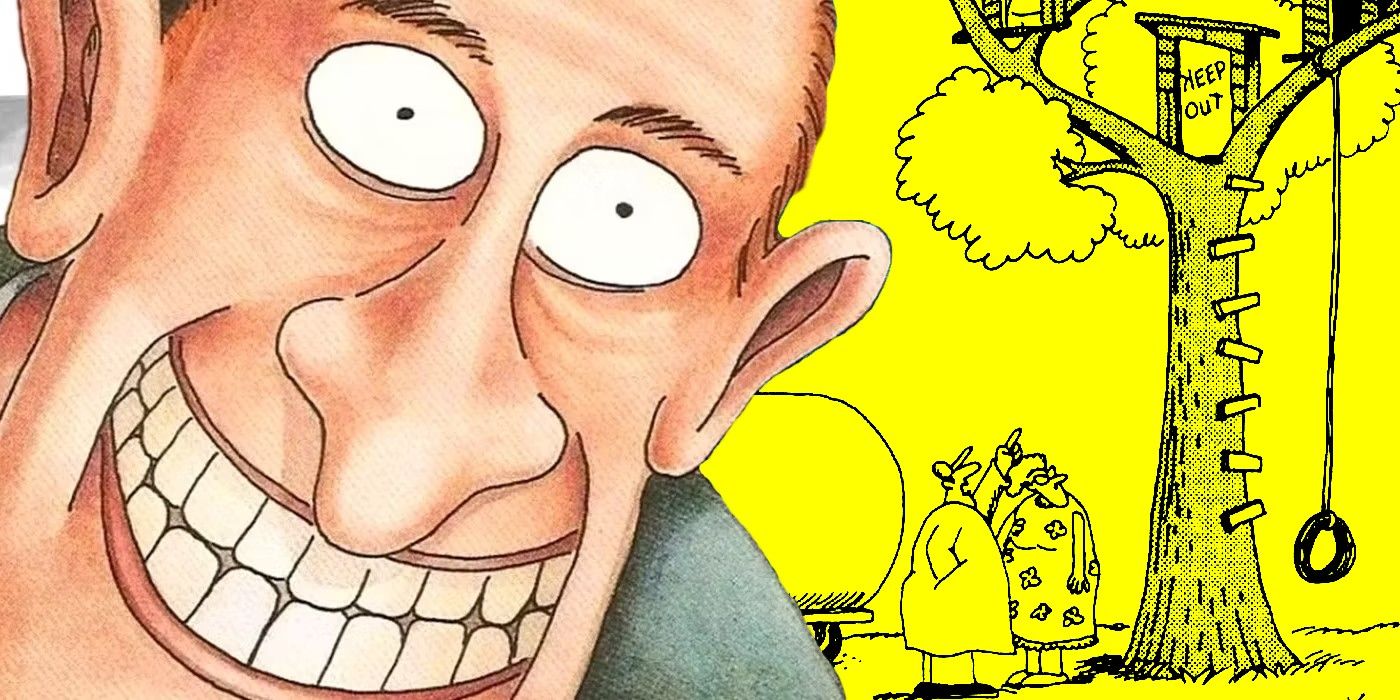
In The Prehistory of the Far Side – a book put together by Gary Larson for the tenth anniversary of his career as a cartoonist – the artist explained that the Citizen-Journal in Columbus, Ohio once mistakenly repeated the caption for one Far Side cartoon with the next day's illustration.
The resulting combination of image and text was inexplicable, and incomprehensible, causing consternation among the comic's regular readers – and as a result, the Citizen-Journal, and Gary Larson, wound up receiving a deluge of reader mail, begging for an explanation.
Related The Far Side: How A Single Syllable Helped Shape Gary Larson's Career As A Cartoonist As creator Gary Larson revealed in "The Prehistory of The Far Side," a small but pivotal printing error proved to be a defining moment for his career.
A Misprinted Captain Led To The Far Side's Only Truly "Meaningless" Comic
A Mix-Up In Columbus
Close
In the absence of social media platforms like reddit and X – where users can aggregate their responses to a piece of art or entertainment and come to a consensus understanding with likeminded fans – writing a letter to the editor was the most straightforward way to get a satisfying explanation.
As Larson explained in The Prehistory of the Far Side:
The caption for the "slug" cartoon, depicting a mass of slugs worshiping their "god" and chanting some nonsensical intonation, was repeated the following day with the "tree house" cartoon.
It is interesting to consider that newspaper readers who had seen the properly-captioned "slug" edition of The Far Side in the newspaper the previous day likely would have been puzzled seeing its caption repeated under an entirely different image, but also likely would have been able to figure out the mistake. Those readers left truly perplexed would have missed the previous day's paper, or at least skipped the cartoon section.
Also worth noting is the fact that Larson himself, in describing the "slug" cartoon's caption, calls it "nonsensical" – the image, and the recognizable connection between slugs and salt, gives the cartoon meaning, even if it is highly bizarre. Transposing the nonsense caption to the scene of an exterminator, standing next to a woman, pointing up at a bunch of kids in a tree, made that day's Far Side indecipherable enough that many people felt the need to reach out and ask what it meant.
Even regular readers of The Far Side, used to the strip's unusual humor, if they'd missed the prior day's comic, would feel compelled to seek an answer. Media consumption was vastly different during The Far Side's run in newspapers. In the absence of social media platforms like reddit and X – where users can aggregate their responses to a piece of art or entertainment and come to a consensus understanding with likeminded fans – writing a letter to the editor was the most straightforward way to get a satisfying explanation.
Gary Larson & His Readers Had An Unspoken Agreement
The Far Side Didn't Always Have To Make Sense
Close
The Far Side was precipitated by nothing more than the desire to provoke a reaction from his readers. This was the qualifier for success according to Gary Larson's artistic standards.
As Gary Larson wrote in Prehistory:
And how many letters did I have forwarded to me asking for an explanation? Don't ask.
The Far Side featured surreal appearances by dinosaurs, aliens, and prehistoric cavemen, but even when the strip offered up its most perplexing installments, it always made some kind of sense. Readers understood this – it was part of the contract between them and the author. When a mistake by a regional newspaper led local readers to feel as though the contract had been breached, they reached out to make their concerns known. Only fair, if a bit of a headache for Gary Larson.
Larson's work was driven by his obsessions and his idiosyncratic perspective, but he remained adamant that The Far Side was precipitated by nothing more than the desire to provoke a reaction from his readers. This was the qualifier for success according to Gary Larson's artistic standards. Laughter was, naturally, chief among the responses he hoped to elicit, but he also dealt in befuddlement, or outright outrage, at times, all in the pursuit of delivering something that resonated with the reader, in some way or another.
Naturally, not every Far Side reader understood the unspoken agreement they had entered with the strip's creator – something that is clear from the consistent complaints newspapers received about the comics' content, especially early in its run. That said, enough of them did to make Gary Larson's work commercially successful, and to make the caption mix-up by the Columbus Citizen Journal stand-out as a step beyond the normal level of confusion a Far Side might evoke. Still, in a way, it is a reminder of the extent to which any form of meaning can be derived from the comic.
Gary Larson Warned Readers About Looking For Deeper Meaning In His Work
The Far Side Was What It Was
Close
The subtleties and the eccentricities of Gary Larson's humor are part of what make his work captivating, but they also invite a greater level of scrutiny than he ever expected, or intended.
According to Gary Larson, his greatest strength as an artist was also the same reason he dreaded discussion where his ideas "came from," and why he warned of looking too deeply for meaning in any given Far Side strips. Certainly, the cartoon was replete with thematic reoccurrences, and repeat gags, but the extent to which a single comic "meant" something, or "made sense" only ever served the purpose of making the punchline register for the reader, on at least some level.
In other words, The Far Side put all its cards on the table and operated at face value more than many fans and critics alike tend to give it credit for. The subtleties and the eccentricities of Gary Larson's humor are part of what make his work captivating, but they also invite a greater level of scrutiny than he ever expected, or intended. The Far Side can be looked at as a sort of existential exercise – each cartoon is best examined in insolation, as its own fully-formed world.
The nature of the comic's format lends itself to this. More closely examining the career of Gary Larson is a noteworthy pursuit, and in this way, readers can draw connections between various installments of The Far Side, but when it comes to individual panels, fans' best course of action is to consider what the panel is offering, independent of anything other than the artist's work and the expectations the reader has brought to the table. Together, these two things are the essential keys to understanding Gary Larson's The Far Side.
Source: The Prehistory of the Far Side





COMMENTS