Doublespeak: India slams China for using veto to block evidence-based terrorist listings
China's Parliament grants Communist Party more executive control over State Council
Amid tensions with China and Pakistan, India prefers France, US over Russia for arms
'Parts Of India Are Occupied, But We...': EAM S Jaishankar
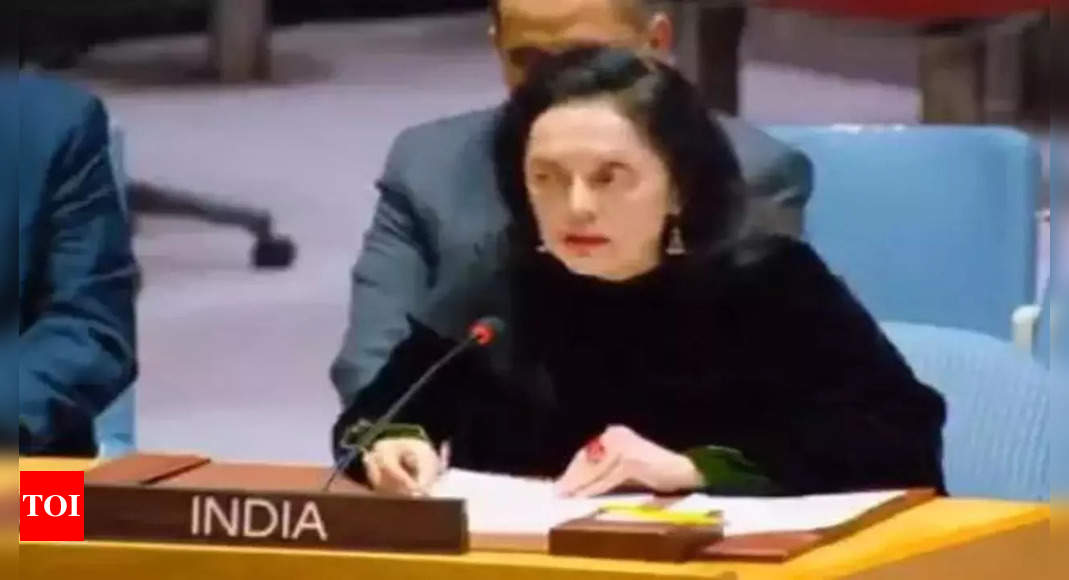
NEW DELHI: In a veiled reference to China, India on Monday, strongly condemned the countries that use their veto power to block evidence-based terrorists at UNSC. India's permanent representative to the United States, Ruchira Kamboj, at a United Nations Security Council's session said that the practice is uncalled for and smacks of doublespeak to the council's commitment in tackling the challenge of terrorism."Let us turn to the subsidiary bodies inhabiting a subterranean world with their own custom-made working methods and obscure practices which do not find any legal basis in the charter or any of the council's resolutions. For instance, while we do get to know of the decisions of these committees on listing, the decisions on rejecting listing requests are not made public," Ruchira Kamboj said."This is a disguised veto, but an even more impervious one that indeed merits a discussion amongst the wider membership. For genuine evidence-based listing proposals for globally sanctioned terrorists to be blocked without giving any due justification is uncalled for and smacks of doublespeak when it comes to the council's commitment in tackling the challenge of terrorism," she added.Earlier, China had effectively blocked a proposal to designate Pakistan-based Lashkar-e-Taiba (LeT) terrorist Sajid Mir as a global terrorist after India and United States jointly proposed to UNSC's sanction committee to designate Mir, who is wanted for his involvement in the 26/11 Mumbai terror attacks. For a proposal to be adopted, it needs consensus from all the member countries.In May 2019, India had won a huge diplomatic win at the UN when the global body designated Pakistan-based Jaish-e-Mohammed chief Masood Azhar as a "global terrorist", a decade after New Delhi had first approached the world body on the issue.Kamboj argued that the selection of chairs of subsidiary bodies and decision-making power must be given through an open process that intends to be transparent."The selection of chairs of subsidiary bodies and distribution of pen holderships must be made through a process which is open, which is transparent, which is based on exhaustive consultations and with a more integrated perspective. The consensus of the e ten on chairs of subsidiary bodies, to be assumed by the E-10 themselves, must be absolutely honoured by the P-5," she said."As one of the largest troop-contributing countries, my delegation would like to reiterate that the concerns of the troop and police contributing countries should be taken into consideration for better implementation of peacekeeping mandates. There is a need to review the agenda of the council and remove obsolete and irrelevant items from the agenda of the Security Council," she further added.Kamboj further said that as an organ of the United Nations tasked with the maintenance of international peace and security, the debate on the Council's working methods remains extremely relevant, especially in the backdrop of Ukraine and Gaza."As such, how much has the Security Council been able to deliver on peace and security, with both feet firmly fixed in the past, is a larger question that the member states need to collectively ponder upon," she said.Kamboj asserted that the international community can no longer hide behind the "smokescreen" of the Intergovernmental Negotiations on UNSC reform by delivering "entrenched national positions in a process which has no time frame, and no text."Notably, India presented a detailed model for Security Council reform that includes new permanent members elected democratically by the General Assembly and displays flexibility on the veto issue. Delhi also emphasised that UN' 80th anniversary year serves as a milestone to achieve concrete progress on the long-pending subject.






COMMENTS