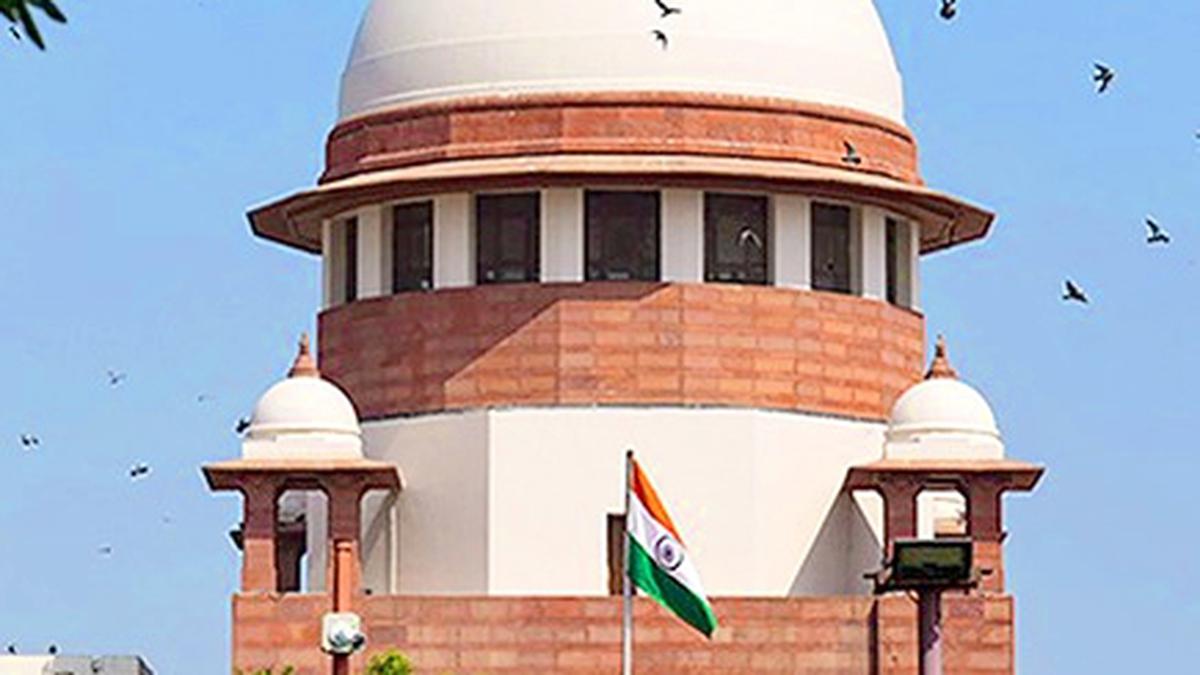
Supreme Court refers Kerala government’s suit on net borrowing cap to five-judge Constitution Bench
April 01, 2024 11:21 am | Updated 12:21 pm IST - NEW DELHI
The Supreme Court on April 1 referred to a Constitution Bench the question raised by Kerala whether a State had an “enforceable right” to raise its borrowing limits from the Union government and other sources.
The reference came on the basis of an original suit filed by Kerala accusing the Union government of arbitrarily restraining its borrowing limits, due to which the State was skirting the brink of a financial emergency, unable to pay salaries, pensions and fulfil its other essential financial commitments.
Also Read | The Finance Commission and public finance in Kerala
The Bench of Justices Surya Kant and K.V. Viswanathan observed that the Centre had already allowed a “substantial relief” of ₹13,608 crore to the State for it to tide over the immediate crisis. The court noted that the “balance of convenience” lay in favour of the Centre for now as it had already given the additional amount to the State.
The court highlighted its earlier disapproval of the Centre’s conduct, pressing the State to withdraw its suit in return for financial help.
The court said the order was ad interim in nature and the larger questions of law raised in the suit would be examined by the five-judge Bench, which the Chief Justice of India would constitute later on.
‘Vacuum in law’
The Division Bench noted that there was a vacuum in law concerning Article 293 of the Constitution, which deals with the financial borrowings by States.
Kerala had approached the top court arguing that the Centre’s shackles on the State’s borrowing powers was an attack on federalism and a catalyst to bring about a breakdown of the constitutional machinery in the State. Kerala had argued that the borrowing limits ought to be fixed by the States
Article 293 mandates that “subject to the provisions of this Article, the executive power of a State extends to borrowing within the territory of India upon the security of the Consolidated Fund of the State within such limits, if any, as may from time to time be fixed by the Legislature of such State by law…”
The court said the five-judge Bench should specifically focus and interpret clause (3) of Article 293 which said a “State may not without the consent of the government of India raise any loan if there is still outstanding any part of a loan which has been made to the State by the government of India or by its predecessor government, or in respect of which a guarantee has been given by the government of India or by its predecessor government”.
In its interim order, the two-judge Bench said the arguments of the Union were whether deductions were permissible in a successive year when there was an over-utilisation of borrowing limits, even over-borrowing, by a State in the previous year.
In the suit, Kerala had said its demands for financial leeway and help was well within the framework drawn by the Constitution and the Finance Commission.
Senior advocate Kapil Sibal had argued that the Centre had “put a spin” on the demands made by the State, portraying it as a “delinquent” which splurged its funds.
Additional Solicitor General N. Venkataraman, for the Union, had argued that the State had a long history of fiscal deficit, by which its expenditure was in far excess of its income.
The Centre had accused Kerala of being “one of the most financially unhealthy States”. A note submitted by the Attorney General in the Supreme Court had said the “fiscal edifice of Kerala has been diagnosed with several cracks”. The Centre had said the poor financial indicators of Kerala pointed to a “lack of proper management of its public finances”. The note had highlighted that debts run by States affected the credit rating of the whole country.







COMMENTS