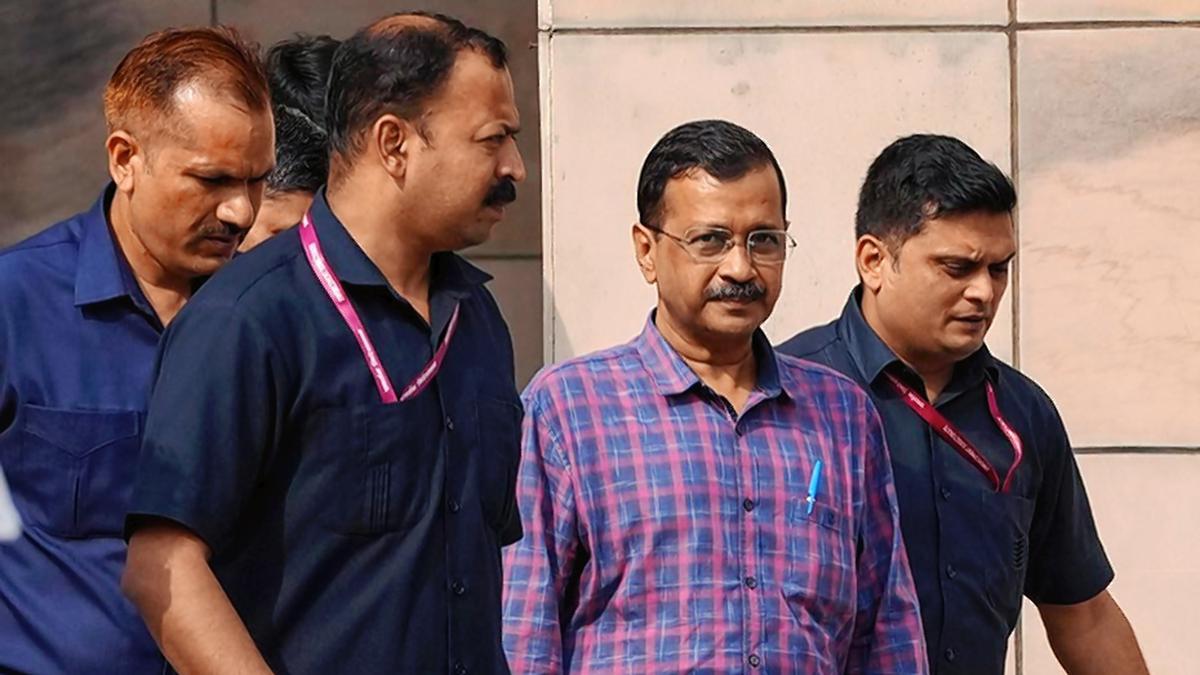
Arvind Kejriwal Arrest: Kejriwal moves SC after Delhi HC rejected his plea challenging arrest in Excise policy case
April 10, 2024 09:26 am | Updated 10:30 am IST - New Delhi
Delhi Chief Minister Arvind Kejriwal, on April 10, appealed to the Supreme Court a day after the Delhi High Court refused to quash his arrest in the liquor policy case.
The petition is likely to be mentioned before Chief Justice of India D.Y. Chandrachud in the morning by senior advocate A.M. Singhvi and advocate Shadan Farasat for an urgent hearing.
The court is closed for the next two days of the week and will function from April 15.
The Delhi High Court had found nothing illegal with the arrest. A Single Judge Bench of Justice Swarna Kanta had based its order on the prima facie finding that there was adequate material, including statements of approvers, involvement of middlemen and references that cash was handed over for expenditure in Goa elections.
Kejriwal’s arguement
In his appeal, Mr. Kejriwal argued that the decision to swoop in and arrest him on March 21, merely days before the general elections, was a carefully calibrated move to create an uneven playing field in favour of the BJP.
He contended that his arrest and the case against the Excise policy was an instance of a Central agency, the Directorate of Enforcement (ED) in this case, being misused as a weapon to crush the Opposition.
Also read:INDIA bloc leaders reach out to EC, highlight ‘misuse’ of Central agencies
Mr. Kejriwal noted that the High Court erred in not considering the fact his name did not figure as a suspect in the prosecution complaints, even in the five supplementary ones, filed by the ED.
The Chief Minister said the summons issued by the ED on earlier occasions were vague in nature. Their ambiguity indicated a roving enquiry intent on muzzling political dissent. He said his continued incarceration was a cock-a-snook on the federal system of governance.
On Wednesday, the ED had countered in the High Court that the arrest and subsequent remand of Mr. Kejriwal were natural outcomes of painstaking collection of evidence.
Kejriwal is the ‘ultimate decision-maker’, claims ED
The agency, represented by Additional Solicitor General S.V. Raju, had informed the High Court that the procedure of arrest was correctly followed. Mr. Kejriwal was furnished with the grounds of his arrest in writing.
The agency had termed Mr. Kejriwal the kingpin and key conspirator of the Delhi excise “scam”.
The ED claimed that he was involved in the conspiracy of formulation of the excise policy 2021-22 to favour certain persons and also involved in the demanding kickbacks from liquor businessmen in exchange of favours granting in the policy.
They said Mr. Kejriwal was also involved in the use of proceeds of crime generated in the Goa election campaign of AAP. He was the national convenor of the party and its “ultimate decision-maker”.
The ED argued that Vijay Nair, on behalf of Mr. Kejriwal and AAP, received kickbacks to the tune of ₹100 crore from the “South Group”.
The ‘South Group’
The “South Group” was represented by Abhishek Boinpally, Arun Pillai and Buchi Babu. Abhishek Boinpalli facilitated the transfer of money in conspiracy with Vijay Nair and his associate Dinesh Arora.
In exchange for the kickbacks, the “South Group” members got control of wholesaler business M/s Indo Spirits and even retail zones, got the business of Pernod Ricard and even got the L1 license granted despite multiple complaints and being in violation of the Excise Policy 2021-22.
As per the investigation done so far, the proceeds of crime of about ₹45 crore, which was part of the bribe received from South Group. The money was used in the election campaign of the AAP in Goa in 2021-22.






COMMENTS