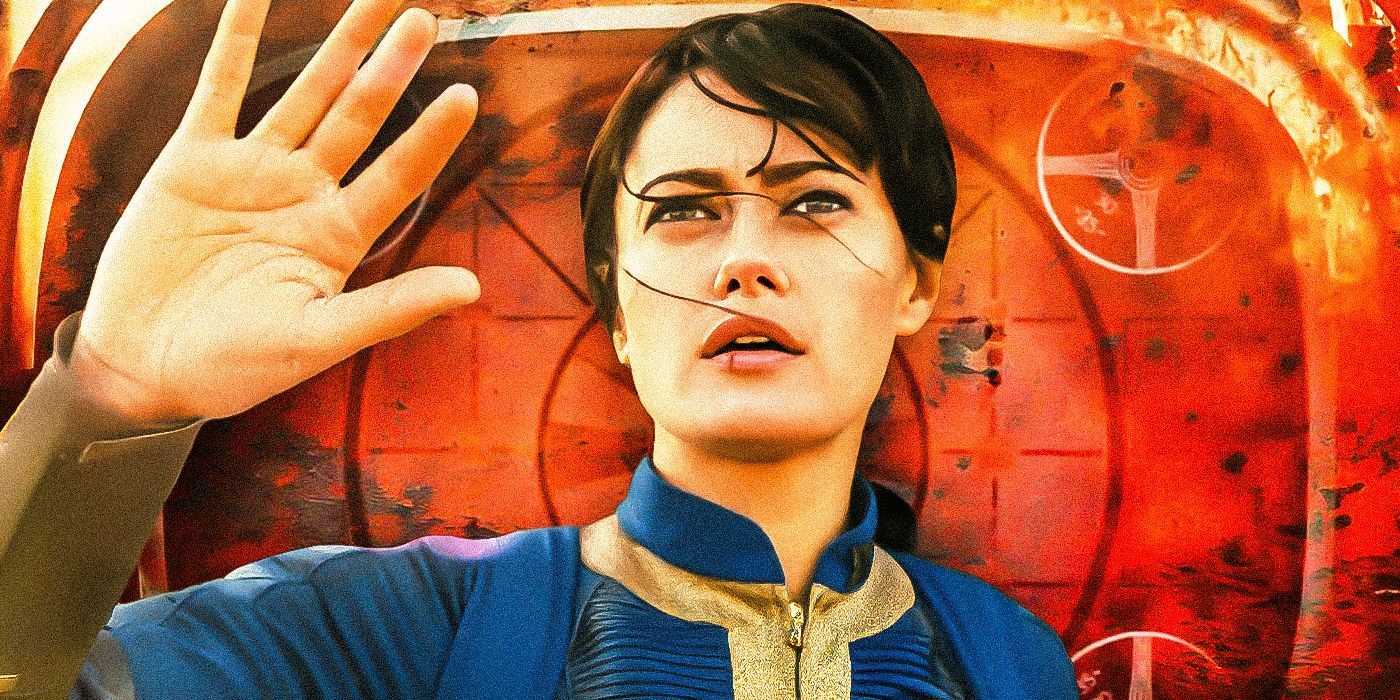
11 Biggest Changes Amazon's Fallout Show Makes To The Video Games
Warning! This article contains SPOILERS for Amazon's Fallout TV show.
Summary The Fallout show made tweaks to iconic elements like Pip-Boys and Power Armor, among others.
Vaults 31, 32, and 33 were connected in the show, a new type of vault never seen in the games, which changes the franchise's lore and future.
The show's ending made several major changes to the game's canon, especially to Fallout: New Vegas.
Amazon's Fallout show was extremely faithful to the game series, but it also featured several big changes to the franchise's canon. Fallout is based on the video game series of the same name and the post-apocalyptic world it created. The show followed three main characters: Lucy, Maximus, and the Ghoul as they traveled through and changed the wasteland. They weren't the only ones to change the wasteland, though, as the show itself also made major adjustments to Fallout's canon.
Fallout clearly has a reverence for the games it's based on, and that respect has infused every aspect of the show. There are several Easter eggs and references to the games in Fallout, and the feel of the games translated perfectly to the show. Despite how closely the Fallout show follows the games, there are still several changes that were made for the first season. Several of them were rather minor tweaks, but 11 of them were very important and fundamentally changed the franchise's lore.
Related Fallout Cast & Character Guide The wasteland of Fallout is a huge world, and there's an equally huge cast of unique characters to fill it and give it an offbeat charm.
11 Pip-Boys Work Slightly Differently In The Fallout Show
There were several minor changes from the Pip-Boys in the games
Close
Pip-Boys, the vault dwellers' personal computers, have been a staple of Fallout since the beginning, but they also went through several changes in the games. In some games, like Fallout 3, the Pip-Boy was biometrically sealed to its users arm, and couldn't be removed without removing the arm. In other games, though, like Fallout 4, Pip-Boys could easily be taken off. The Fallout show seems to follow that game's version, though it added some functionality.
The Pip-Boys in the Fallout show had some extra abilities, like being able to wirelessly connect to devices like the listening device Cooper used before the war. It also added new features, like the tracker Lucy put on Siggi's head, that had never appeared before in the games. That change in particular was a big deal for the show, as it helped Lucy keep track of the head in a way she never could have in the games. Other aspects were simply slightly tweaked, as the flashlight function in the games was simply a glowing screen, whereas in the show there was a dedicated flashlight.
10 The Fallout Show Featured A New Kind Of Vault
Vaults had never been connected like Vaults 31, 32, and 33 before
Close
The vaults in Fallout are one of the most unique aspects of the wasteland. Their cruel experiments and iconic imagery, like the blue and yellow jumpsuits, have made them a beloved part of the franchise. The Fallout show kept most of the details about vaults true to the games, but it also featured an unheard of type of vault. Vaults 31, 32, and 33 were all connected in the show, which had never been seen in the games. Their proximity to each other worked as part of a larger experiment, but it was still a change.
In the games, vaults were largely completely independent of each other. They were also spread across the entire country, so the idea of connected vaults was never even brought up in the games. Vaults 31, 32, and 33 fundamentally changed the way vaults work in Fallout, and their existence could easily lead to even more new types being created in the future.
9 Vault Boy's Thumbs Up Got A Better Explanation In The Show
Cooper Howard popularized the thumbs up gesture, which confirmed a long-debunked fan-theory
Close
Vault Boy was the mascot of Vault-Tec and another icon of the Fallout series. Despite its popularity among fans of the franchise, the Vault Boy had a lackluster origin. Many fans thought Vault Boy's trademark thumbs up pose was a reference to a method to determine the distance of a nuclear blast, but that theory was debunked by the games' creators. It was an interesting theory, and the characteristic wink Vault Boy does with his thumbs up supported it, but for years it was considered non-canon.
The Fallout show, however, canonized the previously scrapped theory. As the show revealed, Cooper Howard was the inspiration for Vault Boy's thumbs up pose, and he got the idea from the very same technique. That origin also created a bad memory for the Ghoul, who destroyed the billboard of the Vault Boy he saw on the road. The true origin of the pose also adds another layer of irony, given Vault-Tec's role in the Great War.
8 Gulpers Are Very Different In The Fallout Games
They weren't originally tied to vaults or human experiments at all
Close
One of the most memorable mutant creatures from the Fallout show was the gulper. Late in the show, it was revealed that the gulpers were actually products of Vault 4's experiments into genetic manipulation. That can be seen in several aspects of their design, from the human eyes and hands they have to the fingers that line the insides of their mouths. While that is a horrifying fate for a person to face, and it makes the gulpers even more terrifying on an existential level, their game counterparts were very different.
Gulpers first appeared in Far Harbor, downloadable content for Fallout 4, but they reappeared in Fallout 76. In both games, gulpers had evolved from salamanders due to radiation from the bombs, much like radroaches. As such, they had none of the human elements the gulpers in the Fallout show did, and were much smaller.
7 Ghouls Have Different Rules In The Fallout Show
The yellow vials were a huge new addition to the lore surrounding ghouls
Close
Ghouls like Walton Goggins' Ghoul character experienced some of the biggest changes from the games. In both the show and the games, ghouls were people who had been exposed to and survived lethal levels of radiation. Survival came with a price, though, as it turned the person into a ghoul and gave them scarred flesh and extremely long lives.
In the show, ghouls were nearly immortal, and could heal from almost any wound. They also had to drink vials of liquid to avoid going feral, though, which was a departure from the established way feral ghouls worked. Because of the need for those vials, and the fact that they were so expensive, it was almost inevitable that a ghoul would go feral. This was such a given that it was seen as impressive that The Ghoul had survived since the Great War.
In the games, ghouls would still eventually go feral due to the high levels of radiation they endured, as it would eventually cause their brains to rot. However, ghouls in the Fallout games didn't have to drink the vials to keep themselves sane. It was also much more common that ghouls could survive for over two centuries, like The Ghoul. In fact, most of the ghouls in the games had become ghouls during the Great War. While they had that benefit over the ghouls in the show, they also weren't nearly as durable, and could be killed just as easily as any other human.
6 Power Armor Had Several Minor Tweaks In The Fallout Show
It was mostly faithful to the games, but one change had an impact on the show's plot
Close
Power armor, like Pip-Boys, had gone through significant changes even within the games themselves. In the first installments of Fallout, power armor was used just like any other type of apparel, and was essentially just armor, albeit extremely powerful armor. Fallout 4 changed that, though, and made it so power armor was more like a mechanized suit. The power armor featured in the show was most similar to the armor in Fallout 4.
Related Fallout’s Brotherhood Of Steel Explained: Origin, Beliefs & Power Armor Amazon Prime's Fallout has already shown audiences glimpses of the Brotherhood of Steel. However, there's a lot of crucial information on the faction.
Despite its similarity to Fallout 4's power armor, the Fallout show changed power armor in a few small ways. Those changes included implementing the suit's flight capabilities into the wrists and adding a voice modulator. The show also brought a newer version of power armor, the T-60, to California than the games had ever shown. One change had a significant impact on Fallout's plot, though, as the show made it so armor couldn't even be exited without a fusion core, which allowed Thaddeus to trap Maximus.
5 The Fallout Show Rewrote The New California Republic's Capital
The NCR's capital, Shady Sands, hadn't been destroyed in Fallout: New Vegas
Close
The Fallout show has made significant changes to Fallout: New Vegas, and especially the New California Republic. When they stumbled upon a sign for Shady Sands, Maximus explained to Lucy that the capital of the NCR had been destroyed by an atomic bomb. That was a devastating blow, and it led the NCR being a much less important part of California's wasteland than it was in the games.
Fallout Installments Year (In-Universe) Fallout 76 2102 Fallout 2161 Fallout 2 2241 Fallout 3 2277 Fallout: New Vegas 2281 Fallout 4 2287 Fallout season 1 2296
The NCR was prominently featured in Fallout: New Vegas, but there was no mention of Shady Sands' destruction. Since Hank destroyed Shady Sands in 2277, and New Vegas is set just four years later in 2281, any one of the dozens of NCR members featured in the game should have at least made mention of the tragedy. Shady Sands' destruction completely changes the context of Fallout: New Vegas and turns the fight for the Mojave Wasteland into a fight for the NCR's survival.
4 The Enclave Had Abandoned The West In The Fallout Games
Siggi Wilzig escaped from them, and the Ghoul was captured by another splinter group
Close
The Enclave, a group that claimed to directly descend from the pre-war United States government, was a major faction in several games. By the time of Fallout: New Vegas, however, the Enclave had very few members who were still operating in the West. Most of them had either gone back to the East coast, where the Enclave was stronger, or had joined other factions like the New California Republic. Because of that, they had very little power in the West, and even less effect on major events of the games.
Related All 8 Factions Amazon's Fallout Show (& How They Compare To The Games) Prime Video's Fallout show brings several important factions and characters to life in series, building off the original games to expand the universe.
In the Fallout show, the Enclave was still very much operating in the wasteland. The main branch of the Enclave wasn't shown much, but Siggi Wilzig escaped from them with the key to cold fusion. There was also a smaller splinter group that ran the organ trade out of the Super Duper Mart and kidnapped the Ghoul. The Enclave's heightened level of involvement in California was very different from the way New Vegas depicted them, but season 2 could explain how they returned to the wasteland.
3 Vault-Tec Wasn't Confirmed To Be The Cause Of The Great War In The Games
It was long theorized, but the show was the first to confirm Vault-Tec's involvement
Close
One of the most shocking reveals in Fallout was that Vault-Tec, the company responsible for the vaults, dropped the nuclear bombs that destroyed the world. As Barb explained, Vault-Tec dropped the bomb to ensure that their vaults would be profitable and to literally wipe out all the competition. The plan was to simply outlast every other company in the world, as if they were the only people still doing business after the apocalypse, they would have the biggest monopoly the world had ever seen.
There was never much information in the games about the root causes of the Great War beyond a simple recap of the resource war that preceded it. While many fans of the series have theorized that Vault-Tec was involved in the Great War and nuclear devastation, it had never been confirmed. The official explanation was just that China and the United States had launched missiles at each other as an excalation of the Sino-American war, and that their salvo had destroyed the world.
2 Pre-War Companies Never Worked Together In The Games
They usually operated independently of each other
Just before revealing Vault-Tec's involvement in the Great War, the Fallout show also featured representatives of many of the United States' biggest companies talking about the plan. The pre-war companies had decided to collaborate on the vaults, with each trying out a different experiment in their respective vaults. The promise of wiping out the competition with nuclear fire and creating a "true monopoly" after the apocalypse was enough of a reason to get them to join forces.
In the games, the pre-war companies were largely separate entities who didn't deal with each other much. When they did interact, it was usually antagonistically, and those interactions often took the form of corporate espionage and sabotage. The closest they came to collaboration was the fact that many of them worked for the Enclave after the Great War, though even then it was hardly a partnership like the one featured in the show.
1 The Fallout Show Destroyed New Vegas
Whoever destroyed it must have been incredibly powerful
The ending of Fallout season 1 saw Hank heading towards New Vegas, but it was significantly different from the city featured in the games. As Hank approached the city, it was revealed that New Vegas had been completely destroyed and seemingly abandoned. Since Hank was headed there to continue Vault-Tec's mission, it seems the city will still be important even in its rundown state. That being said, the fate of New Vegas was significantly different in the games.
Whoever took the city in New Vegas would have established a massive presence there, and only a truly powerful organization could have destroyed it with that much protection.
In Fallout: New Vegas, the fate of the city was left up to the player's choice. There were several options for the player to choose from, such as helping a governmental body like the NCR or Caesar's Legion take the city, allowing Mr. House to continue controlling New Vegas, or supplanting them all and establishing the Courier as the new ruler. While some of those endings were less sustainable than others, none of them gave the impression that New Vegas would be completely destroyed in less than 15 years.
The destruction of the NCR and New Vegas was a huge change from the games, and it leaves the future of the wasteland, and the entire franchise, uncertain. Because of New Vegas' strategic position as essentially the gateway between the East and West, it was an incredibly important, and well-guarded, piece of land. Whoever took the city in New Vegas would have established a massive presence there, and only a truly powerful organization could have destroyed it with that much protection. Whoever was responsible will likely be revealed in Fallout season 2, and they could be the most dangerous faction the franchise has ever seen.




COMMENTS