Benjamin Franklin's Kite Experiment: Why The French Thought He Invented Electricity
Summary Benjamin Franklin did not invent electricity, but he discovered how to harness its power for common use.
Franklin's kite experiment helped identify the electric nature of lightning and the transfer of electrical charge.
The Apple TV+ series "Franklin" dramatizes Franklin's secret mission to engineer the Franco-American alliance of 1778, but doesn't include the kite experiment.
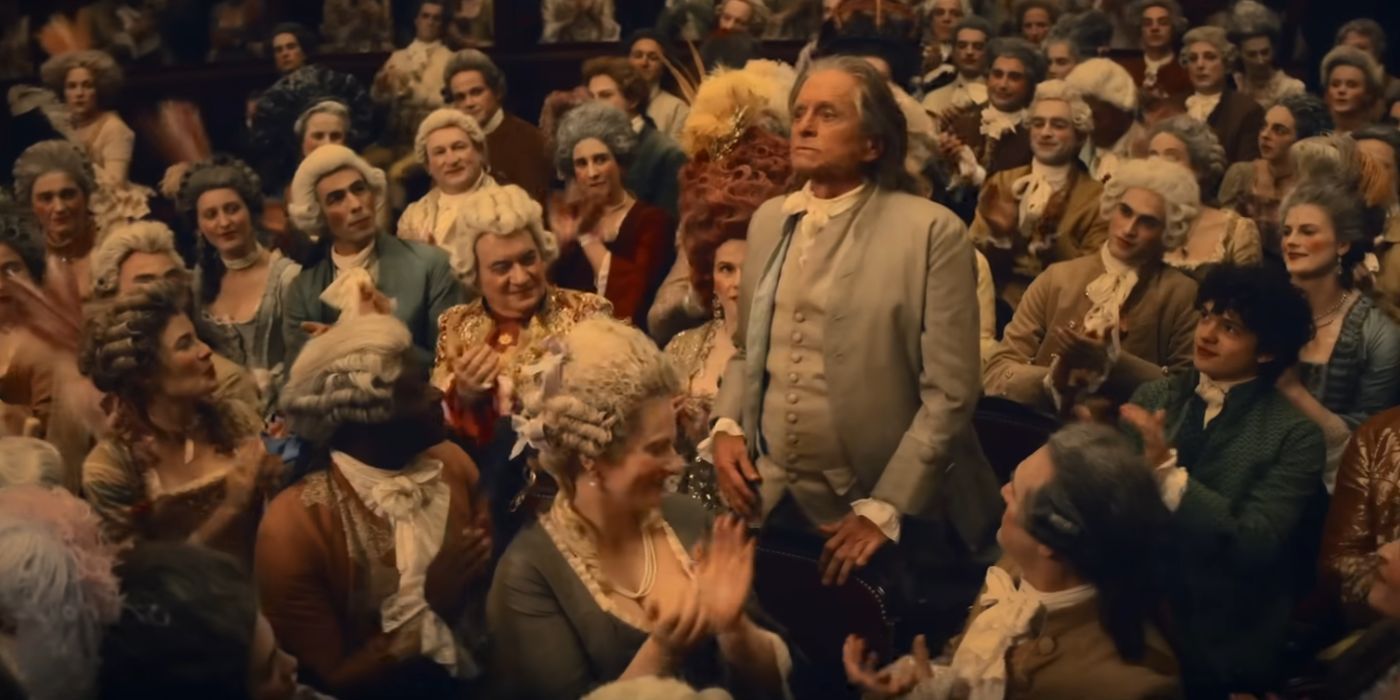
When Benjamin Franklin first arrives on French soil in Franklin episode 1, he is greeted as a hero by the French people, many of whom thank him for giving them electricity. The great American polymath played by Michael Douglas was one of the era's foremost inventors, in addition to being a top-flight politician, writer, and scientist. Some of his most important experimentation as an inventor related to electricity, and his now-famous kite experiment helped contribute to the misguided notion that he gave the French people the power of electricity.
While the first documentation of electricity itself dates back thousands of years, its use did not become widespread until the mid-19th century. During the late 1700s, the time period in which Franklin is set, electricity was little more than a scientific novelty as opposed to something that had a life-changing effect for the average citizen. However, Benjamin Franklin's integral experiment got the ball rolling on how the power of electricity could be harnessed for common uses.
Related Franklin Cast & Character Guide: Every Real Life Person Explained The latest drama from Apple TV+ chronicles the exploits of Benjamin Franklin as he sought support for the United States during the Revolutionary War.
Did Benjamin Franklin Invent Electricity?
Franklin didn't invent electricity, but he harnessed it.
Close
Despite the crowd asserting it in Franklin, Benjamin Franklin neither invented nor discovered electricity. Per Mr. Electric, the earliest known documentation of electrical phenomena dates back to 500 B.C., when Thales of Miletus first recorded his encounters with static electricity. Throughout the centuries, different scientists made strides in understanding and documenting how electricity worked, most notably including the English physicist Robert William Boyle in 1675. Benjamin Franklin made plenty of his own observations, but what sets him apart from the scientists of antiquity is his discovery of how to harness the power of electricity.
Franklin Episode Release Schedule Episode Title Release Date Episode 1 "Sauce For Prayers" April 12th Episode 2 "Welcome, Mischief" April 12th Episode 3 "Pride and Gout" April 12th Episode 4 "Small Revenge" April 19th Episode 5 TBA April 26th Episode 6 TBA May 3rd Episode 7 TBA May 10th Episode 8 TBA May 11th
Franklin's major conceptual contribution to the discovery of electricity is the notion that all matter contains electricity. Before Franklin, static electricity was the only observed example of electricity, and therefore it was assumed that static electricity was generated by friction. Franklin's numerous experiments proved that electrical charge is not created by objects touching, but rather that it was being transferred from one object to the other. This led to the identification of positive and negative charges as we know them today. Franklin eventually invented a practical use for the knowledge when he created and named the first electric battery.
Benjamin Franklin's Kite Experiment & How It Changed The World
The famous experiment helped identify the electric nature of lightning.
Benjamin Franklin's kite experiment has evolved into a highly-embellished myth over the centuries. While it's believed by many that Franklin and his son William flew a kite in a lightning storm in an effort to catch a lightning strike, the reality is very different. The experiment's real purpose was to investigate the nature of lightning, which was unknown at that point in time. The kite was attached to the ground by a wet hemp string, while Franklin's son held a dry silk string in a shed to remain isolated from the electricity passing through the water on the string.
A key, some wire and a Leyden Jar (a device that could hold a charge) were also attached. Franklin and his son flew the kite during a thunderstorm not to attract lightning, but to pick up the electrical charge in the air due to the storm. The key acted as the conductor for the charge, and when Franklin touched the key he observed a spark. This told him that lightning and electricity were the result of the same transfer of charge from one particle to another.
Franklin was also able to collect the charge in the Leyden Jar, which taught him that the power could be harnessed for later redistribution. That directly led to the creation of batteries as we know them now. The kite experiment isn't covered in the course of the political maneuvering and espionage of Franklin, but it was still one of the most important moments of Benjamin Franklin's life.






COMMENTS