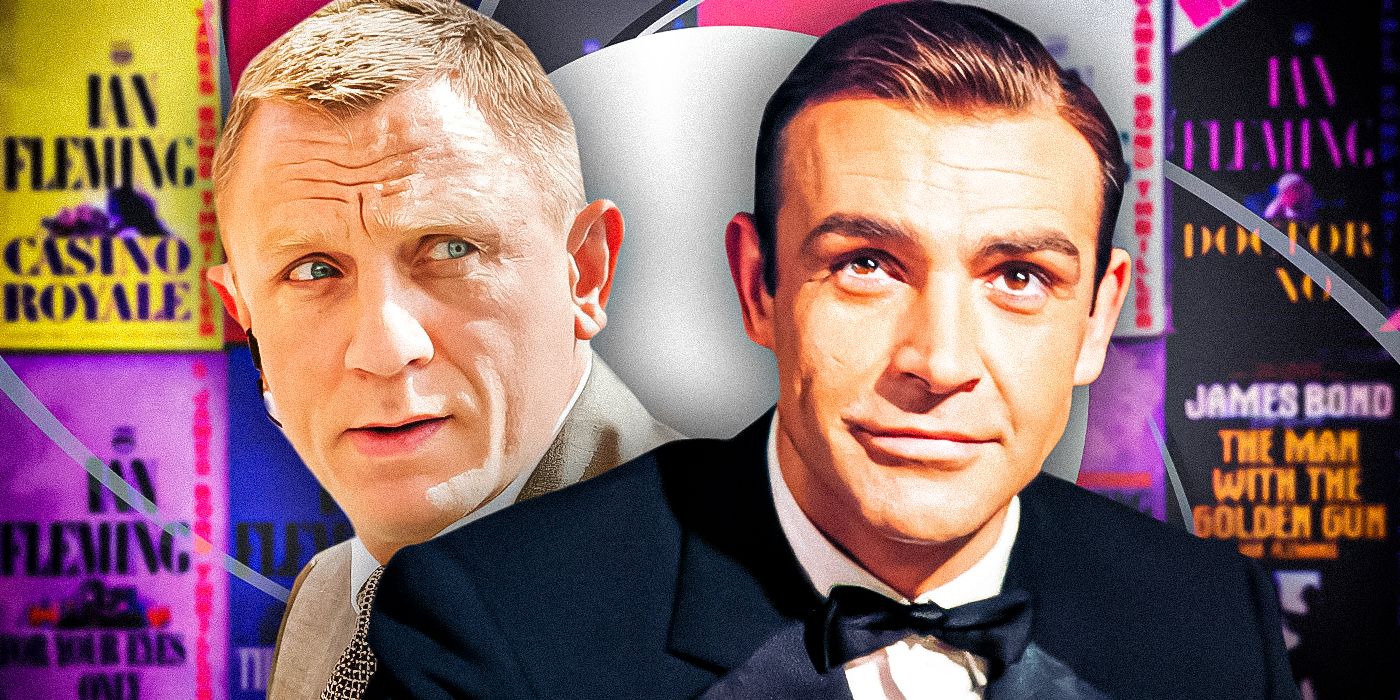
10 Best James Bond Book Changes The Movies Ever Made
Summary Expanding supporting characters like Q and Moneypenny gives depth to the Bond franchise.
Films like "Casino Royale" and "Diamonds Are Forever" make changes to the source material for better storytelling.
Bond films have evolved tone-wise, balancing humor and seriousness over different eras to maintain broad appeal.
The James Bond movies have never been afraid to make changes to the original 007 novels, some better than others. Every James Bond movie prior to 1989's License to Kill shares a title with one of Ian Fleming's works. While some serve as faithful adaptations that make only minor tweaks to the source material, others are unrecognizable from the original novels in almost every way but name. As time has gone on and as Fleming's material has run out, the films have increasingly chosen to tell original James Bond stories. Many of these, however, still take small fragments of inspiration from the books.
Fourteen James Bond novels and short story collections were published under Fleming's name between 1953 and 1966, almost all of which have been adapted for the screen in some way. There are lots of good James Bond stories not in the movies, with the film versions making a number of changes to the books that have had broadly negative implications. Likewise, however, the Bond films have managed to improve on the original books in several ways.
10 Expanded Roles For James Bond's Supporting Characters
Q Is Only Mentioned In The Books
Close
Like in the movies, the James Bond of the novels is nothing without MI6 and its various staff members who make up Bond's closest allies. However, many of the film series' most famous supporting characters don't play prominent roles in Fleming's books. For instance, Q, the head of the research and development division at MI6 known as Q-branch, is only ever mentioned in the novels and never actually appears. Similarly, Miss Moneypenny only plays a small role and is mostly overshadowed by Bond's personal secretaries, Loelia Ponsonby and Mary Goodnight.
Three people have played Q in the official EON films (Desmond Llewelyn, John Cleese, and Ben Wishaw), while Miss Moneypenny has been portrayed by four actresses (Lois Maxwell, Caroline Bliss, Samantha Bond, and Naomie Harris).
The films changed this by expanding both Q and Moneypenny's roles. Q was combined with the character of Major Boothroyd from both the Dr. No novel and its movie adaptation and has appeared in almost every installment in the franchise since 1963's From Russia With Love (with the exception of Live and Let Die, Casino Royale and Quantum of Solace). Meanwhile, Moneypenny makes an appearance in all but two entries in the series, with the Daniel Craig era even giving the character a more hands-on role.
Related Casting The New 007 Gives James Bond 26 A Massive Box Office Dilemma No casting news for a new 007 has been announced, but whoever will play the next James Bond will present a massive dilemma to ensure a big box office.
9 Updating Goldfinger's Evil Scheme
Operation Grand Slam Makes More Sense In The Films
Auric Goldfinger is the primary antagonist of both the Goldfinger novel and its 1964 movie adaptation and, as his name would suggest, the character is obsessed with gold. In both the book and the film, Goldfinger devises a plan to break into the United States Bullion Depository at Fort Knox. The scheme is known as Operation Grand Slam and, in the book, it involves Goldfinger stealing all the gold for himself. On paper, this sounds like a perfectly smart James Bond villain plan, but it actually doesn't make a lot of sense.
It would take days for Goldfinger and his men to steal all the gold and to escape. Even though they knocked out Fort Knox's residents with nerve gas, there was no way they could steal the gold before the effects of the gas wore off. The film version of Goldfinger fixes this plot hole by instead having Goldfinger attempt to blow the bullion up in order to increase the value of his own supply of gold.
8 Reframing Casino Royale For A Post-9/11 World
The Original Novel Was Published In 1953
In the novel version of Casino Royale, which serves as the first installment in the book series, Bond comes up against Le Chiffre, a math genius who takes on 007 in a high-stakes game of baccarat. Le Chiffre is depicted as being the paymaster for a Communist trade union with ties to SMERSH. Given that the novel was published during the Cold War when communist suspicions were at their highest, this made a lot of sense. However, when it came to adapting the book for the screen in 2006, changes needed to be made.
Overall, the film substitutes Cold War anxieties for post-9/11 fears, which ultimately makes it more relevant.
Starring Daniel Craig in his first outing as Bond, the movie version of Casino Royale reframes the story to take place in a contemporary, post-9/11 setting. Instead of working for SMERSH, Le Chiffre is depicted as a private banker who helps to fund global terrorism. M even implies that Le Chiffre profited from 9/11. Furthermore, the movie adds a scene involving an attempt to blow up an airplane that doesn't appear in the novel. Overall, the film substitutes Cold War anxieties for post-9/11 fears, which ultimately makes it more relevant.
7 Bringing Back Blofeld In Diamonds Are Forever
He's The Bond Franchise's Most Famous Antagonist
Diamonds Are Forever is an example of the book and film versions being wildly different. Though some aspects of the novel made it to the big screen - the focus on diamonds, the characters of Tiffany Case and Mr Wint and Mr Kidd, and the boat scene - the movie version is almost unorganizable from the source material. By far the best alteration 1971's Diamonds Are Forever makes to its source material is to to swap out the main antagonists.
In the book, Bond takes on a group of diamond smugglers known as the Spangled Mob, which is led by twin brothers Jack and Seraffimo Spang. The Spang brothers aren't particularly interesting or memorable, so it's no wonder that when it came to making the film version of Diamonds Are Forever, the decision was made to replace them with Blofeld instead. Played by Charles Gray, who brings a camp menace to the role, Blofeld leaves a greater lasting impression than the Spangled Mob. Interestingly, an early draft of the script had Goldfinger's twin brother as the movie's antagonist.
6 The Spy Who Loved Me Changing Everything About The Novel Except For Jaws
The Novel Is Easily Fleming's Worst
Undoubtedly the James Bond film that differs the most from its literary counterpart, The Spy Who Loved Me bears almost no resemblance to Fleming's original work. Though this might seem dismissive of the film's makers, there's a good reason why the movie made so many alterations. The original 1962 novel is widely regarded as the worst in the series. Not only did it garner terrible reviews at the time of its publication, but even Fleming himself was embarrassed by it, so much so that he refused to sell the rights to the novel's plot, only its title.
The book employs an unconventional structure that doesn't see Bond himself showing up until two-thirds of the way through.
When it came to adapting The Spy Who Loved Me for the screen, Bond producers Harry Saltzman and Albert R. Broccoli had to start from scratch. This proved to be a good thing, however. The book employs an unconventional structure that doesn't see Bond himself showing up until two-thirds of the way through. Additionally, it is all told from the perspective of a young Canadian woman. The movie abandons this in favor of a more traditional James Bond story.
The 1977 film does, however, retain one aspect of the novel; Jaws. A man of huge stature and strength, Jaws gets his name from the fact that he has a set of metal teeth. The film version of the character, who also makes an appearance in Moonraker, is one of the best James Bond henchmen of all time. In the novel, he's called Horror, but his main traits are the same. By shedding every aspect of Fleming's book except for Jaws, The Spy Who Loved Me turned the worst James Bond novel into the best 007 film.
5 Dropping Dr. No's Bird Poop Subplot
It's One Of The Weirder Aspects Of The Books
A big difference between the James Bond book series and the James Bond movie franchise is the order of each installment. Despite being Fleming's sixth novel, Dr. No was the first Bond publication to be adapted for film. While the novel itself received mixed reviews from critics, the film version was met with almost universal acclaim. One reason for this is that the 1962 movie dropped the novel's silliest subplot.
Dr. No made $59.5 million at the worldwide box office on a $1.1 million budget (via The Numbers).
Both the book and film revolve around Bond traveling to Jamaica to investigate the disappearance of fellow MI6 agents, which eventually leads him to Dr. Julius No. The novel, however, spends a lot of time focusing on guano - the excrement of seabirds used as fertilizer. Dr. No is depicted as the owner of a guano factory and, during the book's climax, the villain meets his demise by being buried alive in bird poop. Thankfully, the movie changes the guano factory to a bauxite mine and, instead of death by bird poop, Dr. No is boiled alive.
4 Lightening The Tone Of The Earlier James Bond Movies
The Books Are Generally More Serious
Six different people have played Bond over the years, and with each actor's era comes a different style and tone from what came before it. Some have brought a more comedic take, while others have leaned into the character's grittier aspects. The James Bond novels, although not entirely lacking in humor, are, for the most part, grounded and serious spy thrillers. The early film adaptations, however, employed bring a degree of levity to the same stories.
While the Roger Moore movies arguably leaned too heavily into the comedic aspects, the introduction of humor into the Bond films undoubtedly gave the franchise a broader appeal.
Sean Connery's era as Bond struck a good balance between humor and grit, with Bond often making a witty remark after brutally killing one of his enemies. While the Roger Moore movies arguably leaned too heavily into the comedic aspects, the introduction of humor into the Bond films undoubtedly gave the franchise a broader appeal. Though later eras, such as Timothy Dalton's and Daniel Craig's, embraced a serious tone more closely in line with that of the novels, the James Bond series might never have achieved the success it has without the initial adoption of a lighter tone.
3 Making Bond Less Misogynistic Of A Misogynist In The Movies (Seriously)
It Might Be Hard To Believe, But In The Books He's Worse
Close
The James Bond films are unlikely to be the first place a person goes to when looking for positive depictions of women. The James Bond depicted in most of the early movies is a sexist and misogynist dinosaur who largely sees women as objects of sexual pleasure. Fortunately, things have vastly improved as the series has gone on. What's surprising, however, is that the James Bond of the books is ten times more of a misogynist than he's ever been portrayed on screen.
Perhaps the most shocking thing about Bond's character in the novels is how often he threatens to abuse women. At least once in almost every novel, Fleming describes how Bond is tempted to put the female protagonist over his knee and spank her to teach her a lesson. Of course, the books were written at a different time, but it's hard to imagine a world where saying this would be acceptable. Though the Bond of the film adaptations isn't exactly a feminist, at least the movies left this particularly unpleasant facet of his character behind.
2 Ignoring Felix Leiter's Shark Attack
He's One Of Bond Movies' Best Recurring Characters
Close
Felix Leiter is a recurring character in both the books and the movies. A CIA operative, he is a close ally and friend of Bond's who has helped him out of tricky situations on several occasions. Originally, Leiter was killed off in Fleming's second 007 novel, Live and Let Die, after the novel's antagonist, Mr. Bid feeds him to a great white shark. Owing to the character's popularity and protestations regarding his demise, Fleming brought Leiter back for four further appearances, where he sported a hook for a hand and a wooden leg.
Felix Leiter has been played by seven actors in the official James Bond films (Jack Lord, Cec Linder, Rik Van Nutter, Norman Burton, David Hedison, John Terry, and Jeffrey Wright).
Neither the movie version of Live and Let Die nor any other Bond film depicts Leiter being attacked by a shark. It's hard not to feel that this is a good thing. After all, a hooked hand and wooden leg might be a bit too cartoonish for the films. Leiter does, however, die onscreen. In 2021's No Time To Die he is shot by a double agent and dies in Bond's arms, which is a far more fitting (and permanent) death than the one he got in the novels.
1 Making SPECTRE The James Bond Franchise's Sole Evil Organization
One Criminal Oranization Is More Than Enough For Bond To Contend With
Special Executive for Counter-intelligence, Terrorism, Revenge and Extortion or SPECTRE is a fictional criminal organization that appears in both the Bond novels and films. Led by Ernst Stavro Blofeld, SPECTRE is portrayed as being a powerful establishment with a wide reach. It's not, however, the only evil organization depicted in the books. Many of the villains of the early novels, including Le Chiffre and Rosa Klebb, are members of SMERSH, a real-life communist counter-intelligence organization.
Related How Spectre Repeats Skyfall’s James Bond Villain Problem Skyfall and Spectre both have the same problem with their villain’ plots, hurting the James Bond films, and making them narratively nonsensical.
Aside from a brief mention in 1963's From Russia With Love, SMERSH is largely omitted from the James Bond movies. Instead, SPECTRE replaces it as the sole evil organization in the films. This doesn't only remove any link to the real-life organization, which could potentially offend, but it also simplifies things, giving Bond and MI6 a single recognizable enemy. Even Quantum, the evil organization featured in Casino Royale and Quantum of Solace, was later retconned to be a faction of SPECTRE.




COMMENTS