Franklin: What Happened To Pierre Beaumarchais After The American Revolution
Summary Beaumarchais played a crucial role in the American Revolution as a key French ally, using diplomacy, espionage, and financing to support the cause.
His covert activities included supplying arms and supplies to American rebels, ultimately helping to break the British army at Saratoga in 1777.
After the Revolution, Beaumarchais faced legal troubles in France but continued to pledge loyalty to the Revolutionary establishment, eventually passing away in 1799.
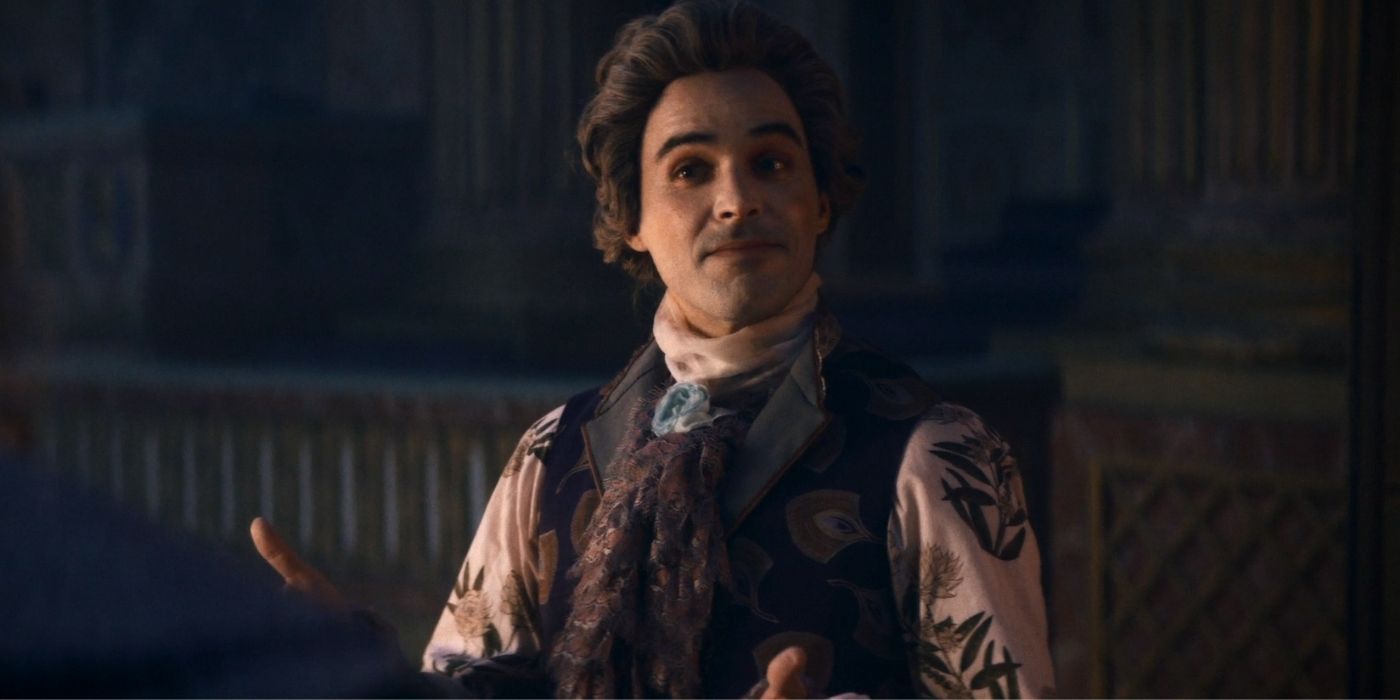
As seen in Franklin, Benjamin Franklin's secret mission to France to secure aid for the United States of America only succeeded thanks to several key French allies, and none was more significant than the French polymath Pierre Beaumarchais. Of the many colorful characters in the cast of Franklin, Assaad Bouab's Pierre Beaumarchais is among the most charismatic and talented. While Beaumarchais was heavily involved in entertainment as a talented musician and playwright, his influence extended into diplomacy, espionage, invention, and finance.
Beaumarchais, along with other revolutionaries like Marquis de Lafayette, leveraged his position within the French aristocracy and government to encourage France to formally enter the war as a United States ally. Prior to that, Beaumarchais did more than almost any other European ally to provide aid for American soldiers. His covert activities provide some of the most thrilling story lines and moments in Franklin, making him one of the most interesting characters in the show.
Related "I Think The Game Is Pretty Near Up": George Washington Quote In Franklin Explained One of George Washington's most famous quotes from the Revolutionary War hints at the very nature of Benjamin Franklin's mission in Franklin.
Who Was Pierre Beaumarchais?
The French polymath became influential under King Louis XV.
Born in 1732 in Paris to a watchmaker, Pierre Beaumarchais first rose to social and political prominence in the court of Louis XV, where he acted as a music teacher to the king's daughters. Per the Encyclopedia Brittanica, he famously invented an escapement for pocket watches that made them significantly more accurate in telling time. Beaumarchais eventually became the secretary to the king, as he notes in Franklin, and turned his attention to business ventures with the French financier Joseph Duverney, which brought him to Spain in 1765.
In his life, Beaumarchais spent time in Spain, Germany, England and the Dutch Republic, establishing contacts that would eventually come into play when he began to secretly assist the American forces prior to France's formal entry into the war.
Upon his return to France, Beaumarchais focused on writing plays, and produced two of the most notable comedies in the history of theater: The Barber of Seville and The Marriage of Figaro. The semi-autobiographical plays were at first outlawed by King Louis XVI for their satirical criticism of the French government, but at the behest of Marie Antoinette and her entourage, Beaumarchais was eventually allowed to put the plays on publicly, where they became beloved by the masses and increased Beaumarchais' influence.
Beamarchais' financial dealings resulted in a number of legal troubles for the polymath, and as a way of restoring his status, Beaumarchais embarked on secret missions to England and Germany on behalf of Louis XV and Louis XVI. During this time, he began to spy on the British on a mission to convince spy Chevalier d'Eon to return to France. Thus began Beaumarchais' interest in the American cause and the downfall of Britain.
Pierre Beaumarchais' Role In France Allying With America Against Britain
Beaumarchais provided both covert and public support for America.
Close
While France didn't officially enter the war until 1778, agents for both America and France worked to supply the American forces with all manner of support, which is the crux of the plot of Franklin. Pierre Beaumarchais was one of the foremost French agents in this regard, as he secretly moved arms, money, and supplies to the United States under his fake business, Roderigue Hortalez and Company. While King Louis XVI was not yet ready to openly war with the British for fear that the French colonies would be inspired to revolt themselves, he did approach Beaumarchais to set up an enterprise to funnel support to the United States.
ranklin Episode Release Schedule Episode Title Release Date Episode 1 "Sauce For Prayers" April 12th Episode 2 "Welcome, Mischief" April 12th Episode 3 "Pride and Gout" April 12th Episode 4 "Small Revenge" April 19th Episode 5 TBA April 26th Episode 6 TBA May 3rd Episode 7 TBA May 10th Episode 8 TBA May 11th
Beaumarchais leveraged support from both the French and Spanish royalty to send weapons, clothes, and provisions to the American rebels beginning in 1775-1776. The importance of Beaumarchais' assistance can not be overstated, as it was an army largely supplied by Beaumarchais that was finally able to break the British army at Saratoga in 1777, which turned the tide of the Revolutionary War. All the while, Beaumarchais had continued to lobby for France to enter the war as a member of the French nobility, which finally came to pass in 1778.
What Happened To Pierre Beaumarchais After The Revolutionary War
Beaumarchais traded one revolution for another in France.
Image via AppleTv+
A decade later, Pierre Beaumarchais fell out of favor with the French establishment after further legal problems; he was implicated in an adultery lawsuit, and saw his reputation take a major hit. When the French Revolution broke out, Beaumarchais' reputation still suffered, but he made money by supplying drinking water to the newly-ravaged Paris. In 1791, he was imprisoned for a few days for criticizing the government, but was released with the assistance of a former mistress and quickly pledged his loyalty to the Revolutionary establishment.
As his status in France wavered, Beaumarchais spent two and a half years in Germany in exile before returning to Paris in 1796. The multi-talented aristocrat died in 1799 in peace in France. Pierre Beaumarchais' bravery in supporting the American Revolution made him one of the most influential French agents of the time period, as depicted in Franklin.
Source: Encyclopedia Brittanica






COMMENTS