Manhunt Creator Breaks Down Booth's Capture, The Conspirators' Trial & Blending Fact With Fiction
Warning: SPOILERS lie ahead for Manhunt episode 7, "The Final Act"!
Summary Manhunt on Apple TV+ follows the 12-day search for John Wilkes Booth after Lincoln's assassination, focusing on Edwin Stanton's role.
Episode 7 delves into the conspirators' trial, as Stanton aims to link Andrew Johnson to Lincoln's murder and impeach him.
Creator Monica Beletsky aimed to depict Booth as a villain, not humanizing him, while highlighting lesser-known figures like Mary Simms and Stanton.
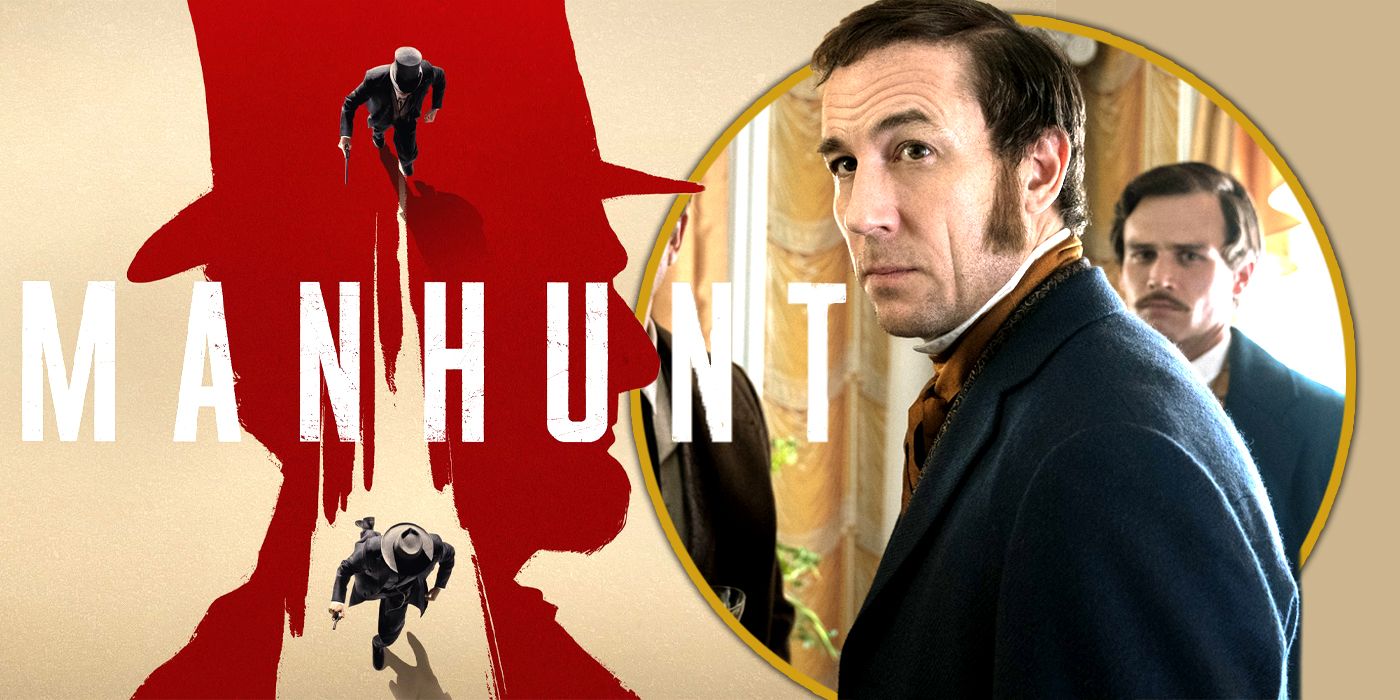
The harrowing search for John Wilkes Booth is finally over in Manhunt. Partially based on James L. Swanson's book of the same name, the Apple TV+ miniseries explores the 12-day hunt for Booth following his infamous assassination of President Abraham Lincoln in 1865. The show is largely told through the eyes of Edwin Stanton, Lincoln's Secretary of War, as he heads up the hunt, while also exploring his friendship with the late President, his relationship with his cohorts, and Booth's desire to be an image for the Confederate Army.
Manhunt episode 7 picks up some time after Booth's capture, in which he holed up in a farmhouse and was shot and killed by Boston Corbett after attempts to smoke him out failed. The episode largely explores the conspirators' trial, in which Stanton looked to build a case of grand conspiracy against Samuel Mudd, David Herold, Lewis Powell, and Mary Surratt for their aiding Booth in both the assassination and escape. Stanton also hopes that the trial will prove that newly inducted President Andrew Johnson had some connection to Lincoln's murder, and as such should be impeached.
Related Apple TV+'s Manhunt Cast & Real-Life Character Comparison Guide Apple TV+ has released a brand new historical drama series called Manhunt, following the search for Abraham Lincoln’s killer, John Wilkes Booth.
Ultimately, Stanton's efforts are not fully realized in Manhunt's ending, as Johnson is not clearly linked to the assassination, while the conspirators are sentenced to hang. Stanton is also forced to resign from his post, though just before handing over the keys to his successor, he barricades himself in the office in the hopes of delaying the transition of power just enough to get Johnson impeached and retain his and Lincoln's plans for Reconstruction.
In honor of the show's finale, Screen Rant interviewed creator Monica Beletsky to discuss Manhunt, how she went about blending fact with fiction to create an entertaining thriller, the creation of Booth's capture in episode 6, her approach to the conspirators' trial and how Stanton's ending was nearly different.
Beletsky Wanted To Avoid Telling Booth's Story In A Humanizing Way
Throughout Manhunt's run, audiences have spent plenty of time with Booth in his effort to escape to the South while also learning more about his motivations and past. While some could see this focus as an effort to humanize Lincoln's assassin in some capacity, Beletsky assures this was never on hers or Anthony Boyle's minds:
Monica Beletsky: I think we both — Anthony and I — see him as pretty villainous, to be honest. [Laughs] I think our conversations were about the fact that this isn't the kind of show where it's like, "inside the mind of a serial killer, and a portrayal from the inside of someone evil." We were very conscious of the fact that anyone you put on screen is glamorizing them, to some extent. And of course, Anthony is so charismatic and charming, which was part of the appeal of casting him as Booth, because he was such a popular actor in his day that, combined with the fact that he was able to round up co-conspirators, it seemed to me that he would be the kind of person who would be a very attractive person to spend time with. But on the other hand, he was using his opportunity for evil. So, I don't think that our intention was to humanize him, I think our project was to depict this type of person in an accurate way, if that makes sense. And to make it seem as plausible and believable that someone with his characteristics was capable of this. So, that's where our attention to detail was, on his behaviors and his personality.
In this effort to ensure he stayed the villainous figure history remembers, Beletsky also made sure to include some moments in which Booth found himself knocked down a peg even by those he thought would side with him. One such moment came in episode 5 when he tried to brag about the assassination to Confederate soldiers heading to turn themselves over to the Union, which Beletsky says was largely inspired by a "real, true-to-life situation":
Monica Beletsky: Yeah, thanks for noticing that. I think that ferry scene is a real, true-to-life situation to some extent. They were on the ferry when some of that happened, when the ferry driver recognized him, and stuff like that. So, we made it a little bit different on the shore there. I think the thinking behind it was I actually wasn't aware that Confederate soldiers signed a pledge to basically say they're not for the Confederate States anymore, they're for the Republic. I found that piece of history really fascinating, that's what a lot of them were on their way to do. They really considered themselves part of a different country, and were now unifying again. So, that was part of my intention was to show that process, because I'd never seen it on screen before. And then, in terms of Booth, I think, for me, it was about chipping away a little bit at the delusion that he's set up for himself, that he's going to be embraced by the South as a hero. And that's the thing that, in our version of the story, he has really set his sights on. So, when he encounters the Confederate soldiers, I was thinking about their point of view, and I was thinking, "Yeah, well, why would you stick your neck out for Booth when you've made it through four years of this brutality, and you're about to go home? Why would you risk being an accomplice to Booth, unless you really believe that you could turn the tide of the war?" So, that was my thinking behind it. And I liked the idea that his reception was just totally different than it was in his mind. I have a friend who texts me every week, and he's like, "I can't wait to see these guys get it."
Spotlighting Figures Like Mary Simms & Stanton Has Been "One Of The Most Fulfilling Parts" For Beletsky
While Booth, Johnson, and Lincoln are key players in Manhunt, the show has also taken plenty of time to spotlight more underexplored figures from the era in history, including Mary Simms, a slave once owned by Samuel Mudd who ultimately turned on him after he helped Booth with his broken ankle. For Beletsky, giving these figures their time to shine was "one of the most fulfilling parts" of making the show:
Monica Beletsky: Yeah, it's been really one of the most fulfilling parts of doing this version of Manhunt, as a more of a saga with an ensemble, to be able to highlight these unsung heroes like Stanton and Mary Simms. I just loved working with Lovie, and that scene was so exciting to shoot. I remember there was some questioning when we were in rehearsal of when she should speak up, and I felt really strongly that she couldn't completely speak up until she knew Mudd was going to be arrested. So, as soon as she knows Stanton's taking him, it all comes out, and she feels safe enough to tell what she knows. So, I'm just really glad to hear that the audience is responding to her getting that agency, finally.
Beletsky Didn't Look At Manhunt As Finding A Specific Percentage Of Which To Be Accurate
Though telling a true story in American history, Manhunt does take some creative liberties with its facts, including making Stanton a key detective in the hunt for Booth. Beletsky acknowledges the changes made in the show came from the standpoint of "reimagining the story as a true-crime story", avoiding putting any number on how factual the show is:
Monica Beletsky: I'm not sure I would approach it that way, with a number. I think that the project here is reimagining the story as a true-crime story. So, I think that taking it literally is sort of a false premise. And I think that wherever possible, where it suited dramatization — we were painstaking in our research, but I think the project of making Stanton more active and more of a detective type of role takes a leap of imagination. And hopefully, it's doing what I hoped, which is bringing the story to so many people who would not take the time to take it in, because it's being told in a genre way.
Crafting Booth's Reverse-Hostage Situation Capture Was "Thrilling" For Beletsky
One of the many points Beletsky sought to stay true to real life with Manhunt was Booth's capture, in which he was cornered in a tobacco barn and shot and killed by Boston Corbett. Beletsky recalled feeling a sense of pride in filming the tense sequence, even noting that one of the reasons she stayed completely accurate to how it happened is it was a "truth is better than fiction" moment:
Monica Beletsky: Yeah, it was really thrilling. We built the barn to make sure it wasn't flammable, and it's such an iconic moment in American history. So I think we all felt really proud and excited to film it. I will say that this is a sequence that James Swanson in Manhunt the book details very well, and it's very well researched. So, this is the section where I relied on his account closer than other parts in the show, and really appreciated how much detail he had. So, I just found it really an interesting predicament, where the people who are outnumbered have the better logistical situation, because if anyone opens the door, they can fire on them first. So, it's just a great "truth is better than fiction" moment. But emotionally, it was, for me, in the writing about, again, just chipping away and chipping away at this delusion of who he is, and who he's going to become, and what the assassination is going to mean for his life. And then, the sort of breakdown of his friendship with David Herold, having the realization — this was a moment in the writing that I was really like, "Oh, yeah, actually, what has Herold done? He's guided Booth, which obviously, he's an accomplice, but at many points, he could have left, and he can leave now." So, there's an interesting sort of toss-and-turn there where Herold says, "Please say I didn't do anything," and you're not sure what Booth is gonna say. And then, Booth takes credit for it, and he's like, "Yeah, he didn't do any of it. It was all me." Which is so fitting in the way we've been portraying his character. So it kind of works for Herold, and for him, in that moment. But it's also about this love and this friendship between them, that Herold is trying to beg Booth to at least go to trial, stand trial, and not sabotage themselves. I thought that was really emotional. And Herold is a person you can't really defend on one hand, but then on the other hand, I wanted to portray him with Will Harrison as someone that really any of us could have gotten caught up as being as young people, when you sort of fall in love with the wrong crowd, and can make bad decisions. So, that was what I was going for with that, and I think Will did such a beautiful job.
Narrowing Down The "Historically Accurate" Conspirators' Trial Was An Interesting Task
Another of the more moving moments in the show Beletsky sought to depict accurately was the actual conspirators' trial, in which Simms, Louis J. Weichmann, and the "duplicitous" Conover testify against those on trial for aiding Booth. For Beletsky, crafting this portion of the story required sorting through the "1000-page trial transcript", but one element she sought to retain was that none of the conspirators were allowed to speak:
Monica Beletsky: So, that's an excellent observation, and it's historically accurate, believe it or not. They were not allowed to defend themselves, and I believe it's because this was a military tribunal. It wasn't a regular trial, it was under the auspices of the military, and Stanton and Judge Holt, played by John Billingsley, they were the puppet masters of it, they had a lot of control. They were slightly manipulative, in how they orchestrated it to try to get the outcome that they wanted, and they felt was deserved. So, I had fun showing someone who has been our moral compass, the whole show in Stanton, that he wants this conviction so badly where his moral gray area starts to arise in those last two episodes. And part of it is the trial, and I believe — I don't know the rules of a military tribunal off the top of my head, but I remember looking at it, there's about a 1000-page trial transcript that I relied on for writing that part. And, yeah, none of them were able to speak. So, obviously, in an hour episode, we don't have time for all that. So, I really narrowed it down to basically the people who I kept, which was Mary Simms, and then officer Weichmann, who was the other person besides Mary Simms who had a close connection with Surratt, and I just think he has a really lovely arc in the show that I really enjoyed writing. And CJ is such a both vulnerable and brave actor in the role. And then Conover, the twists and turns of Conover really basically decided the fate of the outcome of the trial. That duplicitous-ness in his character that we've been building up through the show, I really wanted that to pay off. So, I basically worked my way backwards, I saw what the three of them would mean to the trial, and then, as I created their arcs from the beginning, I hoped that it would be sort of a great setup and pay off emotionally, and story wise, at the end.
Stanton's Ending Was Nearly Very Different In Manhunt
Despite his best efforts to keep the country together and catch the man who nearly tore it back apart, Stanton's Manhunt ending is somewhat of a bittersweet one, as Johnson seemingly gets away with a potential conspiratorial connection to Lincoln's assassination and Stanton is forced to resign. As the show comes to a close, audiences are treated to the image of Stanton barricading himself in his office to delay the transition, which successfully led to Johnson's impeachment, but Beletsky reveals they nearly ended his story slightly later:
Monica Beletsky: That is true to history, and I do a sort of sweep of time. So, there was about three years, I believe, I don't think it happened until 1867, or something like that. But basically, the whole Johnson story is set up in the show so that we could include it, and I feel that it added a lot to the show. But it is true, all of that is true, that he barricaded himself in there to delay giving over control of the soldiers who are protecting the outcome of the war in the South and the new vote for Black men, and gave them the chance to stall so that they could impeach Johnson. So, that's all true, and at one point, I had written a little further of Stanton getting out of the barricade and all this stuff. And then, I just sort of had this day where I could see the visuals of it with the supertitles at the bottom, and I just was like, "Oh, that's the end of the show." I just think it's really powerful, it's not a huge action sequence or anything, but I just think, emotionally, this has been this center of work for Lincoln and Stanton. There's something very symbolic and emotional about the fact that the story's about a workaholic, essentially. [Chuckles] And the way he's going to try to save the country is locking himself in his office, and preventing anyone else from doing the job, so he can try to keep the legacy of Lincoln alive just a little longer.
About Manhunt
Close
Based on the New York Times bestselling and Edgar Award-winning nonfiction book from author James L. Swanson, “Manhunt” is a conspiracy thriller about one of the best known but least understood crimes in history, the astonishing story of the hunt for John Wilkes Booth in the aftermath of Abraham Lincoln’s assassination.
Your browser does not support the video tag.
Check out our previous Manhunt interviews with:
Manhunt is available to stream in its entirety on Apple TV+.




COMMENTS