The Razer Kishi Ultra Fills A Mobile Void I Didn't Know Existed
Summary The Razer Kishi Ultra offers premium mobile gaming with haptic tech, high-end design, and PC controller capabilities at $149.99.
Nick Bourne, Head of Mobile & Console Division, believes the Kishi Ultra's development aligns with the rising quality of mobile gaming.
Users can expect top-tier design with sensor haptics, phone case compatibility, Virtual Controller Mode, and future developer support.
The Razer Kishi Ultra is an impressive piece of hardware. To hear Razer representatives speak about it, it's ushering in a new era for mobile gaming. While I'm not 100% sure that it's going to be that impactful, it's hard to argue that it isn't the nicest mobile-first controller design we've seen to date - and that's before getting into how suitable it is as a mid-to-high end PC controller, too, something that is made possible by its meticulous layout and features.
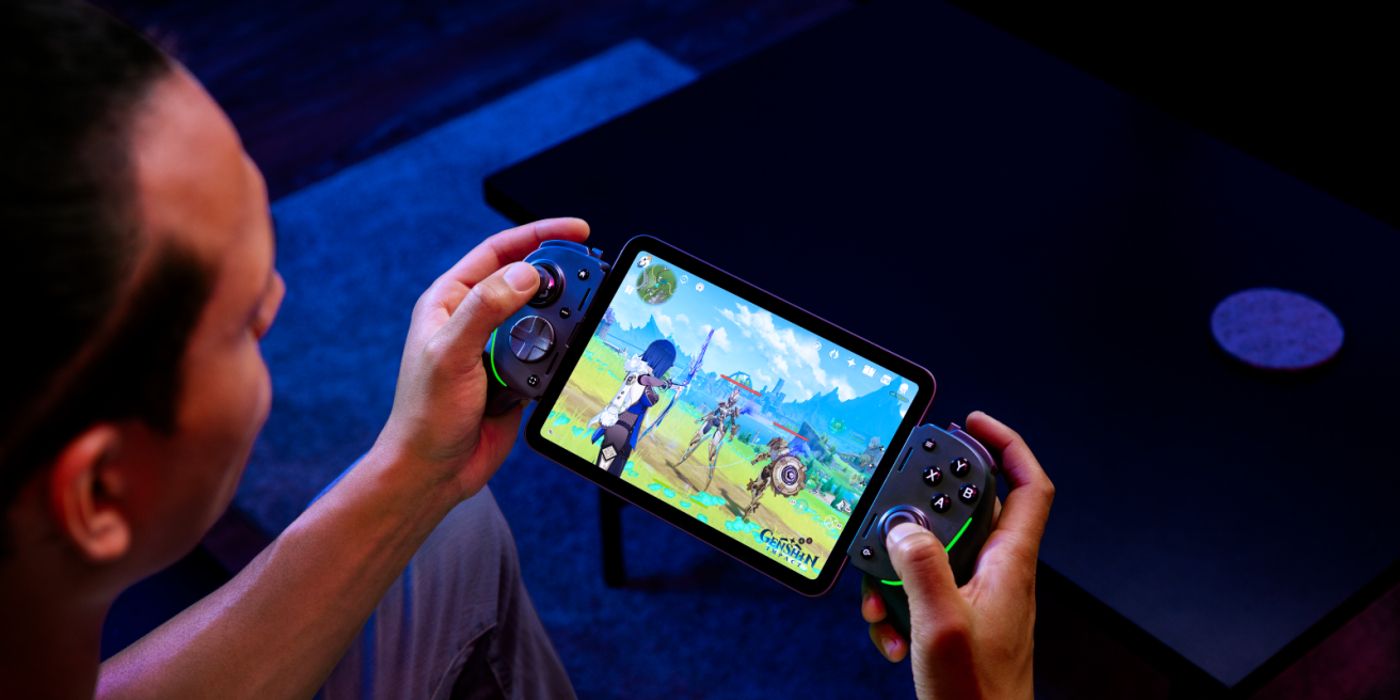
But first, the rundown of what Razer has announced for the Kishi Ultra, which is available now: it boasts full-sized form factor for both phones (iOS and Android) and iPad mini, allowing users to transform their tablets into pseudo-Switches (or Steam Decks, or the many other portable competitors in today's very combative market). The ergonomics of the Kishi Ultra are designed to rival Razer's pro console controller line, with tacticle D-Pad and ABXY buttons that have that nice, clicky response to them that players love. A direct USB-C connection type slots it in line with Android smart phones, iPhone 15, and other devices, while a USB-C port at the bottom allows for charging while playing.
Related Razer Seiren V3 Chroma Review: "Brilliant For A Very Specific Audience" The Razer Seiren V3 Chroma performs well for a mid-level microphone, but its extraneous features will make or break its suitability for a consumer.
Another major selling point is the haptic technology, as the Kishi Ultra is the first commercially available device to sport the new Razer Sensa HD Haptics tech. Razer is marketing this as an upgrade from traditional console controller haptics, and game developers will be given some pretty cool options thanks to its existence. In all, it's an impressive showing, with a retail price at $149.99 USD that immediately slots it into the high-end, premium pricepoint for controllers and mobile hardware. So does it live up to its claim as the god-tier of mobile gaming?
The Razer Kishi Ultra Is Miles Ahead Of Other Mobile Controllers
A Premium, Intricately Designed Mobile Gaming Experience
I had the ability to go hands-on with the Kishi Ultra for over a week, and it's quite simply a game changer for the mobile gaming industry. It feels extremely forward-thinking compared to its competition - even in-house with other Razer options - and really ticks off boxes I didn't even know I had for mobile performance. The haptic technology, when used as a PC controller, was noticeable and efficient, in a way I wasn't expecting for a mobile controller. The tactility present in the buttons and D-Pad have that premium feel that is both responsive and satisfying, and for games like Genshin Impact or Warzone Mobile, that can make a big difference in play experience.
One of the impressive elements of its design was how carefully considered the mobile user experience has been in the Kishi Ultra design. I was able to use my Samsung Galaxy Z Fold 3 both with and without a case without having to adjust anything besides the controller's width, and Razer is claiming that the Kishi Ultra has 11% more device clearance than its previous Kishi models. While that's obviously pretty hard for me to verify on my own, the nuance of the design definitely feels like it has wiggle room to ensure most standard-sized and standard-function phone cases will be supported.
I think the Razer Kishi Ultra is the premium mobile gaming controller.
There's even a Virtual Controller Mode that allows users to program the Kishi Ultra to work with touchscreen-only games. While that technology existed before in the Kishi family, Razer says this version is the best yet, with upgrades to customization. Testing it out with something simple, I was able to make the virtual controller seamlessly adapt to the game's UI, though different screen layouts mean there's a lot of fiddling depending on the game. I'd rather have that option and have it require some tweaking than not have it, though, and it's a smart fix for a problem that's difficult to tackle.
Overall, I think the Razer Kishi Ultra is the premium mobile gaming controller. Its build quality, innovative design, intelligent implementation of technology, and stand-alone excellence as a PC gaming controller all combine to make it a must-own for anyone who takes mobile gaming seriously.
How The Razer Kishi Ultra Got Made
Why Now Is The Perfect Time For A Premium Mobile Controller
We also had the chance to discuss the Razer Kishi Ultra with Nick Bourne, Head of Mobile & Console Division. We discussed what makes now the right time for this product and much more:
Screen Rant: What makes now the right time to be catering to mobile gamers with such a high-end performance controller?
Nick Bourne: For the longest time, there was a delta between hardware and software available on mobile, preventing it from being a viable alternative to traditional ‘hardcore’ platforms like PC and console. This era is over. Not only has the software delta closed with AAA games readily available across all handsets, but the processing power of the hardware is well beyond the spec needed to play these games anywhere. The last piece of the puzzle was addressing the input device, and Kishi Ultra is the solution. With this launch, we’re celebrating the end of gamers having to compromise on mobile, Kishi Ultra is built for performance to help you win more.
Haptics haven't traditionally been a selling point for mobile controllers. Why was that such a focus, and what do you envision it doing for players using the Kishi Ultra?
Nick Bourne: Immersion is about invigorating your senses, whether it’s with Chroma RGB lights or haptics to deliver an elevated player experience. With this in mind, we developed the first product in our brand-new integrated haptics ecosystem, Sensa HD Haptics. This next generation haptics technology is implemented with a dual haptic coil system that is symmetric across the controller. Gamers feel more nuanced and precise vibrations than what they’ve experienced with any controllers before – not just mobile controllers.
Wire-to-PC functionality means you're competing with a lot of higher-end, specifically designed for PC controllers. Is that something you think the Kishi Ultra can exist within, or is it more of a bonus for mobile gamers to also have a better-than-average controller for PC?
Nick Bourne: I love this question - the way the product is positioned, it’s going to be an awesome bonus for a lot of mobile gaming players who pick this up for their mobile gaming and discover the PC functionality later. But for us, PC play was always part of our development spec, since the initial concept, and we believe it can thrive in the dedicated PC controller space. Bringing in performance features from our award-winning console controllers, combining with new ergonomics is going to be far more than a bonus on PC.
After a lot of hands-on, I'd say the Kishi Ultra is the controller that most makes my Samsung phone and my iPad feel like a Steam Deck-equivalent. What sort of designs did the Kishi Ultra go through before arriving at this form factor?
Nick Bourne: Our baseline during development was to deliver a comparable experience to our best console controllers. I can’t say how many iterations exactly, but it took a lot to be able to bring the classic console design that any Xbox or PlayStation player would recognize and fit it within the extendable Kishi bridge. The result is a gaming experience that delivers best-in-class mobile gaming on devices like the sixth gen iPad mini, the iPhone 15 pro max, or the Galaxy S24 Ultra, and is uncompromising in a way that rivals the best dedicated handhelds available today.
How many phone cases did the team have to test before they were confident in this form factor? Are there any particularly big gets in the 11% increase in compatibility with cases from the previous generation of Kishi controllers people should know about?
Nick Bourne: The most important issue here was tackling compatibility with first-party cases from Apple and other major cases from popular third-party providers. Having to take your case off before playing is one of the largest and most unnecessary hurdles that we completely bypassed with this new design. Our official compatibility extends beyond just first-party cases, and we’ll continue to update our list of popular phone and case combinations on our web page.
I know the haptics technology is really exciting - have there been any developers already planning to support it in the near future? What sort of possibilities do you see it opening up for developers designing mobile experiences, to know there's this potential accessory that opens up another potential way of feeling immersion?
Nick Bourne: We revealed Sensa HD Haptics at CES 2024 and have made the SDK available to developers recently at GDC this year. To date, the response from the game development community has been tremendous. We’re alleviating a huge pain point of having to develop and optimize haptics separately for each haptic-enabled platform and device. Razer wants to enable game developers to build the most precise haptics experiences they can and this SKD lets them do that.






COMMENTS