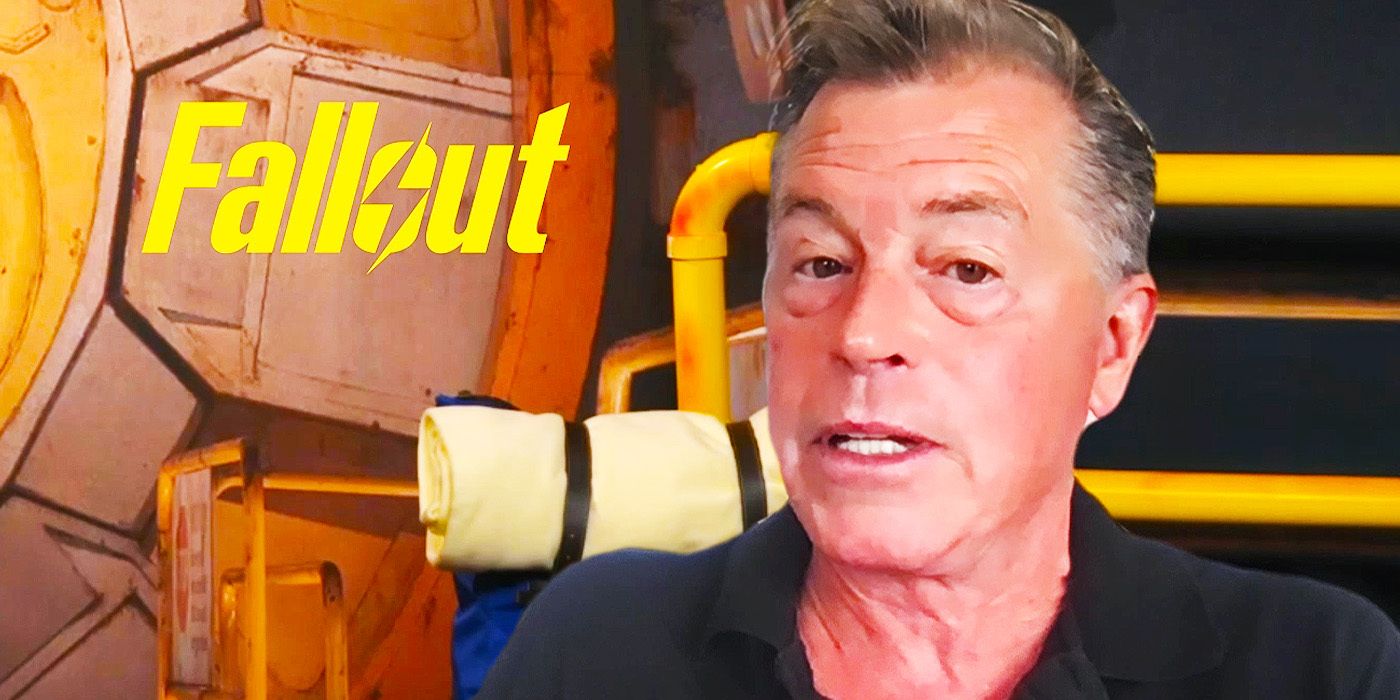
Fallout Production Designer Howard Cummings Talk Keys To Translating The Games To Screen
Summary Fallout production designer Howard Cummings fully "immersed myself" in the world of the games to authentically translate them for the show.
Cummings worked hard to find the right blend of practical effects and CGI to match the scale of the games, particularly in regard to the Power Armor suits.
Cummings had first been introduced to the games by buying one for his son, whom he humorously recalls having told him he "sucked" at playing.
The video game adaptation success streak is alive and well with Fallout. The Prime Video show serves as an adaptation of the Bethesda post-apocalyptic game franchise of the same name, which puts players in the world of the Wasteland centuries after a nuclear war destroyed the world. In their journeys, players encounter mutated animals, mutated humans known as Ghouls, and various factions, including the Power Armor-wearing Brotherhood of Steel.
Rather than directly adapting any one game's story, Fallout is instead set in the world of its source material, telling an original story with original characters, including protagonist Lucy MacLean. The young Vault Dweller, played by Ella Purnell, is forced to leave her comfortable existence in Vault 33 to search for her father after he's kidnapped by a group of raiders. Along the way, Lucy will have to quickly adjust to the darkness present in the new surface world as she faces everything from Radroaches to Walton Goggins' The Ghoul.
Related 11 Biggest Changes Amazon's Fallout Show Makes To The Video Games The Fallout show serves as the newest canon entry to the franchise, but it also went back to change several elements of the established lore.
Alongside Purnell, the ensemble Fallout cast includes Aaron Moten, Walton Goggins, Kyle MacLachlan, Moisés Arias, Johnny Pemberton, Dale Dickey, Carita Choudhury, Michael Emerson, and Leslie Uggams. Created by Geneva Robertson-Dworet and Graham Wagner, and executive produced by Westworld's Jonah Nolan, the show has seen The Last of Us-level success for Prime Video, garnering widespread acclaim and setting multiple records for the streamer in its premiere weekend.
On the heels of the show's premiere, Screen Rant interviewed production designer Howard Cummings to discuss Fallout, how he immersed himself in the world of the games to authentically translate them to the screen, and the surprisingly extensive dedication to practical effects on display in the show.
Cummings Had A Heartwarming Personal Inspiration To Dive Into Fallout
With a near-30-year life cycle of titles thus far, the Fallout games have offered a variety of players the opportunity to jump into the franchise and explore the offbeat post-apocalyptic world. For Cummings, he only "knew roughly" about the games before signing on for the show, though recalled a heartwarming reason of why working on it would be a meaningful venture for him and push to "immerse myself" in the games:
Howard Cummings: It's such a gift, because I didn't really know — I knew roughly what the game was, in fact, I gave it to my son for Christmas along with an Xbox. He said, "You know you gave me the game?" And I said, "I did." He goes, "Yeah." I said, "Did we play it?" He said, "Yeah, you sucked, but it changed my life." [Chuckles] Because he became a huge gamer, so he was the most excited about it when I landed the show. But once I started to learn what the game was, and the fan base, and the deep story — I used to fall asleep, listening to the history of the Brotherhood of Steel. I immersed myself in it, and I began to really love the look of the show. And then, because we were doing a new part, you know, it's in any of the games, it's all in LA, it's sort of after Fallout 4, and we're closest to Fallout 4, I got to, what I call, Fallout locations. You start to learn enough about the game, like the decorator, her name's Regina Graves, she literally could tell you, "Go online, and you can make a kit to make your apartment look like a Vault room in Fallout." We didn't do all-vintage stuff, we did stuff you can literally buy on Amazon, or Wayfair, or whatever. You can actually now print crazy wallpapers and rugs, even, and you can get all that. A couple of them, the manufacturers, we called them up.
The Fallout Production Team Had 1 Key Rule In Mind For Adapting The Games: Scale
Though various comparisons have been made between the two thanks to their small-screen homes, one of the big differences between The Last of Us and Fallout shows is the scale of their worlds. Where the HBO show is primarily a character-driven drama that happens to be set in a post-apocalyptic world, the Prime Video title relishes in its big set pieces as much as it does develop its core characters. Matching the epic scale of the games was the big guiding light for Cummings and his team, including one iconic device:
Howard Cummings: Everything Fallout is all about scale, right? And the Pip-Boys are huge in the game. Huge. So, I talked to Todd Howard about it, I said, "You know we're shrinking the Pip-Boy?" And he said, "Oh, no, the Pip-Boy is big in the game, because you have to play it on your screen. Pip-Boys should be smaller." And then we had Ella Purnell, who's a tiny girl and she has tiny wrists. So, we had to question everything, but I kept it exactly the way it looked. And we shrunk it down, and they wanted it to work. I forget what the prop guys did, I don't know which phone we found, it was some weird phone that actually could fit in that thing. So when they're using it, you're seeing it, it's not replaced later in post, we actually did all that stuff. Because it was important to everybody that there'd be reality mixed with CG.
Fallout's Dedication To Practical Effects Created 1 Big Hurdle
With the scale of the Fallout world including everything from mutated creatures to flying ships and Power Armor, Cummings and his team were presented with a unique challenge in trying to keep things as practical as possible, especially with the latter suit. The production designer recalled how they ultimately turned to the studio behind the Marvel Cinematic Universe's Iron Man visual effects for help to authentically bring the Power Armor to life, while also finding a unique real-world location to create the show's main hub town:
Howard Cummings: For instance, we wanted the suit to work. That's the first thing I did. I was like, "Do you know how long that takes?" I had never really done it. We got this company called Legacy, who does Iron Man and all that stuff, and they were experts at it. But, to make this suit fully functional, have actors get in it, as well as stunt people. That was a real challenge. But, it was very important that these tangible things be mixed with the things that were enhanced. So, I think that helps make you feel like you're in the game more, because so much of it is real. Like that whole junk town, that's all real. I went online and found this crazy junkyard in New Jersey that had only been in business between 1946 and 1966, and they shut it down, so everything in it was period correct to Fallout, or in the retrofuturistic of the world. There were rows of 1960s buses, and there was an airfield next to it, a military base, and they stuck jet fuselage pieces and cockpits on top of the buses. So, when Lucy comes in to go into Filly, and she's walking, everybody's trying to sell her Radroach meat, or whatever disgusting thing they could. That's all real, when she's walking through the woods of cars. Those cars got dumped there in the '40s, and a forest grew up around them, they've been there so long. That's so real, and so that was so cool to be able to take that stuff and go, "Oh, that's Fallout. We've got to grab it." There is stuff, it comes from somewhere, so that was really fun, too, and part of trying to make it feel like a film, feel real. The game isn't the game without the detail, and I said that in the very beginning. And I said, "Oh, we're going to do the game." And they said, "Oh, great." I go, "Oh, you don't know what that means." [Chuckles] One of the line producers at one point walked through the sets and said, "No more rivets. No." They weren't wrong, but we figured out a system of how to do it much faster, so it got cheaper. I said, "You can't cut the rivets, you got to have the rivets." So, it's part of the texture of it all.
About Fallout
Close
Based on one of the greatest video game series of all time, Fallout is the story of haves and have-nots in a world in which there’s almost nothing left to have. Two hundred years after the apocalypse, the gentle denizens of luxury fallout shelters are forced to return to the irradiated hellscape their ancestors left behind — and are shocked to discover an incredibly complex, gleefully weird, and highly violent universe waiting for them.
Your browser does not support the video tag.
Check out our other Fallout interviews with:
All of Fallout season 1 is available to stream on Prime Video.
Source: Screen Rant Plus




COMMENTS