Rumble Club Interview: Free-To-Play Brawling, Stream-Friendly Game Design, & Future Plans
Summary Rumble Club, a goofy party brawler, offers physics-based fun like Fall Guys and Gang Beasts.
Stream queue system simplifies gameplay with viewers, and daily events keep the experience fresh.
The game's PvP focus, 20-player lobbies, and free-to-play model aim to engage players across all platforms.
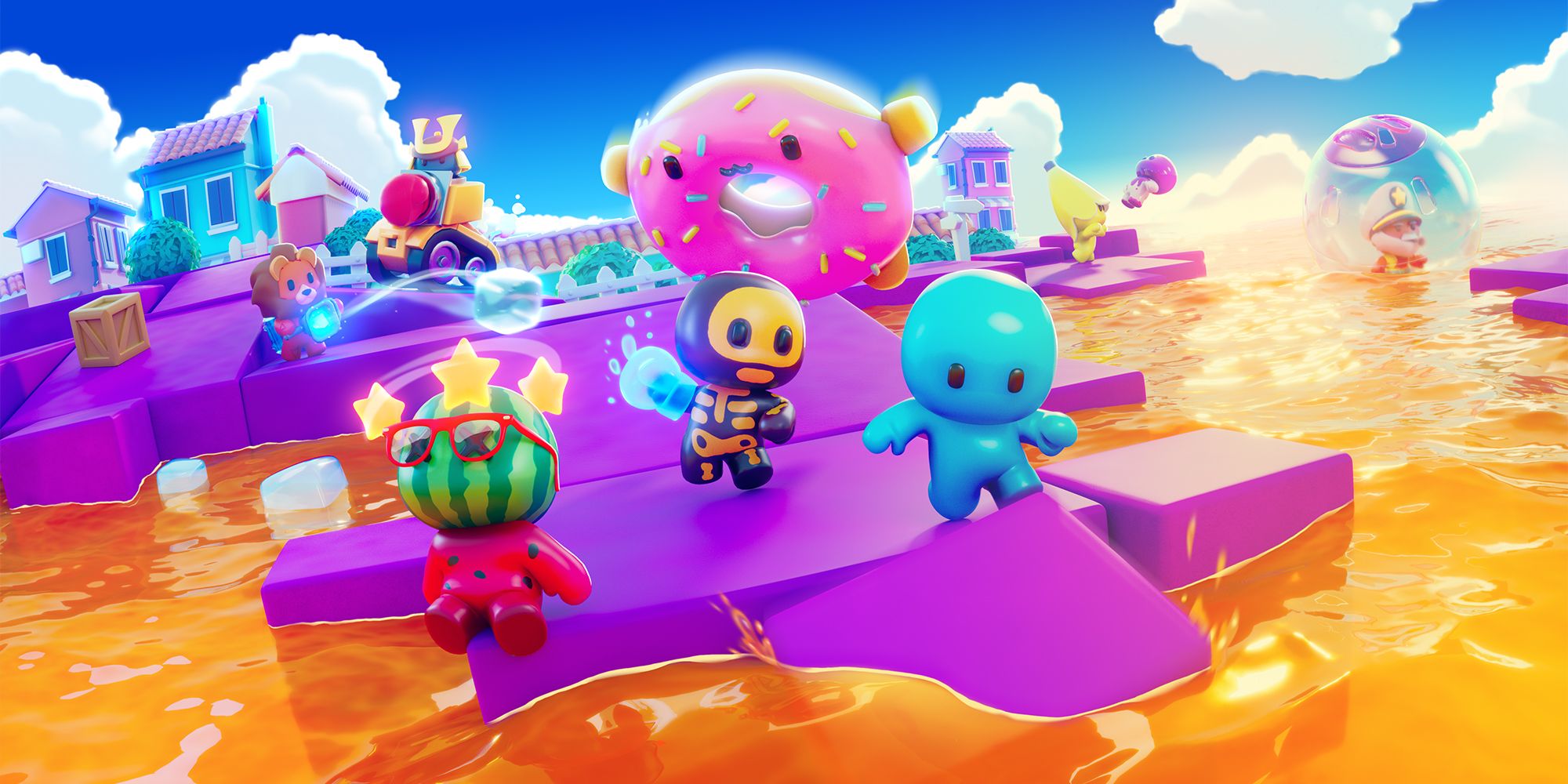
When it comes to games focused on goofy fun, Rumble Club is the new kid on the block. Developed by Lightfox Games and published by Mad Mushroom, this goofy party brawler bears an obvious resemblance to cartoony physics-based titles like Fall Guys and Gang Beasts, throwing twenty players into an arena to duke it out in various challenges. It's easy and free to pick up and play, and the element of chaos means that even newcomers should have a good chance against veterans.
It's a genre with a lot of appeal for streamers and their viewership, and Rumble Club is making strides to leverage that. Mad Mushroom is the publishing arm of creator group OTK, with Rumble Club being the first game to release under the label. A stream queue system stands out as a way to make arranging games with viewers simple, and daily events and new game modes could keep the experience fresh.
Ahead of Rumble Club's launch, Screen Rant sat down with Lightfox Games COO & Product Jordan Arnold to talk about what the game does differently and how its future could unfold.
Lightfox Games COO On Rumble Club
Jordan Arnold Talks About Designing A Party Brawler
Close
Screen Rant: Rumble Club is a physics-based party brawler. In a market with a lot of quick pick up and play options, What are you hoping players gravitate to in this one?
Jordan Arnold: Yeah, so there are a ton of games in the space that are kind of physics-based party games. I think the biggest differentiator that we wanted to have for Rumble Club from the beginning was making it really PvP-focused. A lot of the kind of other games in market are multiplayer, you're playing with a bunch of people, but at its core, the gameplay's PvE. You're trying to race to the end of a map, or it's externalities that are affecting you. And in Rumble Club, we really wanted you to impact other players and vice versa. We think that has more opportunities for hilarity and long-term play, because whenever other players are in there making their own decisions and kind of shifting the meta we think there's a lot of fun there. So I hope the players find kind of like, silly and fun opportunities with friends. Team game modes is also something we're leaning into a lot, so you can actually play with your friends on a team working together. And yeah, those are kind of the big focuses are fun, silly physics experiences — knocking out other people with your friends.
How did you decide on the balance of the 20-player lobby size for this?
Jordan Arnold: Some of it’s initial technical limitations, just trying to figure out what we feel like we could provide at a really high fidelity across devices. Rumble Club is also, from the beginning, a cross platform game on mobile and PC. And that was, I think, also a big differentiator for us in market, is from the beginning we kind of had this mantra of “play anywhere, fair everywhere,” where any device that could possibly run Rumble Club, we’d love if it could be there. We're launching on PC and mobile to start, but the dream is that it could go to a bunch more places. But the control systems need to be built in such a way that that all those players can matchmake together and have a good time. So trying to focus on making sure that the game can run on really low end, like, Android devices that in emerging markets, you know, a lot of their handsets aren't as powerful as the mobile handsets that we have in in the US or even beefy PC rigs. We wanted to make sure it was fun to play on all those devices. So that was kind of initial benchmark that we hit was 20 players. We might do experimentations with higher numbers in the future in future seasons and stuff. But yeah, we felt like it was a good number for those kinds of concessions.
Your browser does not support the video tag.
Another key aspect is free-to-play. Is that something that was also decided from the beginning in terms of development? Or is that something you settled on later?
Jordan Arnold: No, that was from the beginning. So Lightfox Games —historically, the founding team, which I was part of worked at King previously in their Seattle studio — our roots are kind of in mobile free-to-play. So it's actually a new adventure for us to have a game that is PC and mobile first as co-platforms of priority. That’s a new thing for us. We're really excited about it because we think that, with the way the market's evolving, with more focus on on cross-platform play, that's an important step to take with this game.
So with the level playing field across platforms, is that something that can also be expected for free-to-play players?
Jordan Arnold: Yeah. I mean, especially on mobile paid games, paid multiplayer on mobile is a really hard sell and paid multiplayer in general for an indie game can be a really hard sell. Kind of the only games that have matchmaking and cost money usually are AAA games. So we're wanting to make sure that a ton of people can play. It's easy for me to tell my friends, “Hey, let's all play Rumble Club, try it out with me” without making them shell out. So we've always loved the idea of free to play games and getting your game in the hands of millions and millions of people, which is way harder to do when there's a sticker price. That has excited us as a team and was kind of in the roots of how we formulated Rumble Club.
Another thing with lobbies for this is there's a stream queue system, right? Can you talk some about how that works?
Jordan Arnold: Yeah, I'm super excited about the stream queue. Some of the creators during our Steam playtest got a little taste of it, and I think it went over really well, personally. We wanted to build something that made it really easy for streamers to play with their communities in as frictionless of a way as possible. It's always a ton of fun watching your favorite creator have fun in a multiplayer game and celebrating their highs and lows, but it's even more fun if you get to contribute and be the one to be on their team or knock them off or whatever. So there's some fun interplay there. We built a system where anyone can enable streamer mode. When they create a private lobby, you get a code on the screen that anyone with the game can type in and join. That works on mobile, that works on PC totally cross platform matchmaking and play there. And then streamers, when they're ready, they can fill up a queue with — we've tested the technical limitation to like tens of thousands of live connections. So you can have the biggest stream in the world with tens of thousands of live people waiting to play. You can either press a button to add the next — it's a 20-person lobby — so the next 19 people can get invites to join. You can also press a button to have random people get invited. So if a list is so massive, you want to have it, you know, have a little bit of odds of everyone getting a chance to get in, and then they can play a match with you. And when you're done with that group, you finish the match — which are pretty quick because it's the matches are built to work on kind of mobile play sessions and PC play sessions — you're done in three to four minutes. You can kick all those people who just played back into the queue and invite a new batch. And this is a way where if you're streaming for a couple hours, you can get hundreds of people that had a chance to play with their favorite creator and have a chance to be featured on stream in a really frictionless way that kind of isn't possible and hasn't been possible in other games quite to this level. So I'm stoked for creators of all sizes to get their hands on it and get to play with their community.
Mad Mushroom Partnership Details
How OTK Became Involved
This is being published by Mad Mushroom, the publishing label of Creator Group OTK. How did that partnership originally come about?
Jordan Arnold: So we met, Ryan and I — Ryan's the CEO — and I went down to an event put on by 1AM Gaming, which is one of our investors. And that event was put on by 1AM Gaming and OTK. So they were working together to put on a an event in LA. We flew down and showed the game off as kind of a palate cleanser. It was a finance-focused meeting for a bunch of finance guys, but they wanted to show a little eSports-y stuff in there. So like, yeah, let's show Rumble Club. So we did that and got plugged in with both people on the OTK side, the Mad Mushroom side, and conversation started, and it felt like an awesome fit for the angle we were going for with this game. And with some of their feedback and influence, we've been able to lean into that a little bit more than we would have otherwise. I don't know if we would have built the stream queue if we didn't have some of their really great ideas and feedback on how we can make the game really work for their community and for content creation.
Is there any concern with being tied to public personalities with the controversies that can come with that? Or is this something that the team just tends to see as an opportunity?
Jordan Arnold: I mean, I think anytime you're working with any individuals, there's always, you know, you hope that people show the game the best light, but the game is also its own thing. And when you put the game in in creators’ hands, even outside of OTK, or outside of other creators, there's opportunities for people not always to show the game how you want them to. But I think that the hope is that people are excited about the game and excited to play it even outside of the streamer communities, which we hope are strong and love the game, but we want to see it grow even outside of just the kind of streamer audience.
Are there any games in particular that served as inspiration for Rumble Club?
Jordan Arnold: There’s a lot of different games that we looked at. We talked a lot about Mario Party because we've kind of folded in a lot of different party game modes that are all very physics-based. We see Rumble Club as a platform to be able to grow off of in future updates. Mario Party does a good job of just like, there's a bunch of different wacky game modes that are all usually fundamentally kind of physics- or movement- or puzzle- or whatever based. How can we have a lot of variety of game modes in one wrapper? We talked about Super Smash Brothers as one of the kind of very successful fighting games that is more physics-based than many others. We don't have a health bar that when you get to zero you die so that's a decent differentiator. And then there's some of the other, kind of, more recent physics-based party games that have been on the market that we've looked at for scalability and readability things. Although, we are pretty differentiated from them from a moment-to-moment perspective in that our camera is kind of fixed top down on your character, more like an ARPG, and there's our kind of free cam, you're looking behind your character. We draw inspiration from, you know, all sorts of things that aren't even anywhere in the vein of the type of game we're making, as game makers and gamers ourselves we’ll reference all sorts of weird, like, “Hey, I played this game, you know, 20 years ago, and I think there's this cool feature that we should think about.” So there’s fun stuff there too.
How much of a roadmap do you have for the future of Rumble Club right now?
Jordan Arnold: So we have, I mean, there's a ton of stuff we want to do. We have a season two on the roadmap. The game is launching with the launch season. It's space themed because the game is launching and launch in space. And we thought it was funny like eight months ago. And I contend it's a little funny. It's probably not as funny as we leaned on it to be. So launching with the space season. And then we have a second season planned which will come out later. We have a lot of other like gameplay features and game modes and things that we have talked about. But we also want the community to be able to kind of be able to have an impact on what the roadmap looks like. What are people liking? What is frustrating? What's confusing? What would they love if we innovated in this space? So, you know we have a plan until we get punched in the mouth. Like whoever the boxer was said that. We have a roadmap we'd love to hit, but we're totally flexible to changing that roadmap based on feedback and where people are having fun.
With the cosmetics element of Rumble Club, are there any collaborations that you'd like to pursue in the future?
Jordan Arnold: We intentionally built the IP in such a way that we wanted to be able to do that in the future. So we'd love to do collabs with, you know, individual streamers, with IP, with brands, with all sorts of stuff. We think that the kind of wacky and silly and colorful world, you can layer all sorts of things in our world and on our characters and make some really cool content out of it. We’d love to have that opportunity to do that in the future.
In regards to the Super Rumble Pass that's being offered, there's a mention of gadget upgrades being tied to the pass. What does that mean?
Jordan Arnold: Yeah. So as you progress in the battle pass, you'll unlock gadget cards. Gadget cards make gadgets, which are like our weapons, last just a little bit longer in matches. The balance of it is you start with a gadget that will last 15 seconds, at maximum level it lasts 25 seconds, and getting things to level five, which is halfway through, takes a couple of weeks. It's more of a kind of midterm engagement goal of like, yeah, it's fun to upgrade my gadgets and make some progress. But the practical delta in gameplay is pretty minor. So give some, some midterm goals of I want to get my seasonal gadgets. Taking a slight step back, all of our seasons have specific seasonal gadgets that are only live in that season. So the space season has five space gadgets, which will go away and get vaulted at the end of the season, and you can level them up within that season and have them last a little longer. And depending on how far you level them up, you get exclusive cosmetics that you unlock forever that you could only get from leveling up your seasonal gadgets. So it's kind of just an engagement mechanism to give you some progression during a season, and then those seasonal gadgets reset at the end of the season.
There's also a mention of daily event modes. What can players expect to see from those?
Jordan Arnold: We have all sorts of stuff going on in the in the daily event mode. We’re hoping to also just kind of see what players are liking and not liking and be able to update what sort of events show up in there. But we have a bunch of like, quirky one-off weird maps that are probably too weird to put in the normal play button, but we wanted people to be able to enjoy in spurts. So yeah, every day there'll be different free for all maps. And every couple days there'll be different matchmaking buckets for teams, so different game mode types. There are five game modes launching with our worldwide release, and so you'll have a different set of those game modes, where it'll be only that game mode and you can play duos or trios or squads or whatever. So those cycle daily to give variety to players, and as we get more players playing and more feedback on what's resonating, we'll love to build more content that leans into that.
Do you have any particular favorite among the game modes that are currently available?
Jordan Arnold: So the new one that we just basically made in between the playtest and today, I'm having a ton of fun with with the team. It's called Crab Crush. So there's a bunch of crabs around the map, and you punch them to pick them up. And you can see how many crabs you're holding above your head. If you fall in, you lose all your crabs and people can come and steal them. It's fun because everyone gets to play to the end, which is sometimes feedback on a battle royale game. If you're playing with your friends and you got 20 people and you're the first one eliminated, it's kind of sad to watch everyone else play to the finish line. And it allows for really big comebacks at the end. So I can have — first to 15 wins in solos — so I can have 14 crabs, but if someone knocks me off with zero and picks all of them up and grabs one more, then they're winning. The swinginess has led to a lot of expletives being thrown in a very joyful way in our team play test. So that is a new fun one. It's a little absurd. It's pretty competitive and it's a lot of fun, so I've really been enjoying that one.
I imagine a lot of ideas just get thrown around for game modes and stuff. Is that something where you've got a number in your back pocket right now that you're thinking about for the future?
Jordan Arnold: Yeah, totally. We pitch game modes all the time, and luckily the tech stack that we've built is pretty, like, flexible to experiment and iterate pretty quickly on new game modes. The Crab Crush game mode I think we pitched as an idea to the creators the week after the playtest ended. So that was three weeks ago? And it went from concept to playable and fun with one unique map for it and three kind of rehashes of existing maps to support the game mode. So we work really fast being able to kind of experiment and create these game modes. We hope to take that level of flexibility and iteration speed to the players too. Just like, here's a bunch of stuff for you guys to play around with and whatever you think is cool and people are resonating with, we'll iterate on and make even better. And the stuff that isn't cool, oh, that's fine. It wasn't a huge sink for us, so we just do less of that. We think that that level of responsiveness to the community will keep people engaged and wanting to come back and see what's new as opposed to, I don't know, some companies and some games get so precious with their stuff of like, it's all gotta be perfect. It's all gotta be huge. And it's gonna take us, you know, a year to get this thing out. We want to ship stuff all the time, and we want to get feedback and see what's cool and what's not. And we hope to lean into that as we continue to go forward. But yeah, we have a couple ideas for season two game modes, a couple ideas for — we actually have one game mode that might ship pretty soon after worldwide that I'm also excited about. So, yeah, trying to keep the variety coming.




COMMENTS