Star Wars: 10 Secrets Of The Jedi Temple You Never Knew
Summary The Jedi Temple on Coruscant was built on a Sith shrine, possibly dating back to the ancient Zeffo days.
The Four Founders of the Jedi Temple were chilling statues representing the Warrior and Sage Masters.
Palpatine used the dark side nexus beneath the Jedi Temple, even daring to wield the dark side on the grounds.
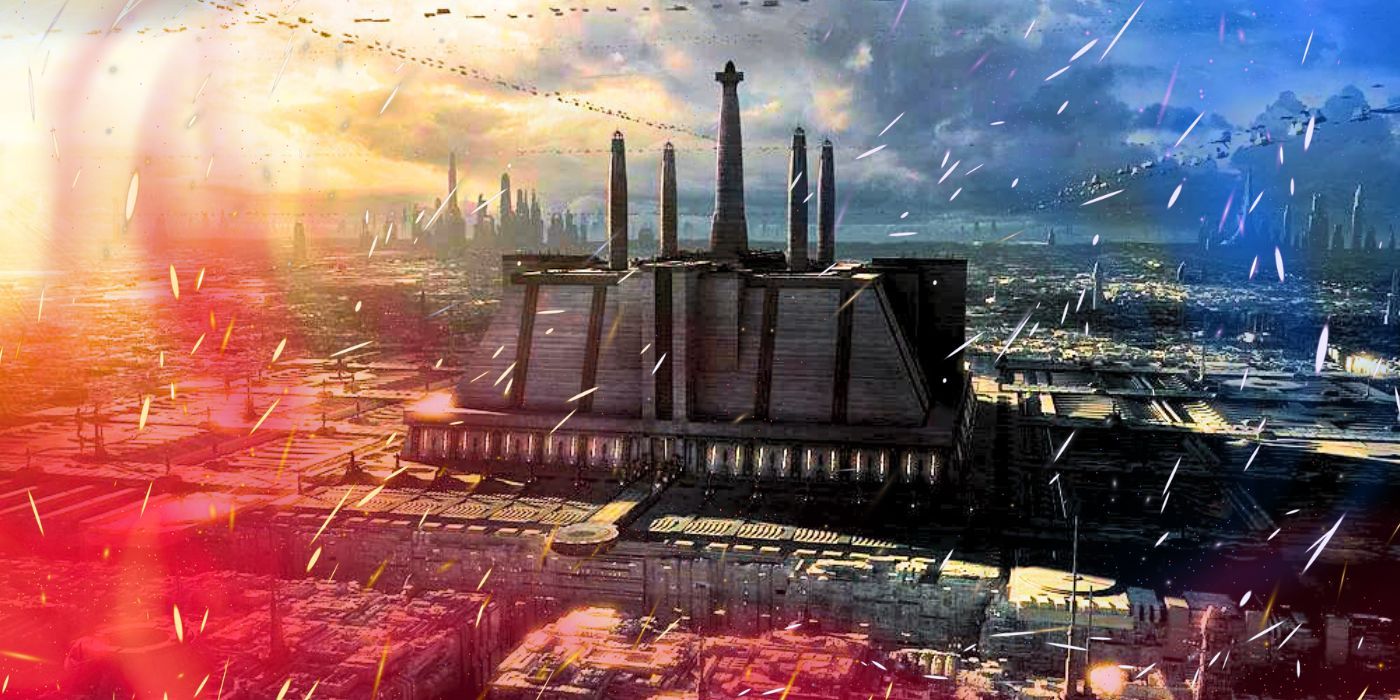
The Jedi Temple on Coruscant is one of the most iconic buildings in Star Wars lore, but it hides many secrets. The Jedi Order has been based on Coruscant since the fall of the Sith some 1,000 years before the Skywalker saga. This wasn't the only Jedi Temple, of course; galactic travel was once a lot more difficult, leading the Jedi to establish countless outposts in different sectors. The Jedi gradually retreated back to Coruscant in the years before Star Wars: Episode I - The Skywalker Saga, until this became their only temple.
Few Jedi knew all the secrets of the Jedi Temple on Coruscant, a dark truth that Palpatine himself used against them. These secrets have been revealed in countless different mediums - from comics to novels, from TV shows to console games. Here are some of the most shocking secrets and intriguing details about the Jedi Temple.
Related Star Wars Movies In Order: How To Watch Release Order, Chronologically & With The TV Shows What's the best way to watch Star Wars? Here's everything you need to know to watch in release or timeline order, and how to include the TV shows.
10 The Jedi Temple Was Built On An Ancient Sith Shrine
Close
Jedi venerate the balance of the Force. They consider darkness to be an imbalance, and strive to correct it with the light. That has led the Jedi to build many of their temples atop ancient Sith shrines and vergences steeped in the dark side of the Force. The Coruscant Jedi Temple was no exception; it was built on a sacred mountain, site of a powerful dark side nexus that had even served as a Sith shrine.
It's possible the vergence hails back to the ancient days of the Zeffo
Coruscant has long been teeming with life, which explains why this planet is rich in the Force. It's unclear why this dark side vergence exists, though, one that appears to predate the Sith Order. Coruscant was one of the identifiable planets marked on an ancient starmap in Ahsoka, though, so it's possible the vergence hails back to the ancient days of the Zeffo when the Nightsisters explored this galaxy from their homeworld in distant Peridea.
9 The Four Founders
Your browser does not support the video tag.
Star Wars: Episode III - Revenge of the Sith showed one chilling scene in which clone troopers entered the Jedi Temple, passing by four massive sculptures of Jedi. These were the Four Masters, or the Four Founders, who established the temple a thousand years ago. These masters haven't been given names, either in Star Wars Legends or in canon.
The interior of the Jedi Temple contains sculptures that are strikingly similar to these, and may represent the same individuals. Curiously, two of these are known as statues of "Warrior Masters" and two are identified as statues of "Sage Masters." This may hint at the structure of the Jedi Order back when the Coruscant Temple was founded, which would make sense; this was a time of galactic war, after all, as the Jedi strove to destroy the Sith Empire.
8 How The Jedi Used the Dark Side Nexus
Surprisingly, the Jedi used the temple's Sith shrine. Claudia Gray's Into the Dark is set 200 years before the events of the Skywalker saga, and it reveals the Jedi would take relics imbued with the dark side down into the shrine. There, they would perform mysterious rituals of purification, stripping the dark side from the objects and depositing it within the vergence. They believed it would then dissipate into the Cosmic Force.
It's likely the reality is very different; rather than dissipating, it seems probable the dark side from these relics remained, making the vergence ever stronger. This may explain why the Jedi abandoned this approach by the time of the Star Wars prequel trilogy. Whatever the case, Palpatine would make use of the Jedi Temple's dark side nexus in later years.
Buy Into the Dark from Amazon
7 The Bogan Vault
Close
Cavan Scott's Dooku: Jedi Lost reveals that the Jedi shifted focus away from using the dark side nexus, instead establishing a secret section of the temple where relics were kept securely. This so-called "Bogan Vault" was accessible via the Jedi Archives, and it was overseen by Jedi Master Vernestra Rwoh, the chief archivist in the prequel era. Dooku stumbled into te Bogan Vault while he was still a Padawan, and seems to have been subtly corrupted by its influence.
Palpatine coveted the Bogan Vault, not least because one item kept within it was the mask of the ancient Sith heretic Darth Momin. He had successfully preserved his consciousness within his mask using the dark side Force power known as essence transfer, and Palpatine believed that technique could help him achieve immortality. He ultimately gave the mask to Darth Vader once he had learned Momin's secrets.
Buy Dooku: Jedi Lost from Amazon
6 The Jedi Detention Center
Close
In addition to the Bogan Vault, the Jedi Temple also contained a detention center - also known as the Sith containment cells. Built before the Sith Rule of Two, this massive complex contained hundreds of cells, mess halls, interrogation rooms, armories, guard barracks, and control centers. The inner cells were sturdy enough to contain the most powerful Force-sensitives, while outer cell blocks held non Force-sensiitives or rogue Padawans.
The Sith containment cells were lined with the lightsaber-resistant cortosis ore, a fibrous material capable of absorbing energy. Striking cortosis disrupts a lightsaber's power, causing it to short out. In addition to cortosis, the cells also used more conventional duracrete, blast shields, and ray shields.
5 Even The Trees At The Jedi Temple Are Sacred
Your browser does not support the video tag.
The Great Tree was situated at the heart of the Jedi Temple on Coruscant; like all uneti trees, it has a strong connection to the Force. This tree was said to have grown from seeds acquired from the first Jedi Temple, and indeed there is an ancient long-dead uneti tree at Ahch-To in Star Wars: The Last Jedi - one that is eventually set ablaze by Master Yoda's Force ghost. The blossom of the Great Tree was used to create incense for meditation.
Luke's studies of uneti trees became the key to his discovering the location of Ahch-To
Palpatine had the Great Tree removed after he took over the Jedi Temple. Fragments were kept for study, though, and they were eventually discovered by Luke Skywalker; he gave one to rebel pilots Kes Dameron and Shara Bey, who planted it outside their home on Yavin 4. Luke's studies of uneti trees became the key to his discovering the location of Ahch-To.
4 The Kyber Arch Honored Fallen Jedi
Jedi believe in letting go of their fallen, but that doesn't mean they fail to honor them. That's particularly true when it comes to the handling of a fallen Jedi's lightsaber; a Jedi bonds with the kyber, leaving an echo of their own spirit within it, meaning these used kyber crystals are incredibly precious. Recognizing this, the Jedi built a kyber arch within the temple, one made of the crystals of all fallen Jedi. It's only been mentioned a few times, and appears in Star Wars: The High Republic Adventures: Quest of the Jedi #1, by Claudia Gray and Fico Ossio.
Many Jedi would choose to perform a ritual where they scaled the kyber arch. This was considered a sacred act, a solemn duty, because it taught a Jedi that they stood on the shoulders of all who had gone them - rather than embracing individualism. It was first mentioned in Claudia Gray's Into the Dark.
3 Jedi Who Weren't Temple-Trained Are Called "Bokken"
Close
Ahsoka revealed that Jedi who were trained away from the main Jedi Temple on Coruscant are known as "bokken." The term was used by dark Jedi Baylan Skoll, and the dismissive tone in his voice suggests it was seen as a slur, referring to a lesser "class" of Jedi in some way. There seems to have been a strong sense of status associated with the main temple on Coruscant.
In Baylan's view, every Jedi trained during and after the Dark Times is bokken - because there is no longer a Jedi Temple on Coruscant. It is unclear whether he would have revised his opinion after Luke Skywalker established his own Jedi Temple on Ossus. He probably wouldn't, though, because he'd have considered Luke to be bokken in the first place.
Related All 12 Bokken Jedi In Star Wars Canon Baylan Skoll introduced the concept of Bokken Jedi in Ahsoka episode 6, and 12 Star Wars characters fit that description in the official canon.
2 Palpatine Used The Dark Side On The Temple grounds
Close
Palpatine was a Machiavellian mastermind, but there were occasions where he decided to gamble and take terrible risks. A good example can be found in E.K. Johnston's Queen's Shadow, in which Darth Sidious dared to use the dark side of the Force on the grounds of the Jedi Temple itself. Incredibly, he did so at a social gathering with Jedi Masters.
Senator Padmé Amidala had disrupted Palpatine's plans by switching with her old body-double Sabé so she could go on a secret mission. Frustrated, Palpatine pressured Sabé to persuade her to return; he does so using Force compulsion, leaving the Queen's Shadow shaken by the experience. Fortunately for Palpatine - and unfortunately for the galaxy - the Jedi in attendance didn't notice.
Buy Queen's Shadow from Amazon
1 How Palpatine Used The Sith Shrine Beneath The Jedi Temple
Your browser does not support the video tag.
Palpatine converted the Jedi Temple into the Imperial Palace, making it his main residence. It can be seen in Jedi: Survivor, with Order 66 survivor Cal Kestis grieving as he reflected how the Empire had turned something he loved into a symbol of evil. But Palpatine's choice wasn't just a way of celebrating his victory over the Jedi; it also meant he had access to the dark side shrine.
Palpatine made use of this shrine in James Luceno's novel Tarkin, but it can actually be seen in Star Wars Rebels season 4, episode 13. There, Palpatine successfully uses the power of the dark side nexus to access the World Between Worlds, a realm beyond time and space. He is presumably only able to do this because Jedi Padawan Ezra Bridger has opened the way to the World Between Worlds through a light side vergence on Lothal - explaining why the Star Wars villain couldn't get in without help.




COMMENTS