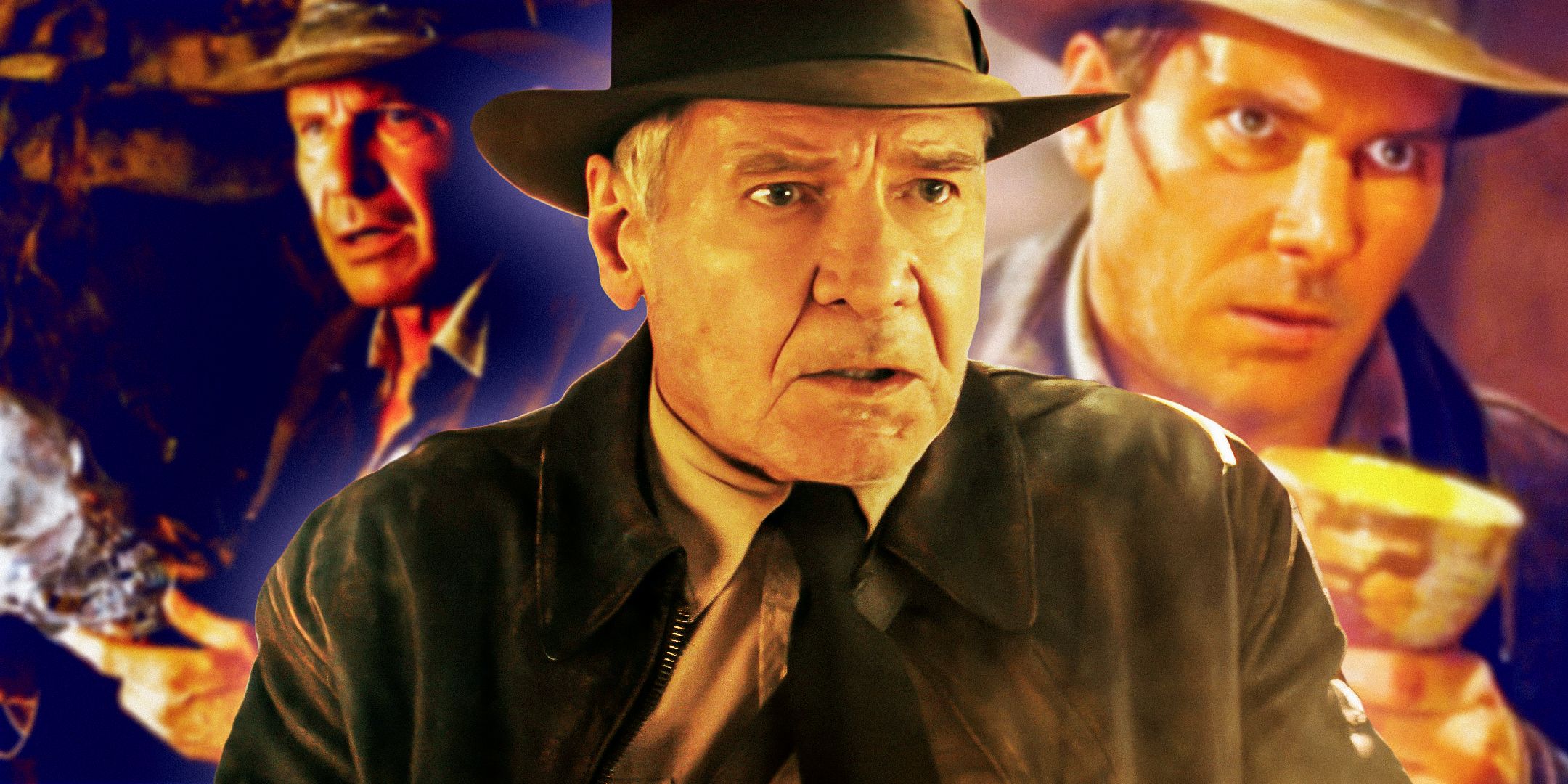
All 5 Main Indiana Jones Artifacts, Ranked By Power
Warning: This list contains spoilers for all the Indiana Jones movies, including Indiana Jones and the Dial of Destiny.
Summary The artifacts in the Indiana Jones movies often possess hidden powers not easily discernible to characters.
These artifacts' powers are typically tied to specific conditions, limiting their potential use by people.
The power of the artifacts is emphasized by their formidable defenses against misuse.
Throughout the five Indiana Jones movies, Indy (Harrison Ford) and his allies come across a variety of powerful artifacts from the ancient world. The exact nature of these artifacts' power can be hard to gauge because they most often do not work the way the movies' characters want them to. The standard Indiana Jones plot depicts Indy racing to find the relevant artifact before the Nazis do, to prevent them from using the artifact to further their agenda. However, most of the time, the conditions or hazardous nature of the artifact would have prevented the Nazis from achieving what they wanted anyway.
This is the basic thinking behind the famous, now-debunked Raiders of the Lost Ark argument that Indy is not important, not affecting the outcome of the story. However, it is clear that the artifacts seen throughout the series still possess varying amounts of significant power. The message is generally that humankind was not meant to meddle with these artifacts but to leave them alone to have a specific ordained effect on the world. The only true indication of the power of any given Indiana Jones artifact is how disastrous its built-in defenses are to the people searching for it.
Movie Release Date Indiana Jones and the Raiders of the Lost Ark (Raiders of the Lost Ark) 1981 Indiana Jones and the Temple of Doom 1984 Indiana Jones and the Last Crusade 1989 Indiana Jones and the Kingdom of the Crystal Skull 2008 Indiana Jones and the Dial of Destiny 2023
Related How To Watch The Indiana Jones Movies In Order (Chronologically & By Release) Here's the best way to watch the Indiana Jones movies by George Lucas & Steven Spielberg, by both release date in theaters and chronologically.
5 The Crystal Skull
Indiana Jones And The Kingdom Of The Crystal Skull
Close
The notorious investigation leading to a "kingdom" inhabited by aliens in Indiana Jones and the Kingdom of the Crystal Skull reveals that the crystal skull artifact is a remnant of an extra-terrestrial life form; once the skull is returned to the rest of the alien's body, it regains consciousness and leaves Earth. The interdimensional beings themselves are powerful, even if it's not clear what they can do with this power. They apparently possess more knowledge than any human ever could, demonstrated by Spalko's (Cate Blanchett) fiery death.
On its own, the skull has some psychic abilities if a person looks into its eyes for too long. Oxley (John Hurt) also uses it to divert an army of red ants away from himself and Indy. Additionally, the skull has a very strong magnetism, attracting metals that aren't even magnetic. However, other than these incidental properties, the crystal skull is not that powerful in its own right. The issue is that all the real power the skull has is attached to the alien race it comes from. At the point it rejoins the body, it is no longer an artifact but a living, sentient being.
When it is just the skull on its own, it can only accomplish these parlor tricks that happen to be incredibly useful to the protagonists based on the very specific dangers they find themselves in. It might be argued that it has the potential to be powerful by bestowing vital knowledge upon a person, but Kingdom of the Crystal Skull vividly illustrates how one person can only handle so much knowledge. Ultimately, the crystal skull can only achieve so much on its own, making it the weakest Indiana Jones artifact.
Your browser does not support the video tag.
4 The Sankara Stone(s)
Indiana Jones And The Temple of Doom
Close
The stones' power cannot be undersold because the one that is housed at the village's shrine evidently does affect the people's welfare, and what they were able to yield from the land.
In Indiana Jones and the Temple of Doom, Indy, Short Round (Ke Huy Quan), and Willie (Kate Capshaw) are prompted to go to Pankot Palace to retrieve Sivalinga, a sacred stone stolen from the shrine of the village Mayapore. The village's shaman (D.R. Nanayakkara) only ever discusses the stone that was taken, but it is revealed that there are five. Two are never discovered, and Indy loses two more after retrieving them from the Temple of Doom, before returning the single lost stone to the village.
The loss of the stone causes a blight of drought, crops failing, and livestock dying in the village. Indy causes the stones to burn by reciting a Sanskrit incantation during the final fight. When Indy returns the stone in the final scene, Mayapore's bountiful crops and water have apparently returned. Mola Ram (Amrish Puri) also believes that if he could find all five stones, he could rule the world. When Indy theorizes that the missing stone is believed to be one of the lost Sankara stones, he tells Short Round that Sankara means "fortune and glory."
The stones' power cannot be undersold because the one that is housed at the village's shrine evidently does affect the people's welfare, and what they were able to yield from the land. The burning trick is a minor power that has the most impact because of when it is used. However, the theory that the Sankara stones could be used to rule the world is never proven; it is merely a vague characterization of what they could be rather than what they are in the movie itself.
Your browser does not support the video tag.
Related 10 Things That Haven’t Aged Well About Indiana Jones The Indiana Jones franchise is one of the most critically successful and loved of all time. But since it's been a while, some things didn't age well.
3 The Holy Grail
Indiana Jones And The Last Crusade
Close
The Holy Grail is a classic example of an Indiana Jones artifact that is immensely powerful in theory, but this power isn't necessarily accessible to people. Whatever it is supposed to do is negated by strict conditions. Indy can live forever by drinking from the Grail, but only if he stays in the cave where the Grail is housed forever. The Holy Grail technically can grant immortality, something that is held up as an impossible feat within the story, and therefore merits consideration as a powerful artifact.
Characters like Indy's father Henry Jones Sr. (Sean Connery) and Elsa (Alison Doody) want to find the Holy Grail because of what it is and not what it can do. Their reverence of the history surrounding the Grail suggests a less tangible kind of power. In the end, Henry makes his peace with having seen the Grail for himself and leaves it behind, while Elsa refuses to give it up and dies as a result.
The barrage of defenses surrounding the Holy Grail also demonstrates its power. When Donovan (Julian Glover) drinks from the wrong goblet, he immediately withers until he turns to dust. When Elsa attempts to leave with the real Grail, the entire temple begins to collapse. Traps surrounding an artifact are characteristic of an Indiana Jones adventure. In the case of the Grail, they are not indisputable evidence of its power, because it's not clear if they are directly triggered by the Grail itself. However, this chain reaction can still be associated with the artifact.
Your browser does not support the video tag.
2 The Dial Of Destiny
Indiana Jones And The Dial Of Destiny
Close
The most recent Indiana Jones movie again introduces an artifact with a very specific purpose that is essentially the only thing it can do. There is a lot to discuss concerning what led to Indiana Jones and the Dial of Destiny's massive box office losses, or its failure to end Indiana Jones' 42-year losing streak at the Oscars. However, the dial accomplishes another monumental feat that is positioned as a fantastical end goal in much pop culture and mythology: time travel. Indy and his goddaughter Helena (Phoebe Waller-Bridge) race to find the dial before Voller (Mads Mikkelsen), a Nazi-turned-NASA scientist.
Voller believes he can use Archimedes' dial, also called the Antikythera, to travel back in time and change the outcome of World War II. If Voller could do this, the dial would be granting him a dangerous amount of power. Dial of Destiny doesn't really land on an answer about whether the past can be changed, although most of the characters seem to believe it can. However, Voller's plan is derailed because people in the present day cannot control where they go into the past. While Voller tries to take them all to 1939, they are brought back to Archimedes' (Nasser Memarzia) time.
This plot twist highlights one of the harsh realities of Indiana Jones' character because he wants to stay in the past but is prevented from doing so by Helena. As far as the dial is concerned, it is a powerful artifact that can take the user into the ancient past — that much is non-negotiable. Just because the conditions of what it does are not convenient for humans who are trying to use it to achieve their own ends does not mean that it is not powerful.
Your browser does not support the video tag.
Related Indiana Jones And The Dial Of Destiny: 31 Easter Eggs & Hidden References Indiana Jones 5 honors the entire legacy of the adventuring archaeologist with several fun Dial of Destiny Easter eggs and references.
1 The Ark Of The Covenant
Raiders Of The Lost Ark
Close
The way the characters speak of the Ark creates an image of it that is too powerful for any person to understand, let alone be able to use that power for themselves.
In Raiders of the Lost Ark, Brody (Denholm Elliott) tells Indy: "The Bible speaks of the Ark leveling mountains and laying waste to entire regions. An army which carries the Ark before it is invincible." This is obviously what the Nazis were hoping for when they set out to find the Ark. Theoretically, the Ark could do this in the modern day. It turns against the Nazis because they were not meant to use the Ark. In the context of the religion from which it originates, the Ark's power can only be used by humankind if God wills it.
The famous scene where the Nazis open the Ark leads to a demonstration of its power where they are all killed. While nearly all the artifacts in the Indiana Jones movies are protected by practical and supernatural traps, the Ark warrants extra consideration because its defenses are self-contained. The flashing lights and spirits circling during the face-melting scene don't seem to do anything in particular besides suggesting more potential power that the Ark contains. They could, hypothetically, launch an attack on a bigger threat.
The way the characters speak of the Ark creates an image of it that is too powerful for any person to understand, let alone be able to use that power for themselves. Brody is not the only character to raise concerns about how destructive unearthing the Ark could be; Sallah (John Rhys-Davies) tells Indy that the Ark "is something that man was not meant to disturb. Death has always surrounded it. It is not of this earth." That combined with a real if brief demonstration of that potential makes the Ark of the Covenant the most powerful artifact in the Indiana Jones movies.





COMMENTS