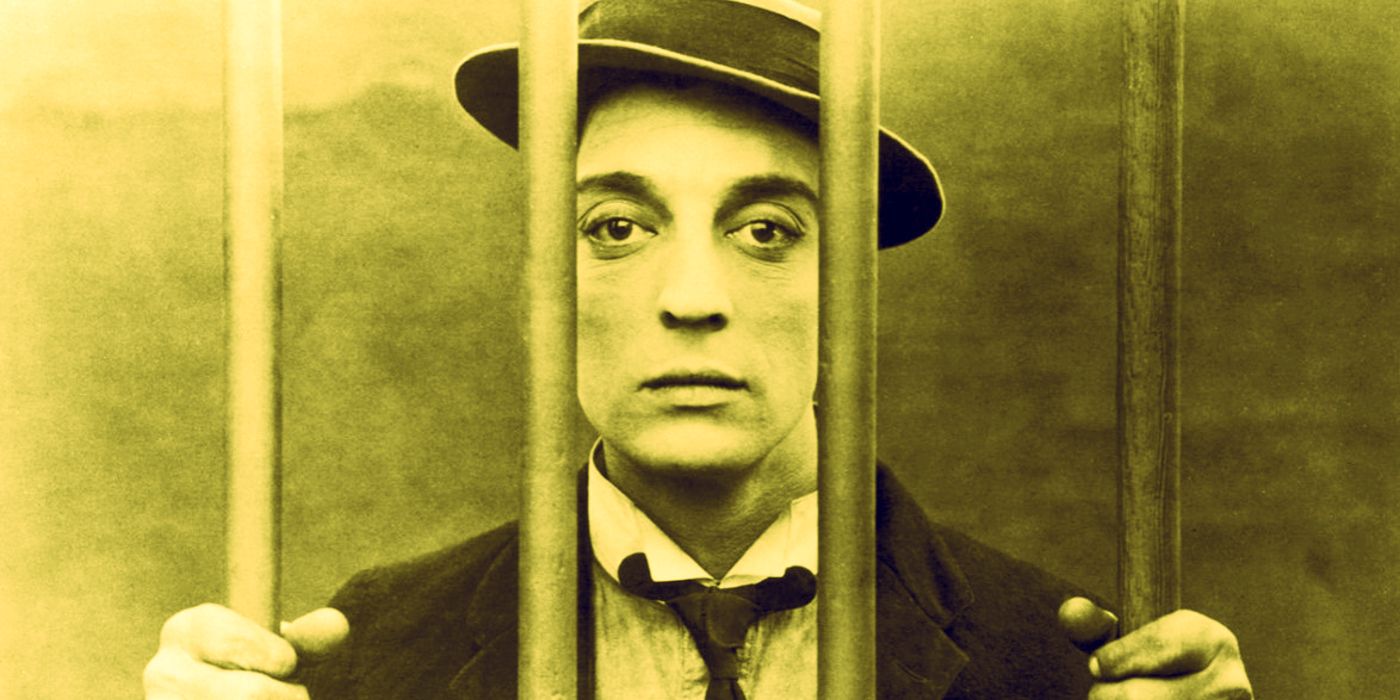
Why The Iconic Buster Keaton Is Never Smiling In His Movies
Summary Buster Keaton's lack of smiling enhanced the humor in his stunts and comedy compared to other silent film stars.
Vaudeville experience taught Keaton that taking his work seriously garnered more laughs from audiences.
Keaton's signature acting style in films like Sherlock Jr. and The General showcased his comedic sensibility and physical stunts.
Movie audiences have seen Buster Keaton do a lot of things, but few can say they've ever seen Buster Keaton smiling. Joseph Frank Keaton, better known as "Buster", was a star of the silent film ra. All of Buster Keaton's movies had one thing in common: their incredible, eye-popping, death-defying, and most importantly, plot-critical stunts. He has hung onto a train with one hand, swung off a waterfall, and watched as a two-ton building facade nearly crushed him, all in the name of cinema.
As one of the classic actors of the silent film era, Keaton and his contemporaries could obviously not use their voices to express themselves. Instead, they used physicality to show intention. For many, this meant exaggerated facial expressions: wriggling eyebrows, elastic smiles, and twitching noses. For Keaton, this meant stunts. Buster Keaton's meticulously planned stunts were impressive then and have only grown in their estimation. And what makes them so enduring is that Keaton deadpans through them all, never once smiling to say, "Did you see that?"
Related 10 Movies That Will Get You Into The Silent Era After roughly 100 years of cinema, these old silent movies are still so good that even modern audiences will be entertained.
Buster Keaton Learned That Vaudeville Audiences Liked Him Better When He Wasn't Smiling
Smiling Took Away From Keaton's Comedy And Stunts
Close
Buster Keaton made his bones in Vaudeville, just like the Marx Brothers, Abbott and Costello, and other legendary performers. In an interview with Stud Terkel, Keaton describes how his Vaudeville background was responsible for his deadpan acting (via Stud Terkel):
"Well you see, I learned that [lack of a smile] from the stage, that I was the type of comedian that if I laughed at what I did the audience didn't. So I just automatically got to that stage where the more seriously I took my work, the better laughs I got... So by the time I went into pictures, not smiling was, was mechanical with me. I just didn't pay attention to it."
Keaton perfected his craft over years in front of Vaudeville audiences and found that, like modern audiences who enjoy the comic sensibility of seriousness in the face of absurdity, he was funnier when he was "Mr. Stone Face".
The best use of Keaton's signature acting style can be seen in Sherlock Jr., The General, and Our Hospitality. In these films, Keaton does stunts as always but also makes a fool of himself (or nearly does) time and time again, always upping the danger and the laughs as his characters never seem to find their wild predicaments, like being stuck on the handles of a police motorcycle, as riotously funny as the audience does.
Buster Keaton Vs. Charlie Chaplin — Who Is Really Better?
It's A Toss-Up Between Two Silent Film Era Legends
Close
It's an age-old question of who is the better actor: Charlie Chaplin or Buster Keaton? The comparisons are easy. Both were famous silent film actors, both dabbled in directing, both made the leap to talkies, both were smaller-sized men whose slight frames belied an explosive and athletic strength.
For the longest time, Chaplin was seen as the more successful of the two. His speech in The Great Dictator is still one of the most moving and germane treatises on fascism. He was perhaps more classically handsome, or at least he smiled more. Robert Downey Jr. was nominated for an Oscar for playing him. There is no denying that Chaplin still has more star power and recognition nearly half a century after passing away than many living Academy Award winners could ever dream of.
However, recent years have seen a resurgence of appreciation for Buster Keaton. Adam Gopnik of The New Yorker writes about Keaton in a book review,
"...Keaton was cinema—he moved like the moving pictures. Chaplin’s set pieces could easily fit onto a music-hall stage: the dance of the dinner rolls in “The Gold Rush” and the boxing match in “City Lights” were both born there imaginatively, and could have been transposed there. But Keaton’s set pieces could be made only with a camera. When he employs a vast and empty Yankee Stadium as a background for the private pantomime of a ballgame, in 'The Cameraman,' or when he plays every part in a vaudeville theatre (including the testy society wives, the orchestra members, and the stagehands), in 'The Play House,' these things could not even be imagined without the movies to imagine them in.
Ty Burr from EW says,
"...Buster Keaton has slowly risen in esteem, to the point where he’s now regarded as Chaplin's superior in filmmaking (true) and in comic genius (endlessly arguable). What's undeniable is that Charlie's sentimental sensibility was rooted in the music hall and vaudeville of the past, while Buster was a poker-faced modernist who pointed to the future."
It's no easy debate. Chaplin's visibility and ubiquity in Hollywood must grant him some points as "the best", not to mention the many incredible genre-defining films Charlie Chaplin made. However, as Gopnik and others have pointed out, Buster Keaton and his movies are perhaps the best use of the medium. Artists are still trying to use all the tools available to creators, but Buster Keaton may have emptied the kit a century ago.




COMMENTS