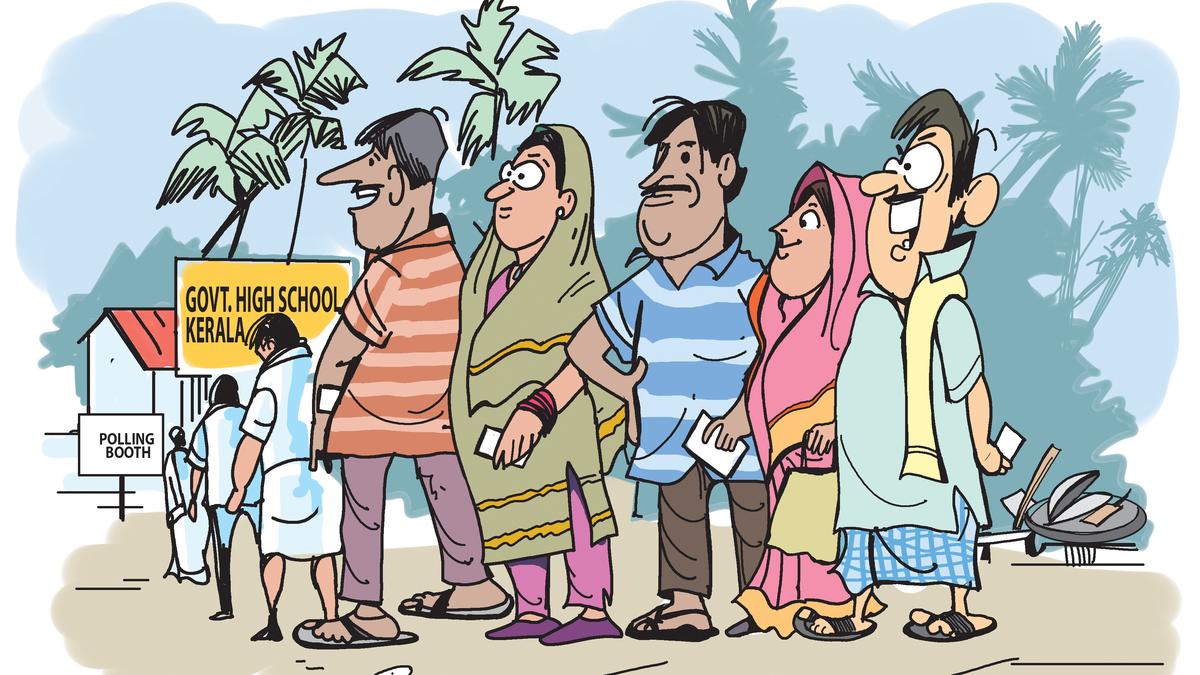
Lok Sabha elections | Migrants are drawn to the allure of free and fair elections in Kerala
April 09, 2024 11:42 pm | Updated April 10, 2024 08:26 am IST - KOCHI
Kanak Mandal, 37, originally from Balasore district in Odisha, has little memories about elections back home.
Having come to Kerala 18 years back, she is now proficient enough in Malayalam to go about her job as a domestic help with ease. She is so assimilated that she now owns a house in Maradu municipality where she lives with her husband, who is from West Bengal, and two sons.
Kanak got enrolled in voters’ list here a decade ago and is now a voter in Ernakulam Lok Sabha constituency. “Back in our village, girls had to mostly remain indoors. Interaction with outside world, especially with men was out of question. So, elections were hardly a priority. It is so different here as there is no discrimination between men and women,” said Kanak.
Rajendar Naik, 40, considers Odisha his birth place and Kerala his home.
For, he migrated to Kerala when he was just 15 years old, and has since settled down in Perumbavur with his wife, who is from Kollam, and two children. Kandhamal, the district in Odisha where he was born, has at best become a place he visits only for occasions.
Freedom to choose
Having turned Kerala his home, it was only natural that he became a voter here, which he did in 2012 and has voted in all elections since then. “Though I have never voted in Odisha, whatever I remember about elections from my early years, votes were bought there by threats. In Kerala, we are free to vote as per our choice,” said Rajendar.
Ponraj Chinnakalai, 52, was born in Dindigul district but came here with his parents when he was just a year old. A resident of the migrant-intense Vathuruthy in Kochi, he has always voted here. However, he frequents his parents back in Dindigul where his house falls within in the Nilakottai Assembly constituency and has felt the difference between elections in the two States so obvious.
“There, votes are bought with money and gifts, especially during by-elections whether it is to the Assembly or the Parliament. Here it is free and fair and support cannot be bought,” he said.
Key link to home
Benoy Peter, executive director, Centre for Migration and Inclusive Development, however, observed that the migrants who choose to enrol in the voters list here were more of an exception rather than norm and bats for remote voting for the community. “Given a job with a decent income, they would prefer to stay back home rather than migrate. Majority of the migrants are single male and their link to the home is maintained through documentation and the voters list is a critical document that reaffirms their identity. Facilitating remote voting will also enable migrants to exercise their fundamental right of voting without fear, which is not the case often in their home States,” he said.
Pramod Kumar, 50, however, has not regretted getting his family enrolled in the voter’s list here in 2020 after migrating from Gosaimadhi village in Sheikhpura district in Bihar back in 1997. “Elections here is very peaceful unlike back in Bihar where it is often marred with m violence,” he said.
Munna Singh Yadav, 45, from Kaimur district in Bihar, airs the same opinion. For him, returning to Bihar is out of question as he owns a house in Allapra in Perumbavur, where he has settled down with his family and runs an electric repair shop. “I live here, so why would I vote elsewhere,” he asks.






COMMENTS