Luigi’s Mansion 2 HD Can Redeem The Series’ Most Misunderstood Game
Summary Luigi's Mansion 2 HD is a remake of Dark Moon, crucial but often underrated installment in the series.
Dark Moon introduced key elements like the Strobulb and multiplayer modes, enhancing gameplay.
Despite its flaws, Dark Moon's contributions to the series are essential, paving the way for Luigi's Mansion 3.
This June will see the release of Luigi's Mansion 2 HD, bringing Nintendo's fresh take on the 3DS staple to the Switch. Luigi's Mansion 2 is a remake of the second installment in the Luigi's Mansion series, Luigi's Mansion: Dark Moon. The sequel was released 12 years after the original Luigi's Mansion on GameCube, and was an unexpected surprise when it was first announced at E3 2011. The game fared well with critics, garnering an above-average reception. Players also warmly received the game, bringing in roughly 6.5 million unit sales, making it the twelfth best-selling game on the 3DS.
However, wedged between the original game and the celebrated Luigi’s Mansion 3, the important role of Dark Moon in the series is often forgotten or misunderstood. Various ideas regarding exploration and gameplay mechanics were introduced in the 3DS title, and while some were successful, others were not. Many of the core mechanics that are standard in the series today originated in Dark Moon. Despite this, the game is often written off as a weaker installment. The game will soon find new life on the Switch with Luigi's Mansion 2 HD, and it may even redeem the misunderstood Dark Moon.
Related Luigi’s Mansion 2 Switch Release Is Repeating Nintendo History The coming release of Luigi's Mansion 2 HD on Nintendo Switch shows a historical pattern that may be a sign of what is in store for a future console.
Many Core Aspects Of Luigi’s Mansion Series Started With Dark Moon
Significant Gameplay Evolutions Despite Its Drawbacks
Close
Dark Moon (also known as Luigi’s Mansion 2 nearly everywhere outside the United States) shook up the formula of the original game. Instead of a single haunted mansion, Dark Moon introduced five spooky locations, ranging from clock towers to haunted mines. Many criticize the game for its structural design, which relies more on puzzle-solving to progress as opposed to exploration, which was core to the first game. The first Luigi's Mansion utilized an almost Metroidvania style, rewarding a player's exploration and backtracking to unlock new discoveries. In contrast, Dark Moon offers a much more linear storyline with traditional boss and mini-boss encounters.
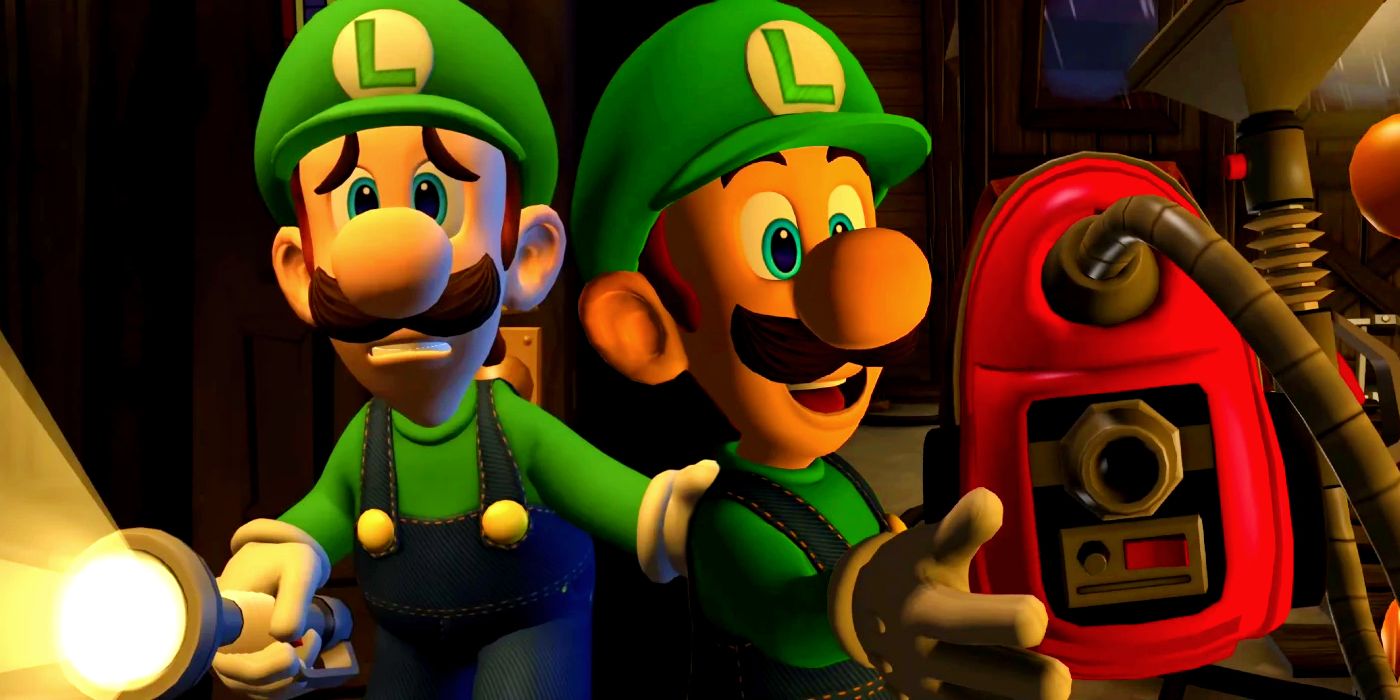
While the game's structure is a valid critique, it shouldn't overshadow the valuable features that Dark Moon brings to the Luigi’s Mansion series. Luigi’s trusty Poltergust 3000 is upgraded to the 5000 model vacuum, introducing significant enhancements. Most notably, the introduction of the Strobulb, which has become a staple in both Dark Moon and Luigi's Mansion 3. This added mechanic gives the gameplay more depth when vacuuming up phantoms. Additionally, the Dark-Light function has become an essential mechanic, allowing Luigi to reveal hidden doors and items. These added elements enhance the fun of the gameplay, becoming cornerstones of the series' identity.
Related Luigi’s Mansion Was Actually Inspired By This Ultra-Violent Horror Franchise Despite being very different in tone and gameplay, the original Luigi's Mansion is speculated to have been inspired by the first Resident Evil game.
At its core, Luigi's transformative series is a single-player experience, and it should always keep its primary single-player focus. However, Dark Moon introduced an endlessly entertaining multiplayer mode called ScareScraper (also known as Thrill Tower in some territories). Available for both local and online play, Dark Moon's multiplayer features various ways to enjoy the world of Luigi's Mansion with others: Hunter Mode, Rush Mode, Polterpup Mode, and an Endless Mode. These additions enhance the game's quality of life by offering players the best of both worlds, providing a compelling reason to engage with the game long after finishing the main story.
ScareScraper returned in Luigi's Mansion 3, though Dark Moon's sequel also introduced co-op to the main campaign.
Dark Moon Made The Luigi's Mansion Series Better Overall
It's More Than Deserving Of Its Remaster
Luigi’s Mansion 3 is generally considered the highest-rated game in the series, and that wouldn’t have been possible without the contributions of Dark Moon. Luigi's Mansion 3 returns to focusing on the exploration of a single environment, The Last Resort Hotel, while also retaining many of the mechanics introduced in Dark Moon. The choice to make each floor of the hotel its own level with a unique theme and boss is a clear evolution of the level design of Dark Moon. Mansion 3 combines the best elements of both its predecessors to create what is arguably the definitive Luigi’s Mansion game.
When Luigi’s Mansion 4 inevitably arrives, it is certain to retain many gameplay elements from Dark Moon. The game suffers slightly by straying from the explorative nature of the original, but Dark Moon was essential in making the series a Nintendo staple. It's important to remember that at the time Dark Moon was released, Nintendo was in a state of transition. The Wii U console was a failure for the company, and placing Dark Moon on the more popular 3DS handheld was the right choice. With the remaster coming soon, Luigi’s Mansion 2 HD can finally redeem the overlooked game.





COMMENTS