10 Best Anime Openings & Closings That Use Non-Japanese Songs to Incredible Effect
Summary Anime like Kaiju No. 8 use English songs to enhance their story and connect with international audiences in a meaningful way.
Songs by bands like OneRepublic, Scott Matthew, and Franz Ferdinand add depth and emotion to anime like Speed Grapher and Cyberpunk: Edgerunners.
English music in anime is carefully chosen to complement the tone and themes of the series, adding layers of complexity and nuance.
Some anime have such a strong image of their story that they can find songs outside Japan to express the vibes. While most shows naturally source their music from Japan, some stand out for having opening or ending credit sequences that utilize English, be it from whole bands, or individual singers lending their voices. Nonetheless, these pleasant surprises make these particular shows stand out all the more.
Given the medium's international popularity, it is reasonable to assume the use of English vocals is a gimmick to get that cross-border appeal. While this is certainly possible, especially for the anime streaming service Netflix bankrolled, many of the choices are actually well-considered and edited.
For anime fans in search of fascinating opening and closing credits, look no further than these following shows and their non-Japanese tunes.
Related Why Anime Music Plays Such an Important Role in Japanese Culture The combination of Japan's two most potent entertainment mediums is why anime music is essential to Japanese culture.
10 Kaiju No. 8
2024's newest anime comes with a wholly original English song
Close
Kaiju No. 8 (2024) Kafka Hibino, a disillusioned Kaiju corpse cleanup worker, dreams of joining the Defense Force that protects Japan from monstrous Kaiju attacks. His life takes a surreal turn when he becomes infected by a Kaiju parasite, granting him the power to transform into a Kaiju himself. Known as Kaiju No. 8, Kafka must navigate the dual life of a monster and a protector, facing enemies both human and Kaiju. Release Date April 13, 2024 Seasons 1 Streaming Service(s) Crunchyroll Franchise(s) Kaiju No. 8 Creator(s) Naoya Matsumoto
Spring 2024's action darling is Production I.G.'s Kaiju No. 8. Set in a world where Japan is under constant attack by the monstrous Kaiju, protagonist Kafka Hibino is stuck doing ignoble work as Kaiju corpse disposal after the Anti-Kaiju Defense Force saves the day. However, the exact day he finds the resolve to try and join the Force, a mysterious creature invades his body and turns him into a human-sized monster as well, forcing Kafka to keep his new identity secret among the people who would gladly blast him.
Besides the high production values, Kaiju No. 8 also has the distinction of having American band OneRepublic compose and perform Nobody specifically for the anime. The pop rock tune serves as an excellent release valve from the fast-paced action and comedy. The lyrics, especially the line "Nobody got you the way I do / Whatever demons you're fighting through", are an apt description for Kafka's situation, who may as well be dealing with a literal inner-demon. Nonetheless, the lighthearted song promises the hero that he will find a place to belong in the Anti-Kaiju Defense Force.
9 Ghost in the Shell: Stand Alone Complex
Cyberpunk cop drama emphasizes maturity with closing credits
Close
While the 1995 movie is best known for its mediative, philosophical pace, the two seasons of the Stand Alone Complex continuity focuses on world-building instead, depicting Section Nine's efforts to combat cyber-crimes and terrorism, even if it brushes against similar themes of identity amid mechanization. Nonetheless, its tone can still feel like a high-tech police procedural, with plenty of action scenes and conspiracies sitting side-by-side with twists that question human nature.
In keeping with this seriousness, both seasons make use of light rock songs: the first season had Lithium Flower, sung by Scott Matthew and written by Tim Jensen, while 2nd Gig ended on Living Inside the Shell, sung by Steve Conte and written by Shanti Snyder. The fact famed composer Yoko Kanno was involved shows the English lyrics were planned from the start. The two songs lend an air of maturity, furthering the idea that Stand Alone Complex is an adult drama, only differing in how its actors appear on screen.
8 Speed Grapher
Science thriller captures the sickness of hedonism with Duran Duran
Close
Gonzo's sadly underrated 2005 anime leaves quite an impression. Photographer Tatsumi Saiga, in search of a big scoop, infiltrates the secretive Roppongi Club, only to find himself captured and inadvertently granted superpowers that allow him to destroy anything he takes a picture of. After rescuing their so-called "goddess", the sheltered teenager Kagura, the two find themselves on the run from the Club's twisted members, who, like Tatsumi, have grotesque abilities based on their fetishes and obsessions.
As Tatsumi struggles with his powers, the anime made a perfect choice to have Duran Duran's Girls on Film for its opening credits. The song and its original music video grapples with the exploitative nature of photography and film, all of which perfectly resonates with Tatsumi's complicated relationship with his photographer's eye, which seeks and now literally creates violence for him. Sadly, licensing issues forced the evocative and timely song to be removed from overseas release, replacing it with the bland instrumental Shutter Speed.
7 Ergo Proxy
Mindbending post-apocalypse stays on track with Radiohead
Close
This twisting, turning sci-fi tale follows three characters: investigator Re-l Meyer, immigrant nobody Vincent Law, and rogue child-like android Pino. Amid various mysteries and an outbreak of malfunctioning androids caused by the Cogito virus, the three eventually join forces and make a long sojourn to the distant city Romdeau, while dealing with the mysterious creatures known as Proxies who hound them along the way.
Ergo Proxy, despite its simple description, can be a confounding, confusing experience that is stuffed with cultural references and tangled narrative threads. Vincent Law's own bizarre relationship to the Proxies is one ongoing mystery, and Manglobe chose to encapsulate all this with Radiohead's famous Paranoid Android, whose strange lyrics leave audiences unnerved all the way until the credits end, while the subtle repetitions of "I may be paranoid, but not an android" is appropriate for Ergo Proxy, with its layered mysteries and various forms of artificial life.
6 Cyberpunk: Edgerunners
Cleverly edited Franz Ferdinand song foreshadows anime's tragedy
Close
Cyberpunk: Edgerunners David Martinez (Kenichiro Ohashi) is a streetwise kid living in the slums of Night City in Cyberpunk: Edgerunners. To survive, David becomes an edgerunner, also known as cyberpunk, taking on mercenary jobs outside the system. Together with a group of new and veteran edgerunners, David will shoot for the moon to escape the underbelly of the increasingly cyber-obsessed city. Unfortunately, the law isn't the only group that the edgerunners will have to contend with, as other heavily cyber-augmented humans will pose an even more significant threat. Release Date September 13, 2022 Seasons 1 Network Netflix Streaming Service(s) Netflix Franchise(s) Cyberpunk
Based on both Mike Pondsmith's Cyberpunk tabletop game and CD Projekt Red's 2077 video game spin-off, Trigger's award-winning anime follows the exploits of David Martinez, who dreams of becoming a big-name "edgerunner" mercenary when he gets his hands on a military-grade cybernetic implant. However, things spiral out of control, leading to tragedy for both him and his team, once more revealing the dark underbelly of the corporatized Night City.
Appropriate to the image of rebellion and punk, the anime uses This Fffire by Franz Ferdinand. Its stripped-down guitar performance provides a rawness that fits the visuals of the opening, but some editing hides some clever foreshadowing: while the song is best known for its chorus "I'm gonna burn this city, burn this city", the anime reduces it to repetitions of "I burn". Despite David's pretensions of sticking it to the corporations, Franz Ferdinand shows that it is they, not he, who will be emerging unscathed.
5 Neon Genesis Evangelion
Fly Me to the Moon remains an iconic cover
Close
Neon Genesis Evangelion Created by Hideaki Anno First Film Neon Genesis Evangelion: Death & Rebirth TV Show(s) Neon Genesis Evangelion
Gainax's 1995 mecha show transformed the anime landscape for years. Its psychological, faux-symbolic vision of giant robots fighting alien invaders was a shock for audiences worldwide, especially when they found themselves following Shinji Ikari and the other pilots, who, rather than being daring heroic figures, were disturbed children at the mercy of dark conspiracies who see the invading Angels as an opportunity to further their own agendas. The end result was and still is a highly divisive product that either pushed anime's boundaries or is too in love with its shock and awe.
Nonetheless, Evangelion is unmistakable, least of all its infamous credits, which use a cover of Fly Me to the Moon. As the anime's narrative continued to get more bizarre and shocking, the jump to the calm and relaxing credits became even more jarring and surreal. Evangelion is often jokingly held up as an example of how anime seems to enjoy jumping from intense drama to peppy credits, but in this anime's case, it may be an intentional choice to keep audiences off guard.
4 Great Pretender
Namesake Freddy Mercury cover extends anime's theme of deceit
Close
Great Pretender Great Pretender is an action-crime comedy anime from Wit Studio and director Hiro Kaburagi. The series follows con-man Makoto Edamura as he fails to trick one of the most prolific thieves in the world, Laurent Thierry, who happens to control several mafia groups worldwide. To stay in his good graces, Makoto now must work Laurent's less-than-above-board jobs and keep himself alive. The series is broken up into different cases, introducing extra main characters in each one. Release Date June 2, 2020 Seasons 4 Streaming Service(s) Netflix Franchise(s) Great Pretender Writers Ryōta Kosawa Directors Hiro Kaburagi Expand
While Lupin the 3rd is the king of thieves in Japan, WIT Studio still made its own competent take on heisting. Great Pretender focuses on Makoto Edamura, a small-time thief who finds himself recruited, not entirely against his will, by master con artist Laurent Thierry, who takes Makoto and his other associates to rob corrupt and crooked figures in elaborate schemes around the world. While its focal character is Japanese, Thierry's team - and the plot - is truly international, which makes an English song a natural fit for its ending.
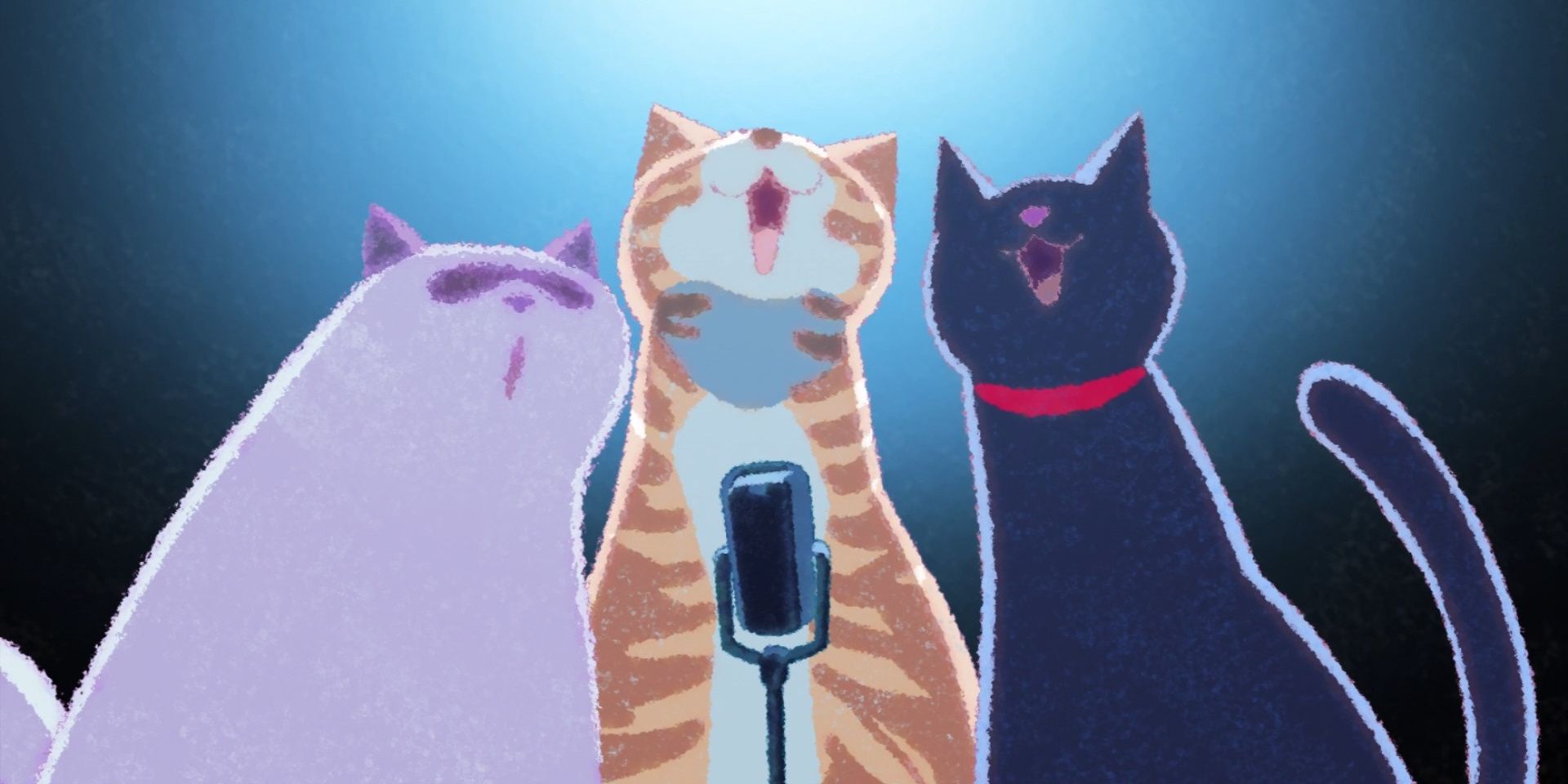
Great Pretender shares its name with The Great Pretender and even has its credits take cues from Freddy Mercury's music video, while the cats are purportedly styled after the singer's own pets. For an extra twist, Mercury's song is actually a cover of the original by the Platters. It's only appropriate that an anime about trickery uses a copy of a song, regardless of the singer's fame. The lyrics, likewise, meaningfully hint at the secret pains Thierry's gang hide under their loud exteriors like Mercury's powerful voice does with his song.
3 Super Crooks
Playful opening shows supervillains' confidence and style
Close
Based on an American comic book by Mark Millar, Studio BONES' Super Crooks is Ocean's 11 meets Marvel. Here, Johnny Bolt, a small-time crook, gathers a team of similarly under-the-radar powered individuals to pull off elaborate robberies while fending off both superheroes and supervillains who want to stamp him out. Ironically it left a bigger impression than the Jupiter's Legacy series it spun off from, which Netflix tried to turn into their own cinematic universe.
For the opening, Towa Tei composed Alpha, which is sung by Taprikk Sweezee. The energetic, R&B beat, which is timed to Johnny's team dancing, illustrates their self-assurance and clarity; their work is not couched in rage against injustice, but a love for criminality. While Johnny's chance at heroism has passed him by, the slow walk he takes while Alpha slows down with its outro hints at the menace he is willing to unleash now.
2 JoJo's Bizarre Adventure
Each anime ending is a prog-rock history tour
Close
Jojo's Bizarre Adventure Created by Hirohiko Araki TV Show(s) JoJo's Bizarre Adventure Character(s) Will A. Zeppeli , Jonathan Joestar , Giorno Giovanna , Jotaro Kujo , Joseph Joestar , Jolyne Cujoh , Johnny Joestar , Josuke Higashikata , Gyro Zeppeli Video Game(s) JoJo's Bizarre Adventure , JoJo's Bizarre Adventure: All Star Battle R
True to its name, David Production's adaptation of the long-running series brushes against all sorts of outlandish scenarios, all of which revolve around the members of the Joestar family, especially the ones whose names can be shortened to "JoJo". Across decades, these characters run into zombies, vampires, ghosts, cryptids, and all manner of pseudo-science that has so far only been limited by the original author's imagination.
Said author, Hirohiko Araki, has an open love for music, especially progressive rock, which was made apparent when one of his earliest characters was named after REO Speedwagon. To keep with the many musical references, David Productions has used foreign songs to close episodes, famously starting with Yes's Roundabout. Across the seasons, other choices reflect the era of each story, or the goals the heroes have, be it The Bangles' Walk Like an Egyptian reflecting Jotaro's journey to Cairo, or Savage Garden's I Want You capturing Diamond is Unbreakable's 1990s energy.
1 Gunslinger Girl
Alt-rock opening captures the anime's melancholy
Close
While its second season isn't regarded fondly, the first by Madhouse is considered another classic by the studio during its 2003 peak. This drama combines military, science, and political thriller elements, as seen through the lens of children turned into brainwashed, short-lived cyborgs who engage in secret missions to protect their country. The concept is played up for all its tragedy, as the anime explores the effects the girls have on each other and their handlers.
Appropriately, Madhouse looked for a solemn song to use for an opening, choosing The Light Before We Land by the Delgados. The echoing vocals lend an air of wistfulness, and the lyrics, which wonder about being able to find rest or feeling, perfectly describe the condition of Gunslinger Girl's young protagonists. The opening thus excellently conveys the show's tone, and while audiences are treated to action shots of the five girls firing their guns, even these only highlight the sadness that they have to use them at all.




COMMENTS