1 Stephen King Theory Completely Changes How You See His Books
Summary Overexposure vs. obscurity: King's Bag of Bones protagonist Mike reveals the perfect writer's pace is one book a year.
Writer's block solution: King might've used Mike's strategy to stash extra manuscripts from productive years.
Near-death trauma: King's accident was life-changing, revealing the true extent of the horror writer's perseverance.
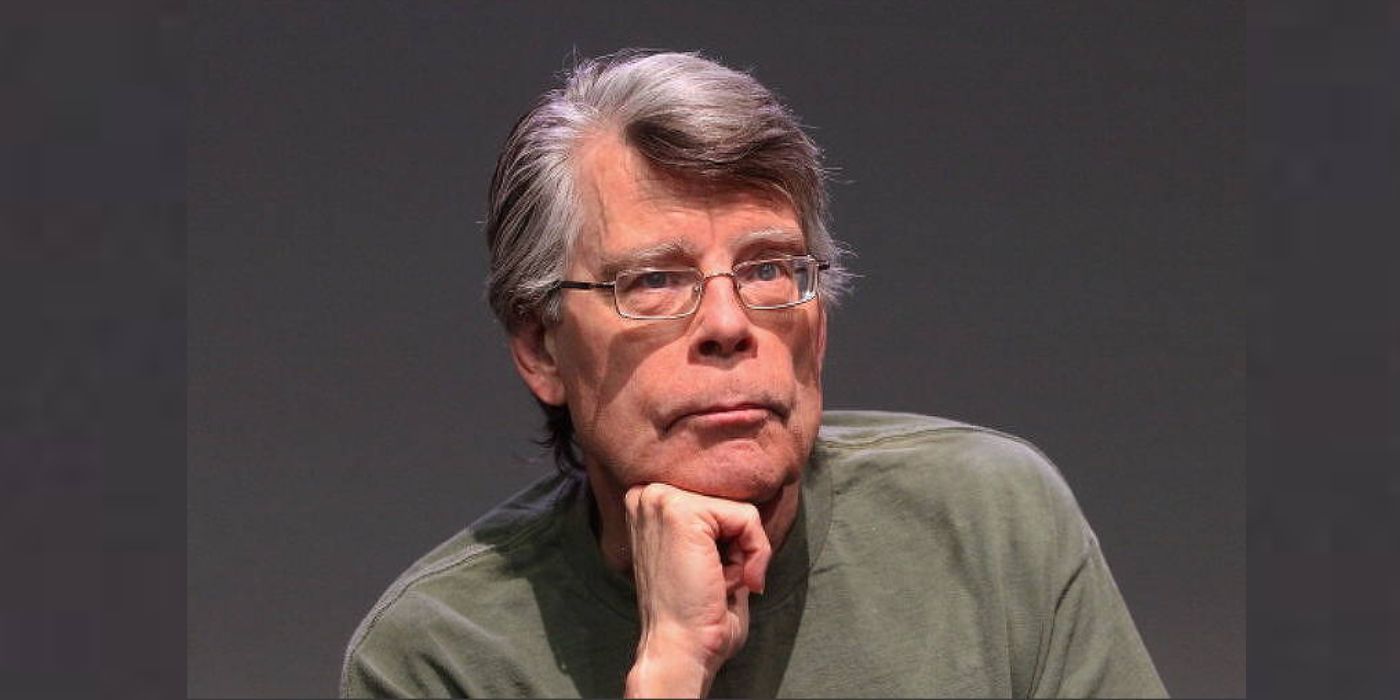
Stephen King is one of the world's most prolific writers, but a theory rooted in one of his novels entirely changes how a reader might view his books. He is arguably the most famous living writer, his name known around the world, his books becoming bestsellers in dozens of languages and Stephen King's villains becoming some of the most memorable in literature. Publishing trackers have estimated he's sold over 400 million books throughout his 50-year career, making him one of the most successful and widely-read authors in history.
His output is absolutely staggering. Since 1974, Stephen King has written 66 books (including under his pen name, Richard Bachman), 12 collections, 5 nonfiction books, 21 screenplays, and miscellaneous other pieces of writing while also consulting on the many, many TV and movie adaptations of his work. He's written so much that it's hard to believe there might ever have been or will be a time when the words weren't flowing and King struggled to write. A chapter from one of his older books, however, hints that he may indeed have struggled with writer's block, but had an ingenious way of dealing with it.
Related 11 Stephen King Short Stories That Are Begging For An Adaptation While there are plenty of Stephen King movies already, some of the author's best short stories still have no movie adaptations (and badly need them).
Bag Of Bones' Mike Noonan Has Been Hiding His Writer's Block
Mike Reveals A Truth About The Publishing Industry That He Exploits
In Stephen King's 1998 novel Bag of Bones, the protagonist Mike Noonan reveals an interesting confession that reads as far too specific not to be pulled from some sort of real-world truth. As a once-prolific writer, Mike hasn't been able to write a single paragraph in the four years since his wife died in a tragic accident. His publisher doesn't know, his editor doesn't know, and he's lied to himself for so long that he's almost become comfortable with his own writer's block. Mike reveals the optimal pace of publishing is to put out one book a year. Publish too often, and a writer becomes overexposed. Publish too infrequently, and writers are prone to forgetting about the writer. Thus, the sweet spot for editors and publishers is a pace of about one book a year.
Publish too often, and a writer becomes overexposed. Publish too infrequently, and writers are prone to forgetting about the writer.
Considering Mike hasn't been able to write in four years, one would think his bosses would have noticed that he hadn't been submitting anything new. However, Mike has been able to hide his profound writer's block thanks to the fact he had written so much before his wife's death that he sometimes averaged two written books every year, enabling him to publish one and store the other one. For the past four years, Mike has pulled out these backup manuscripts, polished them up, and sent them off to his editor as though they were brand-new ideas:
"The secret is simple, and I am not the only popular novelist in America who knows it – if the rumors are correct, Danielle Steel (to name just one) has been using the Noonan Formula for decades. You see, although I have published a book a year starting with Being Two in 1984, I wrote two books in four of those ten years, publishing one and ratholing the other."
It's a brilliant strategy, but Mike knows he can't keep it up forever – eventually, he will run out of manuscripts to pull out of his safe. Healing from the grief of his trauma - in his case, his wife's unexpected death - is his character's arc through Bag of Bones, but it's an interesting little nugget for King to include in the book.
Related 6 Most Controversial Moments In Stephen King Books Stephen King is one of horror’s most prolific authors. However, some controversial elements in his books still make them challenging reads today.
Stephen King Could Have Used This Same Technique
It Would Make A Fair Bit Of Sense
Close
Stephen King has been open about how often he pulls from his own life and experiences as a writer; it's not a coincidence that so many of his protagonists have also been writers. The very specific information Mike Noonan shares about the ideal publishing schedule is something that King himself would obviously know. Considering that, and that a few of King's books right around the time of his near-fatal accident felt more like King's B-sides than his usual stuff, it wouldn't be a stretch to think that King himself has employed Mike Noonan's trick in the past himself.
Looking back at King's bibliography shows many years – more than 20 – in which he published more than one book, with most of those years seeing one book written under his pseudonym Richard Bachman. In others, the other book was a collaboration with another writer, such as The Talisman (1984) or Black House (2001), both of which were collaborations with Peter Straub. There are a handful of years that found King publishing a whopping three novels, but, again, many of those were collaborations, counted as two-parters, or were written under his pseudonym. Despite his prodigious output, it's not common that more than one solo novel under the name of Stephen King came out per year.
Related 10 Stephen King Books That Are Way Scarier Than The Movie Many movies have tried traversing the chills from Stephen King's novels to the silver screen, but not all have been equally successful in this pursuit
All of the above doesn't even include his one-off short stories, short story collections, his novellas, or the partially-formed ideas that King has often talked about. With how much he writes, it's entirely likely that King had more than a few manuscripts squirreled away for a rainy day. It's absurd to think that King had writer's block for four straight years, as his protagonist did, but it wouldn't be at all surprising to learn that the King of Horror has pulled out old first-draft manuscripts and brushed them up to send to publishers from time to time; even the most creative fountains hit a low ebb from time to time. This would be especially understandable in the aftermath of his 1999 car accident, which almost took his life.
It's absurd to think that King had writer's block for four straight years, as his protagonist did, but it wouldn't be at all surprising to learn that the King of Horror has pulled out old first-draft manuscripts and brushed them up to send to publishers from time to time; even the most creative fountains hit a low ebb from time to time.
Stephen King Has Explained How Hard Writing Was In The Aftermath Of His Accident
The Accident Was Far Worse Than People Knew At The Time
Close
Similar to how no one knew how badly Mike Noonan was struggling after his wife's death, few outside those closest to Stephen King knew just how bad his accident was or how close he came to death. On June 19, 1999, King was on one of his walks - originally enough, it was because he had writer's block and found walking often helped him work out story tangles - when he was struck by a minivan driven by Bryan Edward Smith. Smith had been distracted by his dog, which was trying to get into a cooler. The result was his eyes weren't on the road when he hit Stephen King and sent the writer flying 14 feet through the air.
The trauma was so great that he only remembers the accident and its immediate aftermath in snippets. King's extensive injuries included a punctured and collapsed lung, a right leg so shattered doctors considered amputation, a broken hip, scalp lacerations, and more. At some point on the LifeFlight to Central Maine Medical Center, he had to get a chest tube inserted so he could breathe. His injuries were so bad that the EMT who worked on him at the scene didn't expect him to survive the ride to the hospital, King later wrote. (via The New Yorker)
It was before the internet and social media, and despite the severity of his injuries, quite a bit of it had been downplayed in the immediate aftermath of the incident. Likewise, only a handful of people knew how grueling King's recovery process was, including the torturous physical therapy he had to undergo to regain his functionality. King didn't publish another book for two years, and while he'd had two-year gaps before, it had always been after he'd published 2-3 books in the past year. He didn't even attempt writing again for five or six weeks after his accident - a lifetime for King. Even when he did write, it was torture, as he explained:
"That first session lasted an hour and forty minutes, by far the longest period I’d spent upright since being struck by Smith’s van. When it was over, I was dripping with sweat and almost too exhausted to sit up straight in my wheelchair. The pain in my hip was just short of apocalyptic. And the first five hundred words were uniquely terrifying—it was as if I’d never written anything before in my life. I stepped from one word to the next like a very old man finding his way across a stream on a zigzag line of wet stones."
Today, through various interviews and that excellent piece in The New Yorker, fans of Stephen King know just how close the world was to losing the King of Horror and all he wrote after that point. That includes some of the most important books in his vast bibliography, including the second half of The Dark Tower series, various collaborations with his sons, a sequel to The Shining, his foray into the crime drama genre, and more. If Stephen King ever did secretly lean on the Noonan Formula for a while, it clearly worked.






COMMENTS