Jon Chey & Ben Lee On Wild Bastards: What You Can Expect From Void Bastards' Hyped Sequel
Summary Wild Bastards expands on Void Bastards with persistent characters, unique fighting styles, and engaging relationships.
Players must strategically reunite 13 outlaws across various planets, managing bonds and feuds for optimal combat performance.
Six diverse environments provide different play experiences, offering strategic depth and engaging combat scenarios for players.
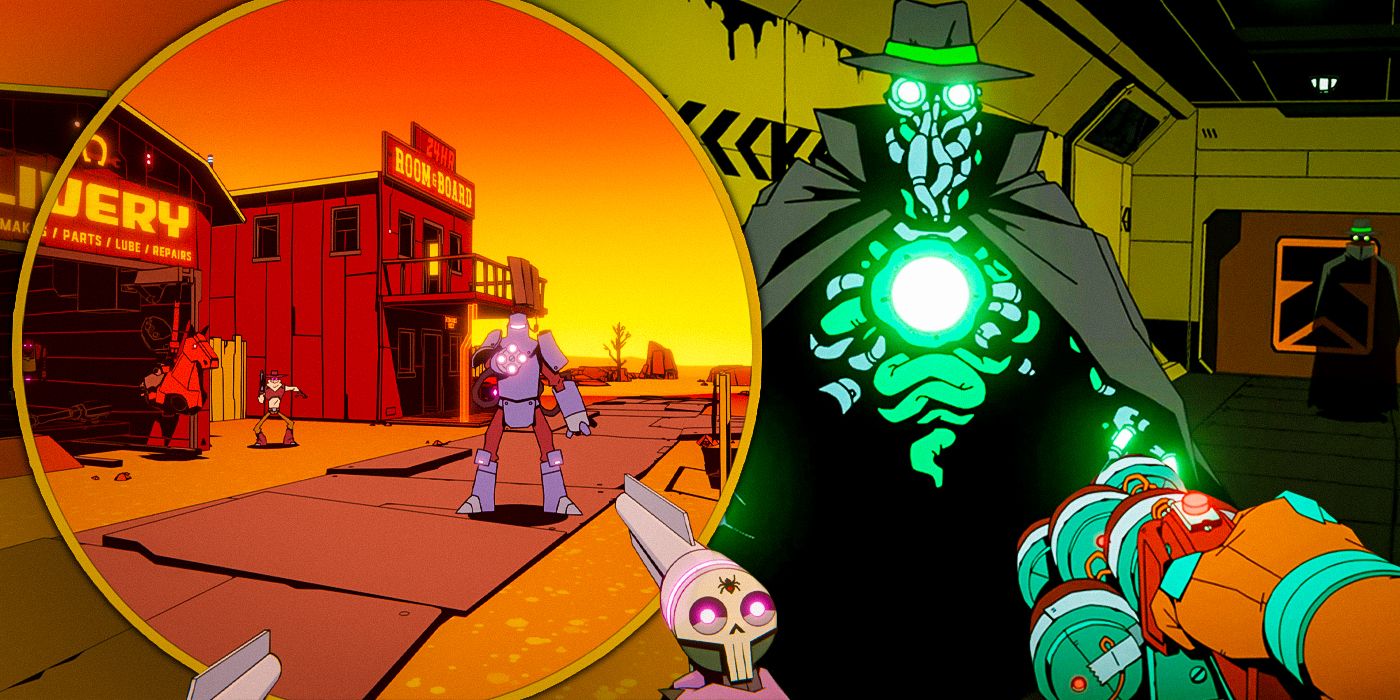
Wild Bastards is an upcoming sci-fi shooter that serves as a spiritual successor to 2019's Void Bastards. Both produced by developer Blue Manchu, this latest venture aims to expand upon the foundations of its beloved predecessor. It maintains the same unique animation style and some of the original mechanics, while adding more depth when it comes to strategy, characters, and environments.
Wild Bastards maintains some of Void Bastards' roguelite elements with inclusions like procedurally-generated environments, but player characters are no longer just disposable prisoners. Instead, players will be working to reunite a group of 13 outlaws scattered across different planets, while also gathering lots of loot along the way. Each of them possesses unique fighting styles, making team building before each mission take on a new element of strategy, and relationships formed between outlaws will impact their success when working together in combat.
Related Roguelike vs. Roguelite: What's the Difference? Roguelike and roguelite are interchangeably used to describe games with permadeath and procedurally generated maps, but there is a distinction.
Screen Rant interviewed Blue Manchu co-founders Jon Chey and Ben Lee - who also each serve as design director and creative director respectively on the new game - to discuss building upon Void Bastards, creating diverse and engaging environments, and what players can expect from Wild Bastards.
Your browser does not support the video tag.
The Transition From Void Bastards To Wild Bastards
Tackling New Environments, Characters, & Mechanics
Close
Screen Rant: The original Void Bastards was so cool in so many ways, and I think this new theme is a really exciting one. What made you guys want to go from a sort of sci-fi, spacey theme to a Western one?
Jon Chey: A lot of the direction for this game came out of wanting to do more character for the player. In Void Bastards, of course it was all about procedural generation and every character was different, but none of them were persistent. You couldn't really develop any kind of relationship with them. I think the starting point for this project was wanting to try to create characters that you could form a relationship with and get to know over time. The Western setting, I think, was actually a later development in the conception of the product. Is that your recollection Ben? Ben Lee: That's true. We didn't come up with the Western setting first for sure, but it partly came out of a discussion that we had about - we wanted to make the game have more tactical complex combat then Void Bastards had, because Void Bastards was slanted more towards the survival aspect than it really did the combat. There's combat in it, but it's not really about combat. You're fighting in corridors most of the time, so your options are fairly limited. We agreed that we wanted to do something where you had a bit more room to move and different tactical opportunities. We were talking about what sort of tactical situations would be good for that, especially with small groups of protagonists and enemies. I think Western gunfights suited what we were trying to do very well. It wasn't about armies, it was just about small groups of people, one or two people. Initially when we were developing the game, we were considering controlling more outlaws than you do with what we've narrowed it down to now. So the idea of a small but complex arena was what made me start thinking about, "Well, I think Western sort of film setups or Western situations are conducive to this." Jon Chey: But also a part of it is just that you've always wanted to do a Western game. Ben Lee: Well, I've got a big history with science fiction and Westerns and I like sci-fi Westerns and it would be cool and different. At the time we didn't want to just repeat Void Bastards with different combat, we wanted it to be a different feeling game. I wasn't very enthused about some of the other ideas that we had about what the theme should be. When we started going the Western direction and some of the other team members were on board with the idea of fighting in a little Western town rather than in a corridor, I got pretty excited about it because I've always wanted to do something like this.
What has it been like design-wise for the team to go from having, like you said, this very randomized cast of characters to having an established set of them. Both when you're creating these distinct personalities and distinct abilities, what is that like on your end?
Jon Chey: I think it's been a big challenge to adapt the way we're designing the game to the notion that these characters aren't disposable. The idea is that you're building back up your gang and you can have setbacks, but we don't integrate into the core game loop the idea that you're going to be dying constantly. I mean, these characters get injured, so they get knocked out for a period of time. But in Void Bastards, we took seriously the notion that the character you were playing was a disposable asset. I mean, that was part of the whole theme of the game is that you were one of an infinite number of prisoners who'd been dehydrated and stored on the ship and was brought back to life for a temporary and kind of unpleasant experience. Whereas here, we're telling a story that's a bit more optimistic and we don't contemplate starvation and running out of oxygen. And as Ben said, it's not really so much of a survival game as it is, I actually refer back - Ben Lee: I think it's quite strategic though. Jon Chey: It's strategic, but it makes me think a lot of a game that Ben and I worked on more than 20 years ago now, called Freedom Force, which was a team-based superhero comic book tactical RPG. It was a classic kind of superhero story about assembling a team of disparate individuals, all of whom have their own strengths and weaknesses and feuds and love interests, and getting them to work together to achieve a greater purpose. I think it's been, from a game mechanic point of view, it's been a challenge to adapt some of the ideas we had about a sort of a survival scene where the game is constantly grinding you down and you're struggling to stay afloat and stay alive, to a game that's more about progression and discovering the relationships and learning how to use these characters in the best way possible with each other. Definitely that change of focus has been a challenge. But also, I mean, as Ben was alluding to earlier, that's part of the point of what we're trying to do here is not just make Void Bastards 2, which where we could just reprise all the themes from the first one.
I know with these new established characters, there's also established relationships. I saw in the gameplay video that the trio who went out on the mission it showed had started to form bonds with each other and that kind of thing. Can you talk a little bit more about how that new system is going to work?
Jon Chey: Yeah, so there's what we call the pals and feud system. It has definitely been a challenge to figure out how to make this work in an interesting and effective way. But basically we represent it as a big ring with all the outlaws sitting around this ring, and they have a relationship with every other outlaw. The default is they're just sort of getting along, but they don't have any particular attachment. But they can also develop feuds or we call it pals when they like each other. And both of those things are very impactful on the game. Pals will actually help each other in combat. in all of the combats in this game, you control two outlaws at the same time, and one of them is active and the other one is off screen commenting on what's going on. But can also, if there a pal, they can automatically interject into the combat and do something to help the other one. They might throw out some pickups or weaken some enemies. The sort of help they provide. Is dependent on who the off screen outlaw is. It's a real advantage to take outlaws that have formed these bonds with each other into combat. The flip side is if they're feuding, they will refuse to work together, which seriously constrains what your choices are about which outlaws you take to a planet and how you match them up with each other. These relationships change over time. Some of those changes are a scripted part of the narrative. We know that Roswell and Spider Rosa have a beef with each other because they both consider themselves to be the natural leaders of the gang. So when you recover Roswell - this is just an example - he gets into an argument with Spider Rosa about who should be leading the gang and then they develop a feud and they won't work together. But the other changes to the system happen dynamically just as a result of playing the game. If outlaws work together a lot, they tend to develop feuds with each other. Conversely, if they help each other out in certain situations in the game, they can develop positive changes to their relationships. When outlaws beam down to the planet, sometimes they get scattered and they have to be retrieved by the other outlaws. If you do that for them, they react positively to that. Then the third aspect of this is that you also have a resource that you gather during the game called beans. You can use these beans to allow the outlaws to sit down and open a can of beans together, and this mends feuds or can induce outlaws to actually become pals with each other. It's quite a complex system and it sort of serves two roles. One is that obviously this is part of simulating a gang. A big part of managing a gang is managing the relationships of the people in the gang and trying to make sure that they get along. But also mechanistically, from a game design point of view, it helps us to mix up the players' choices about which outlaws they're going to use. So every time you go to a planet, you can choose which outlaws you want to send down there, and some of them might be injured and some of them might be tired. But another constraint is you may want to take an outlaw who is pals with one of the others because then they'll be helpful. You also have to deal with these constraints of, "I just can't take these people because they're feuding, so I have to choose one or the other." It really helps. In Void Bastards, we had ammunition supplies, so perhaps you wouldn't take a particular weapon because of running low on ammo, and this system is kind of analogous to that, but in a more complex sort of way.
Learning & Building Upon Past Design
Filling Out A Galaxy & Indulging In Creative Freedom
I know in this game there's six kinds of environments, which is such a stark contrast from being relegated to ship interiors. What has making that change been like, just from both an art and a gameplay standpoint? And can you reveal any of the types of environments that there will be?
Ben Lee: It's been six months of work. [Laughs] Jon Chey: [Laughs] It was quite a step forward. I mean, this whole game, instead of one character, we've done 13. Instead of one environment, we've done six, and I think instead of about 10 enemies, we've done 40. But I mean, part of that is because we've got better, we've figured out a lot of the problems and we understand how to do them. But part of it also is it took us a bit longer and we worked harder. Ben Lee: If you're going to visit different planets, it has to feel like you're going to different planets. That was our initial idea for the game was that you'd be going to different planets rather than little spaceships like you did on Void Bastard, so we sort of needed to do it. Jon Chey: But the other important part about it is we didn't just do it for cosmetic reasons. We tried to make sure that each planet type, each biome or environment or whatever has a different play impact. The environment you start out in is a desert, which is kind of the classic Western environment, and it has very long sight lines and not much cover and just little rocks and buildings and cactuses and so on. But then the next environment, the next planet type you go to is called Bayou. That's kind of like a swampy Louisiana, Southern American kind of environment. And it has big patches of poisonous water that you can't go into, so it constrains your movement. So immediately it's a very different type of play experience. Then it also has large areas of reeds, which you can't see through, but can move through. What that means is that your characters, your outlaws who are sort of shorter range and want to fight up close are better off in that environment. Conversely, the enemies who you fight, who rely on long range like sniping and so on, have a tough time in that environment. It means that you make different calculations about match-ups on the different planet types. We really wanted each one to play differently as well as look different. Ben Lee: To clarify, you don't play progressively in a linear fashion through all the environment types. Once the game opens up a bit, making the choice of which planet you want to go to with which outlaws you have available, and their feud states and everything, it's all part of the decision-making process. So if you had outlaws who were terrible at long range combat, that might push you to choose a planet type which was more suited to that than a desert or a swamp. It's completely nonlinear. Jon Chey: It's somewhat analogous to the different ship organizations we had in Void Bastards. But I think it's much more impactful than that, because there were differences between the different ships, but they were primarily in terms of what kind of loot you could get out of them. They kind of all played pretty similarly because they were all corridors in rooms and had maybe some different modules in them. But in this game there are definitely some of these environments that really change. That's kind of one of our major goals for the project, was to have a lot of variables that would impact the combat experience. The combat experience is kind of like which outlaws versus which enemies and which environment, at which time of day, in which weather conditions, which mods you've taken, and which aces you've upgraded. We're trying to create the biggest kind of possible spectrum of combat play experiences.
You mentioned just being better at things now based on things that you've learned. What do you feel like were the biggest lessons you guys took away from Void Bastards that have transferred really well into making this?
Ben Lee: Just practice. I know that's a boring answer, but all the things that we had to do in Wild Bastards, we had in some way done before. That wasn't the case when we made Void Bastards. I mean, Jon and I both had experience making first-person shooters in video games, but the exact combination of things that went into Void Bastards as a studio we hadn't tackled before. We had to get over a lot of hurdles and figure out how we were going to do it and how we were going to do it with the size of the team we have, given that it's an FPS and we're not a huge team. I think we brought all those lessons with us into Wild Bastards, and then we got a bit ambitious and wanted to make it - I don't want to say bigger. Jon Chey: It is bigger. Ben Lee: It ended up being a lot bigger. Jon Chey: It just happened. Ben Lee: We didn't say, "Let's make it bigger," but as we went along, we understood it was going to have to be bigger for it to work. Jon Chey: I think we did learn a lot. On VB, we spent quite a lot of time iterating, trying to figure out how to draw the world using this sort of faux hand-drawn line style with simple shading and lighting and make that look good and coherent. And that was in a way a piece of IP that we developed, that we know how to do really successfully now. We're obviously not the only people who do that, but we feel like we really have a handle on that particular way of creating worlds. Wild Bastards was a challenge because we had to apply it in a different context. Doing an open environment versus a corridor has actually required us to change a bunch of things. But I also think that all the stuff we learned from VB enabled us to do that much more quickly than we did on VB. Like VB, we had to spend a couple of years trying to figure out how to make that approach work. Whereas we knew it would work this time, but we had to just adapt it to - we wanted to do things like weather effects, and day night, and inside and outside and some light and shadows. Ben Lee: Just even seeing things as far away as you do in Wild Bastards, you didn't in Void Bastards, nothing was more than 100 feet away. That presented its own challenges, but that's what I mean by practice. We had to overcome some new challenges, but we've sort of already got the ground work done in Void Bastards. Jon Chey: I mean another one worth mentioning is that on VB, Ben hand drew every frame of every enemy sprite. That took him six months or a year or something. This game, we wanted to do more enemies and we wanted to have more animation. Like in VB, the enemies just kind of walk around and shoot, and in this game they can duck up and down and they can dodge and they have flying through the air animations and there's a lot more - Ben Lee: There's a lot more. Jon Chey: We kind of realized that we had to get some help with that, so we actually ended up outsourcing that work to an animation studio instead of making Ben sit there and draw them all himself.
That's crazy. I did not know that was just you.
Jon Chey: Yeah, Ben did a lot of drawing. Ben Lee: I drew everything. If it wasn't a 3-D model of the inside of the ship, I drew it in that game. Jon Chey: Luckily Ben likes drawing, because he does an awful lot of it. If he didn't like it would be a pain. Although you probably get sick of drawing animation frames, I'm guessing. That's not very creative. Ben Lee: I don't mind drawing animation frames, it's just when there's a lot of them, it's a big number to tackle. I drew a lot of things for Card Hunter, like 6,000 things or something, and that didn't really bother me either. But I think the trick with Card Hunter was because nobody told me I was going to - if you told me I was going to have to draw 6,000 things, I would've tried to come up with some way out of it. Jon Chey: We start with a hundred and then we go, "Oh, let's just do a hundred more." Ben Lee: But on Wild Bastards, we had a much clearer picture of what we were going to do ahead of time. The mountain was visible rather than being something you just churned through on a daily basis. I quite enjoy doing the animation. I mean, I was directing the animation here in Toronto with the contract team, and I do actually really enjoy it. I enjoy it more than I do making UI, that's for sure.
I know it's been, like you said, six times more work, but from an artistic standpoint, has it been nice to have way more freedom in terms of these environments that you're designing?
Ben Lee: I'd love to say yes, but it's just the problem with freedom versus constraints is that when you've got to work with a tight constraint, you have to be more resourceful, and it's sort of more engaging. When you've got a lot of freedom, the worst possible brief that Jon could give me - he's never done this - but the worst possible brief I could get would be, "Just do whatever you think is cool," because that's too much to try, it's too big. It was fun designing things that went into the spaces and thinking about how to make them look good and everything that goes with it, but it was a lot. It is not as fun as trying to squeeze the most you can out of a tight environment like we did in Void Bastards. The environments, I'd say, I didn't dislike it, but it felt like a huge task. What I would say though is the characters, because this is a more character-focused game, and we knew from the outset that we wanted a lot. But it was a finite number, we wanted X many outlaws. We wanted them to be unique and memorable. I got to design 13 different interesting characters. On Void Bastards, I couldn't really do that because generic was really the name of the game there. They had to be all sort of fitting into the same thing. They just had different faces, which you didn't even see unless you went and looked at the little profile. Designing a world where everybody is interchangeable is actually harder than designing specific things which are cool. I'd say in that way, Wild Bastards was actually really fun. It was very creatively satisfying coming up with not just the outlaws, but their weapons and their effects and their adaptations. We didn't really get to do that at all on Void Bastards. It was more about the enemies really, and the enemy ships, which were more clinical and less weird. Jon Chey: In Void Bastards, the enemies were more interesting than the player characters. I think one of my favorite things about Void Bastards is the enemy voices and they yell out all this crazy stuff. Which is a lot to do with Cara [Ellison]'s excellent narrative writing. But the player characters don't speak and have no personality because they're disposable. I'd say in Wild Bastards, the outlaws are more interesting than the enemies. I don't think the enemies are uninteresting, but you get to really spend time with the outlaws. Creatively, I think that's probably been the most satisfying part of the project is developing them.
The Future Of Wild Bastards
Biggest Highlights & What Fans Can Look Forward To
What new elements, in terms gameplay and story and that sort of thing, are you most excited to see players react to, that you'll think will be kind of the biggest hit with those who were fans of the first game?
Jon Chey: Well, I think the answer again is the outlaws. There are outlaws that I like and outlaws that I think are kind of mean. You can develop an attachment and a relationship to them. Referencing Freedom Force again, that's a game that I wouldn't be interested in going back and playing it again now. But I still think fondly about the characters from it. They're drawn in very broad strokes, but they come across as memorable people that you can develop some sort of relationship with. I think Jerry Hawkins did all the writing for the game, and he's developed these characters I think into - they're also quite broad in some ways. Ben Lee: They're archetypes to a degree. Jon Chey: They're archetypal, but they've all got a twist on the archetype. They're not just taken from Magnificent Seven and rebranded. They all have something unusual about them. I think my favorite character is Roswell, who's kind a stereotypical - he looks like a little green alien in a space suit. Given his name, there's an obvious kind of reference to stereotypical alien. But his personality is, how would you describe it, Ben? It's kind of like a cross between - Ben Lee: He's dry. [Laughs] Jon Chey: And someone who's a complete a**hole. [Laughs] He's very sarcastic, he thinks he's better than everybody else. Whether you are in the narrative or in combat, he has a way of kind of deflating the other characters who might be thinking about themselves in a serious kind of - he deflates a lot of their pretensions. He's got a lot of amusing lines, so I hope that players will find the outlaws as appealing as I do. Ben Lee: I like all of them. Now, when you work on a game for this long, you tend to have characters that hit or miss for you, even if you are the one who came up with them. But at the end, we're right at the end of making this game now and when I'm going through working on their portraits or whatever it is I'm doing, I don't really have a favorite and there aren't any I don't like, and that's quite unusual. I think other games, even Freedom Force, I would've had three or four characters I thought were my favorite ones because they were the funniest or they appealed to me the most, and a couple that were lower on my ladder of which ones do I like. But even though it's a game that we made, but I don't have a favorite or at least favorite, I like all of them as a group. You were mentioning Jerry before, that is in part due to Jerry, that he made them. We just gave him very, very broad overviews. This is what they can do, this is what they look like. We designed them visually before we started working with Jerry. But the whole personality and how they interact with each other was completely up to him. I think the way that he's created whole people amongst them, it really changes how I felt about them. I think they're all funny, and I think they're all interesting. Jon Chey: Yeah. They're all interesting, they all play differently too. We've been doing some pre-release play testing, and one of the things that I really love to read about is players' reactions to both of the personality of the characters, but also the kind of arguing about who's better and worse and who's overpowered and underpowered. It's been very positive, because you'll never balance 13 characters so that they're all equally as good as each other. In fact, you don't even want to do that. But I don't think we've created any total duds that people just don't think are useless. Ben Lee: All of them can be in the wrong situation, and all of them can be perfect in the right situation. Jon Chey: Some of them are real super specialists and shine in some situations and not others, and that's particularly interesting to me because sometimes you get feedback - we have had feedback that this character is way too weak. But then you can also get different feedback from other people about the same character saying, "I think this character's overpowered." That's when you kind of know you're doing it right, because people can discover how to use this outlaw successfully. Hopalong I think is probably the biggest, clearest example of that. He's a character who has a lasso and he whips it around enemies and captures them and then he can strangle them. At first it seems like a very weak weapon because it's quite short range, and you can only capture one enemy at a time, and while he's strangling them, other enemies can shoot you. It really leaves you very exposed. But over time you discover that his huge advantage is that while he's strangling somebody, they can't attack him. You can use him to - Ben Lee: And they also can't break free. Jon Chey: They can't break free, yeah. So you can use him to take down very, very powerful enemies. He's kind of like just a counter to these sort of boss-like enemies that you encounter occasionally. You can use him against big groups, but you have to sort of sneak around and capture them one at a time, and while you're strangling them, you can kind of maneuver them so they block the fire coming in from their compatriots. He can become extremely overpowered in some situations and then in other situations really hard to use effectively. That kind of character I'm really pleased about. It's always fun to read people's take on how good or bad they are.
Wild Bastards is slated for release some time in 2024.




COMMENTS