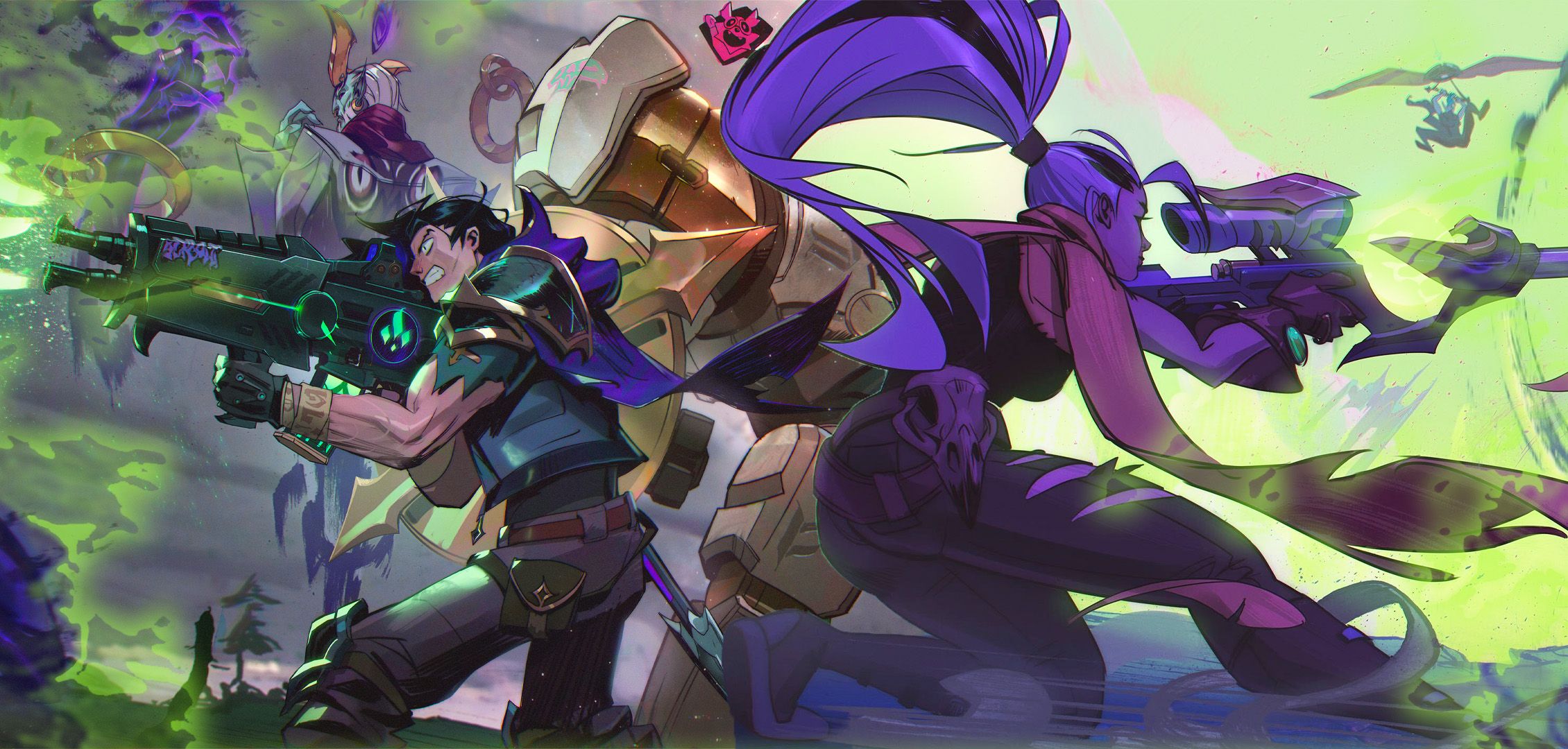
LoL's Influence On A 10,000 Hour Game - Joe Tung Discusses New PvP Title Project Loki
Summary Project Loki is a blend of genres like battle royale, sandbox, and strategy, aiming for constant player improvement.
The game's development team consists of industry veterans from popular franchises like League of Legends and Valorant.
The game's unique sandbox element uses physics to create emergent moments for enjoyable gameplay.
Upcoming squad-based shooter Project Loki is a fusion of gameplay elements spanning several genres made by a group of industry veterans. It's the debut title from Theorycraft Games, which boasts a team that's collectively worked on franchises like Apex Legends, Overwatch, and League of Legends. It was founded in part by developer Joe Tung, former executive vice president of the League franchise, with the goal of creating a title that fans could play for 10,000 hours.
The expansive background of those working at Theorycraft has undoubtedly influenced Project Loki's direction, drawing from a myriad of sources when it comes to incorporating things like PvP mechanics and emergent moments. A combination of battle royale, sandbox, and strategy, the squad-based battler aims to be a title in which players can constantly learn and improve through each match. Though more in-depth details like narrative, specific characters, and how the game's world will generate are still under wraps for now, June is slated to be a big month for Project Loki, featuring its largest and longest playtest yet.
Related 10 Best Battle Royale Games Of The Last Decade, Ranked From Fortnite to Tetris 99, these titles proved to be the best battle royale games of the last decade.
Screen Rant interviewed Theorycraft Games CEO Joe Tung to discuss how the studio first came together, the vision behind the game, and what sets Project Loki apart within the shooter landscape.
Your browser does not support the video tag.
The Beginning Founding Theorycraft Games
Building A Team & The Birth Of Project Loki
Close
Screen Rant: So first I would love to hear just a little bit about how the Theorycraft team first came together. What led to you guys making this new venture?
Joe Tung: Yeah, so I was at Riot for a long time. I led League of Legends for a few years there. Before that, I was at Bungie for a long time. I left Riot in October 2020, and we actually founded Theorycraft like a month later with the founding team. Pulled together what I think was one of the most incredible founding teams of that cohort of game startups at the time. I hadn't talked to my co-founders even about starting a new game until I had decided to leave Riot. It just came together incredibly quickly. I think certainly, there was a moment in time at the beginning of the pandemic where I think people were sort of thinking about what they wanted to do with their lives for the next 10 years. That was true for me as well, and I think true for my co-founders. There was also sort of the factor of timing and how incredibly good the fundraising environment was back then to start a game company. Those things certainly played a role in us deciding to go off and build Theorycraft. I think I could go on and on about this topic. There are lots of other reasons why we got together, but like I said, a month after I left, we had started the new company and we started building the game immediately and actually put the game in front of players less than a month or so into development.
So you as a team also automatically all had a very similar shared vision for the game?
Joe Tung: I think we had a lot of shared vision around the company and how we wanted to operate, things like building the game iteratively, getting it in front of players as quickly as possible, sort of building out in the open. I don't know if any of us thought that building out in the open would be as open as we've actually done it, but we certainly shared that. We shared the goals of wanting to be a small, super, super talent-dense team and move really quickly. Of course, all of that's relative to the places that we were all coming from. Many of us came from Riot, some of us came from Bungie and other studios. I think there are many, many, many wonderful things about operating at scale. It allows you to do things that you could never do otherwise, but certainly there are lots of challenges with operating at scale as well. I think everyone was super excited about, "Hey, what can we do as a small team? Can we keep the talent bar incredibly high? And can we move super-fast to get something out to players really quickly?" Everyone was really, really aligned on that. The game itself, I think we had a very, very clear and sharp strategy, I would say. Aspects of that strategy were we wanted to make a game that players could play for a really long time. We wanted to make an IP that was globally appealing. We wanted to make a game that served. I sort of think about the world in terms of player needs, and so we wanted to make a game that served the needs of mastery and belonging, because those games tend to be the games that you can play for years and years and years and years. We sort of had a very, very clear take on the strategy and the game itself went through a handful of iterations and then sort of quickly became what it is today.
And you mentioned there were a few iterations, and even what it is now, Project Loki is this really interesting blend of different genres it sounds like. Can you talk a little bit about how the team did land on that direction and what you feel really sets it apart in a landscape where hero shooters are fairly common?
Joe Tung: Yeah, like I said, we had this very clear strategy that we wanted to achieve as a company. That strategy, it's like those foam gutter things in the bowling alley -
Oh, the bumpers?
Joe Tung: Yeah, exactly. So we sort of had guidelines like that that the strategy was providing, but we could have gone many, many, many different directions. We could have tried to quickly make an existing genre and just sort of follow a genre with our take on it. We didn't want to do that, we wanted to make something new. If you look at our studio, it's like the studio was made in a lab to create competitive PvP games. We've got people from League of Legends, tons of people from VALORANT, tons of people from Overwatch and Halo and Destiny and so on. It's just baked into our DNA to do competitive PvP. I think we were always likely going to head in that direction, but if you ask people on the team who have known me a long time, they'll tell you that when the Battle Royale genre came out, and when PUBG actually came out, it was super, super influential, I think on me and many of the team members as just sort of came out of nowhere and created a genre out of nothing. I was leading League at the time and even talked to the team on League about, "Hey, is there anything we can do in this space?" There are attributes to the genre that are just really incredible. So something that I say about the Battle Royale is it's this incredible genre where losing doesn't feel as bad, but winning feels as good as it does in many other competitive games. It's really easy to play with friends of mixed skill levels, which is not true for other competitive games, and so certainly was really influenced by the emergence of that genre. Then, like I said, when the team got together and we had that strategy written in stone, we tried a few things and really quickly landed on the direction that we've ended up going in.
Project Loki's Gameplay
The New Shooter's World, Characters, & Sandbox Elements
And what can you tell me about the world that players will be playing in? It's entirely set up in the sky, right?
Joe Tung: It is, yeah. I don't know how much we're talking about the world just yet. It is entirely set in the sky. We do have a backstory, but I think we're sort of keeping it under wraps for now. I think the most important aspect of PvP from my perspective is that we make something that, like I said, is not just broadly appealing, but globally appealing. That's a really, really, really difficult challenge, and I think one that only a handful of games have ever cracked, League of Legends being one of them.
And this is probably another thing where you can't talk that much about it, but I'd love to hear anything you can reveal about the kind of roster that players will be seeing, and also just what it was like behind the scenes developing a cast of characters that feels unique in their personality and abilities.
Joe Tung: Well, I think for us, a gameplay-forward company, certainly the idea for a character can come from anywhere. It can come from a little nugget of a story or a really cool piece of concept art, but we're definitely a gameplay-forward company. That's sort of the thing that has to be there for the character to survive in the game. When it comes to making our characters, I think something that we talked about a lot was there are a lot of hero shooters out there. There's a lot of hero games with lots of different characters in them, and so we wanted to make sure that we had something new to say in that context. Something we would always say is we want players to look at our characters and say, "I can't believe this game is letting me do that. I can't believe this game is letting me go that far." There are a number of various aspects to the game that make that true, they're sort of underlying the characters. We've really, really invested deeply into what we call our sandbox, and that is sort of at the beating heart of what makes the characters allowed to provide just sort of a crazy experience for the player. It's also at the core of what differentiates Loki from many, many other games out there.
I would love to hear any minutiae you can get into about the sandbox element, because I can imagine so many different things when I hear "sandbox game" that I'm curious the direction that yours is going specifically.
Joe Tung: Yeah, maybe I'll start out by explaining that one of the biggest pivot points in the course of the project was in the beginning, I would say maybe for the first year or 18 months or something; the combat model was very MOBA-esque. You piloting your character felt similar to League of Legends or Dota 2, for example. Somewhere along the way, like I said, we've been playing with players from day one and taking their feedback. In one of the first big play tests that we did with players that weren't just our friends and family, we got a bunch of feedback about the game feel. We took a huge step back and realized we had to tackle just the feeling of moving around in the game from the ground up. We called this moment combat 2.0, and we just completely changed the combat model. That meant changing movement, it meant changing your abilities, the damage, projectile speeds, all the little things that make combat got revamped at this moment. We added physics to the game at this moment, and physics plays a huge role in not just how the game feels, but how it plays as well. In a game like League of Legends, when you press a button, your ability does a thing and you know exactly what that ability is going to do the first time and the 10,000th time that you press that button. Because we use physics, the game is less deterministic. There's a lot more emergent moments. There's a lot more emergent interactions between characters, character abilities, powers that we've got in the game. That's a whole big chunk of what we would call the sandbox. I think some of our players have called movement in Loki "schmovement." They've created a special name for it. That's something that we spent a lot of time on as well in the sandbox, just making sure that there's a lot of joy and agency and mastery in how it feels to move in the game, and I think that it's hard. It's hard to sort of get that from watching a video or seeing a screenshot, but when players play the game, it's almost always one of the things they cite as what feels awesome about Loki.
The Project Loki Difference
Setting The Shooter Apart & Making A 10,000-Hour Game
And obviously your past experience, what you've taken from that into this new project is very multifaceted. But I'm curious the lessons that you found from working at Riot and working at Bungie that have proved to be the most impactful so far on this new game.
Joe Tung: The first thing I did when we started the company was I wrote the culture page, which is on our website for the company. As I was writing it, I was like, "Wow, this is the distillation of 20 years of being in games and working a Bungie and working a Riot." Both the distillation of what I think works really well and all of the things that we want to avoid, all the things that I think don't work well - that's sort of my worldview is what's articulated in the culture. Some of the things that I think are just incredibly important to me are things that I've mentioned before. We wanted to be really small. We wanted to move really fast. We wanted to build out in the open, we wanted to get player feedback as quickly as possible. We wanted to build really iteratively. In order to do that, you have to have a team that is both experienced, but also they have to really be wanting to bet on themselves. They have to have an incredible amount of ambition and autonomy and drive. Then to top it all off, the fact that we're doing this remote and it started in the pandemic, that has a bunch of requirements as well when it comes to building the team and working the way that we work. The company and the game and the way we work, it's just all the culmination of those 20 years and thinking about what works and what doesn't.
And I know in terms of Theorycraft's core belief systems, as you mentioned, is making a 10,000-hour game. To you, what qualities make a game a 10,000-hour game? And why is that so important for you guys?
Joe Tung: I'll answer the second question first: it's important because I've had what seems to me like the rare experience of starting at Bungie, working on Halo, making $60 box products, having the $50 million plus marketing budget to sell as many copies as you can in the first 48 hours. I've had that experience. Then from there I went to League, which is not only a different genre, it's like a completely different business. The free to play games as a service business is totally different than, "Make a game, stick it in a box, sell it for $60, and sell as many copies as you can in the first 48 hours." Obviously - well, maybe not obviously - when I went from Bungie to Riot, I fell in love with the development model and the business model and everything about free to play games as a service. There's obviously big challenges with it, but from a developer perspective, the thing about the model that I love is it is aligned with making great choices on behalf of the player all the time. When you're making a $60 box product, that isn't always true. I fell in love with that entire way of doing things, and so obviously wanted to emulate that when we founded Theorycraft. In order for that model to make sense, you have to make a game that has incredible longevity. You can't build that model for your company if your game is a game that you play for 10 hours or 20 hours and never play again. Also, these are the types of games that as a studio, it's just in our DNA. These are the types of games we want to play. I've always been a hardcore competitive PvP player my entire life, and those are the games that I can form a lifestyle around. Those are games that I can attach to for years and years and years and thousands of hours. It's just baked into who we are and also happens to be the model that is required for us to succeed as a company. To answer the first part of your question, I think there are multiple paths to making games that you can play for 10,000 hours. Obviously, the MOBA genre or even competitive PvP, those aren't the only games that people can put 10,000 hours into. But if you want to make games that have sort of incredible longevity, you're either going down the path of creating a game that has an endless content need where you just have to crank out content week after week after week after week, or you are making a game where there's sort of an endless path of mastery in the form of playing other players. For all the reasons that I mentioned before, we're heavily biased towards the competitive PvP space because of who we are and what our expertise is, but also I just fundamentally think that is the engine of a game that can last 10,000 hours.




COMMENTS