When Diablo Immortal's Tempest Class Is Most Fun
Summary The Tempest Class in Diablo Immortal is unique, with narrative inspiration from ancient lore and gameplay based on elemental forces.
Art design for the Tempest Class was influenced by Art Nouveau and historical references, creating a fresh visual identity.
Challenges in developing the Tempest Class included creating a brand-new class in an unexplored niche, balancing emotional ties to existing classes, and delivering a unique yet iconic experience.
The new Tempest Class in Diablo Immortal is the eighth class to join the roster in this game. It is also a new class for the whole of the franchise, with nothing like it appearing in any of the Diablo games before this one. Blizzard Entertainment aims to make this class feel unique and fresh, while also maintaining the iconic depth and lore of the other classes in the franchise.
After the release of the new class for Diablo Immortal last year called the Blood Knight, the team set out to create another class that was on the opposite end of the light-and-dark spectrum. This class features new skills and abilities, as well as a lot of fluidity in its movement, which makes it mechanically unique. To add to that, the art team led by Emil Salim ensured that those mechanics would also have a unique visual aesthetic to go with them, while the team has set about creating sixty unique items for launch with more to come in the future.
Related How To Get Platinum in Diablo Immortal To participate in player-to-player trading via the Market in Diablo Immortal, adventurers will need to collect a currency known as Platinum.
Screen Rant interviewed Ryan Quinn, the Lead Narrative Designer, and Emil Salim, Lead Artist, from the Diablo Immortal team to learn more about the class's background and the thought process behind the development and design of the Tempest Class.
Creating The Tempest Class In Diablo Immortal
Origins and Narrative Of The Tempest
Close
Screen Rant: You talked [in the presentation] about how at the beginning of forming the Tempest Class, you wanted to go more light. Was there anything else that made you go in this direction specifically?
Ryan Quinn: Yeah, from a narrative perspective, but also a gameplay fuel perspective, I think when we were kicking around some early ideas for a wind and wave class, we had some concepts like the Sage, or the Siren. We had sort of an illusionist type of character, but they felt a little bit softer in impact. They were cool. But then we looked at the way that you play Immortal - which is, a large volume of monsters surrounding you, and you're trying to play Whack-A-Mole with as many of them as you can, as fast as you can. We aligned there on using elemental force, using this sort of hurricane force, all the fury of the wind and waves, and letting that kind of guide us as the chief venue of how the class interacts with enemies. Emil Salim: Yeah, I'm not from systems design, but I also know that really early on, we looked at all of the existing classes in the entire franchise, and we tried to find - "where is the sort of niche, the extra space, that we haven't explored yet?" That's eventually what led us to the Tempest.
So with that in mind, can you tell me about the writing process or the artistic process of creating a new narrative within existing lore?
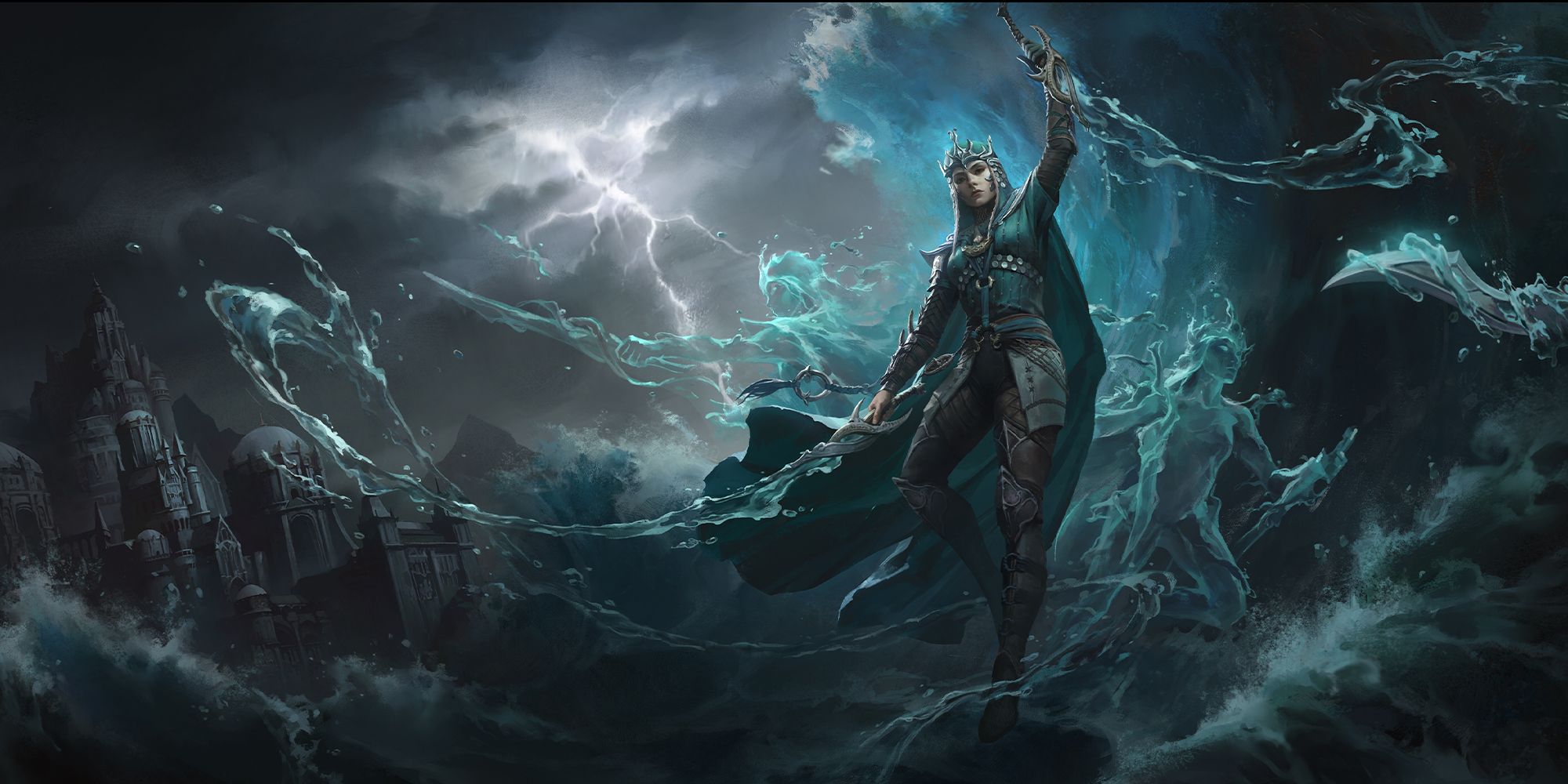
Ryan Quinn: On the writing side, I think for us, it was "look at the unused corners of the world." We looked at the Frozen Sea north of Arreat and said, "I wonder what's up there. We don't have much third party work, or extended universe stuff that goes there, we could really do something with that space. I bet it's really cold." But on the mysticism, and kind of metaplot side, we have this unused gem in our back pocket, which is the idea of the Nephalem. In Diablo Immortal, and in our timeline, recently, the Worldstone has been shattered. The Worldstone was used by an artist to kind of adjust all of humanity, and that's been broken. Now you, the player characters, are going around grinding the remaining pieces into dust. That made us feel like, "well, hey, if this has influenced the very soul, the very pillar of humanity, maybe hearkening back to some of this ancient Nephalem mythos, that would be a great direction to take a new class." That's kind of what inspired us to go there from the writing perspective. Emil Salim: Then it goes into art. So they will tell us what he just explained, that it is somewhat in the north, it is really, really cold. Then the systems designers will tell us this class will have something to do with water, and they can control water and wind. Then on the art side, we kind of took all of this information and it dictates our approach to the visuals. For instance, it is to be in a place that's very cold, very stormy, and there is a lot of rain, so we designed their gear to be waterproof - but they cannot be bulky, because under systems design, this is a very movement-based class, so they need to move fluidly around the battlefield. We designed them to be very lightweight so that they can move around easily. Color palette is another one that comes to us very early, because it is water and it makes sense to be teal and white as the main color that we start with. It is very different from any of the color palettes that we usually do, which is usually red, yellow, and black. We were a little bit nervous about that the entire time. Eventually, what helps is that when you are playing it in the game, they stand out very easily. If you are in Eternal Damnation, especially, everything is red and you can clearly see where the Tempest is.
Your browser does not support the video tag.
Was there any specific inspiration behind the class, writing-wise or art-wise?
Emil Salim: Art wise? Art Nouveau was one of the big ones for me personally. I did a trip to Prague, so I saw a lot of work by Mucha, and that was what kind of inspired me to incorporate a lot of Art Noveau. You've probably seen illustrations where the Tempest is standing in the center, and then there is this circular motif all around them. It is directly taken from a lot of Mucha's work from Art Nouveau. I will say that's one of the biggest influences. Ryan Quinn: Narratively, the Tempest was our chance to kind of comment on empire. The area that I look to the most for inspiration for the old empire, Pelghain, was largely Phoenicia. We were kind of ideating our early story and we said, "What if we took Carthage, and we transported it to Antarctica? What, and how, would that place build up?'"From there we got into this motif, and reading about how naval empire-style -ocracies kind of grow and expand their reach. We said, basically, "what if the chief architects of that empire had two very different perspectives on what they were here to do? And what was important? Was it the legacy of the human beings who were within your empire? Or was it the legacy of the history that you would create?" That's when, obviously, we deviate from historical Phoenicia and we start to make something new. Emil Salim: I remember we were discussing the architecture of our Cold Isles. Very, very early on, we made a decision that we wanted to keep it grounded in reality. I think [Ryan Quinn's team] kept telling us "No Atlantis! This is not Atlantis." So this is not an undersea world, and we very purposely did not go high fantasy. A lot of the architecture is actually based on Eastern Europe. That trip to Prague really inspired me a lot, not just the art movements, but also the architecture. I remember when we were designing the Tempest face, the headliner face, we took a lot of inspiration from Eleusis, so we looked at a lot of those facial features. But of course, not just copying it exactly. We took a lot of different features as well as combine them to create what the Tempest looks like. Ryan Quinn: One thing about these expansionist old empires is they're often a lot more cosmopolitan than we imagined them. People think about where they do television shows that depict Ancient Rome - it's just a bunch of Italian people. It's not really that historically accurate. I don't know that we have this ironclad duty to be perfectly historically accurate in our fantasy game about angels and demons, but I do think we get a little bit of extra verisimilitude when we decide to represent these societies as more cosmopolitan and as they expand, they take in culture from all over. If you look at some of the architecture that you'll see in the Cold Isles and a few of the traditions, some of that is borrowing from Xiansai, some of that is borrowing from the northern area cultures. And we imagine that these folks traded with Pelghain in the early, early, early years, millennia ago. Emil Salim: It also made sense, because we decided really, really early on that at its peak, Pelghain as an empire is not just trading, but also a center of knowledge. There's a lot of universities and stuff like that - places of learning that attract the best of the best minds from all over Sanctuary, which then dictates what they look like. They're supposed to be diverse because they come from a mix and match from all over Sanctuary.
Challenges and Comparisons
Building the Tempest Class To Be Unique
You mentioned in the presentation earlier that you said the special questline for the Tempest came out of a need from that not happening when the Blood Knight class released, was there anything else you took from that release to improve the release of this character class?
Ryan Quinn: I think when we come up with complex mythologies for a new class, it's tempting, because a lot of us have played multiple necromancers, multiple barbarians, to kind of come out the gate and go "Well, they should have the same density of worldbuilding as these classes that we've been playing and working on for the last 20 years." I think that can be a bit of a fallacy. I think for the Tempest, what we've tried to do is roll detail about the class out in stages. We want to give people enough at the launch of the class to excite them and for people who are really, really hungry for this information, we have flavor texts all over the items and equipment that people who want to dive deeper can dive deeper into it. But I also think there is always a risk of kind of overriding the putting of trying to do 20 years of worldbuilding in like six months. And so my thought, my big learning, from the Blood Knight was to stage the rollout of this thing. I know where I want the Tempest narrative to go. I know where I want the Cold Isles to develop. We're not going to put all of it into one single patch. There are many more releases of legendary gear and you have requested story art. Emil Salim: And we have done so much worldbuilding for the Tempest.
So if the Tempest is more like a pure-hearted Warrior Priest with this mission, do you think they have a specific weakness? Or if you could say they were blank-to-a-fault, what would you say?
Ryan Quinn: I'm gonna be really arch with that question. But I think the challenge with the Tempest - the biggest fault they have is they come from this really, really communalist society. It is so conform or die, because the environment they're in is super, super hard. They have broken away from that, and it's gonna leave you a little discombobulated. Every Tempest is going to be hearing the whispers of Pelghain's legacy in their ears as they go down, they go through the normal quest, the main questline of Diablo Immortal, and I think they kind of have two masters to serve to a certain degree. They've got to think about this charge that they've been given to uphold, but at the same time, you can't really go home again. Once you're in exile, once your people kick you out or say "we don't want you anymore." So the Tempest also has to forge a new life. If they're anything to a fault, it's - they're an exiles' exile. Emil Salim: And of course, when they moved to the mainland Sanctuary, they are now part of this whole complicated story going on.
Is there a favorite build that you guys have for the class?
Ryan Quinn: For me, it hinges a little bit more on specific items than a recommended build. I geek out about legendaries because I've been a fan of that sort of thing since the D&D arms and equipment guys. There's a legendary that I really like called Overflow that basically changes Vortex so that instead of you having to hit the button every time you want to blast a bunch of enemies, you hit the button once and then there are random geysers, random little waterspouts, that appear under enemies' feet and knock them off into the air. And I find that it's cool because you get to look awesome. But also, it's an opportunity to toy with your enemies, which to me is one of the great joys of playing Tempest. Anything where you can set up your little triangle kill zone and have you and your Zephyrs all throwing golf balls at Demons - that's just super fun for me. Emil Salim: I can't pick any favorites, from the art perspective. We work with everything. I can't pick between my babies.
So the Crusader Class is also a light class. What do you think is the biggest difference between the two?
Ryan Quinn: Well, the Crusader has this sort of holy or zealous charge, whereas the Tempest is a little bit more mystical in origin. They get their metaphysical power from inhaling the expired breath of this sort of godlike figure. At least, that's how they see it in their Creation Myth, whereas the Crusader is calling upon their inner light as a sort of heavenly power that resides in their soul, through the faith of Zakarum, which they believe resides in all people. That, in my mind, it's not just the narrative backdrop, it's also how we visualize them. The Crusader is heavy, heavy on the white and gold and the sort of classic, Inquisitor Paladin [look], and that kind of tone. Whereas the Tempest feels more elemental, more ecstatic almost, in the way that they channel their power. Emil Salim: Yeah, and that's one of the challenges for art really early on, is that we wanted to design a light-based class that is not holy. For us, it's like, we work on Diablo, either angels or demons. Now we cannot use any demonic elements, we also cannot use any angelic elements. So that's why, for the Tempest, we hope we've created something that is new. How we do it for individual styles is, we looked at history, we looked at a lot of patterns, Celtic patterns, Art Nouveau, different art movements - we looked at visual elements that other people have done throughout history. Then we take those pieces and try to combine them together. The key for us is not to create something that is brand new to the point that players don't have anything visual they can tap into. That's what we took from history so that it feels familiar enough to you that you can relate to it, that the combination of the different elements is what gives you that fresh, new feeling.
What is the biggest challenge you faced when making the Tempest?
Emil Salim: I think on the art side, it is so new, and it is not based on an existing class. It also sets into that niche of that area that we have not explored, compared to all the other classes in Diablo. So from that perspective, we didn't really have anything existing that we could tap into. We really had to create something brand new, so that was a big challenge. Ryan Quinn: There's an emotional challenge when you are making a brand new class after launching a game with six classes that people have been playing for a long time that they're very familiar with. The biggest challenge for me, I think, there's just an emotional one - can the Tempest, like the Blood Knight, hang with the Necromancer and the Demon Hunter? That was the thing we constantly had to remind ourselves. If we strike the balance, if we do something that is equal parts new and familiar to your point, that feels iconic, but it's got enough of its own identity that people can look at and go, oh, that's kind of weird. That's kind of different. I want to try that. Then we succeeded.
Diablo Immortal's Tempest Class will be released on May 23rd on all platforms, with a new short story giving more depth on the background of the class releasing on May 21st.






COMMENTS