10 Iconic Star Wars Sound Effects & How They Were Created
Summary Lightsabers' iconic sound: interlocking motors hum, enhanced by old TV tube noise and dry ice clashing. Actor's favorite!
AT-AT march: stamping feet are metal shearing machines, rhythmic engine sound from an oil derrick. TIE Fighters are just elephants!
Wookiee speech made of 4 bears, lion, badger, and walrus. R2-D2's voice required a year of work and experimentation - a real performance!
How were some of the most memorable and iconic sounds in the Star Wars original trilogy made? We tend to underestimate the importance of sound effects when making movies, but the best sound engineers spend months and perhaps even years looking for just the right sound. When George Lucas began work on the Star Wars original trilogy, he hired some real trailblazers - including sound engineer Ben Burtt. Since then, Burtt and his team have constantly done the rounds, revealing secrets of their stunning sound effects.
Fans may often wonder how lightsabers work, but how was the unforgettable sound of the lightsaber created? Where do the ominous background noises of the Death Star come from? Here's a guide to some of the most iconic sound effects in the Star Wars original trilogy, from TIE Fighters to Wookiee roars.
Related Star Wars Movies In Order: How To Watch Release Order, Chronologically & With The TV Shows What's the best way to watch Star Wars? Here's everything you need to know to watch in release or timeline order, and how to include the TV shows.
10 The AT-AT Walking
Sound designer Ben Burtt put himself in the line of fire - literally
Your browser does not support the video tag.
Who can forget the intimidating sound of the AT-AT marching across the frozen wasteland of Hoth? There are actually two components here, though; the rhythmic sound of the engines and the stamping of the feet. Both were recorded by sound engineer Randy Thom. As Burtt explained in an interview with StarWars.com:
"There was the stamping of the feet and the rhythmic sound of the engines, and that really came from two different sources. I think Randy [Thom] recorded the elements for both. One were the metal shearing machines [at an Oakland factory]... a place where a sheet of metal comes down a conveyor belt and then it would get stamped, knocked into different shapes, or embossed with a pattern. It ]made] a big stamp. And Randy started recording those, and we sent him back a second time. There was a nice variation of heavy stamping that had some clickety-clacks to it….The other element on the walkers which is running constantly is an oil derrick pumping."
The weight of the foot was created by recording the sound of exploding artillery shells at a shooting range in Oklahoma. Burtt settled in a trench near the target, and recorded actual high explosive shells as they were fired. It must have been an incredible experience.
9 Blaster Fire
The most unlikely origin story of all?
Your browser does not support the video tag.
Star Wars' blasters are among the most memorable sound effects, and they essentially set the pattern for almost all science-fiction movies and shows afterwards. Burtt was inspired by a hike in Pennsylvania on a vacation during the early stages of production, and he walked beneath a radio tower with large guy wires. His pack caught on a guy wire, making a twanging sound, and he felt it was otherworldly enough to work as a laser sound.
Returning to Los Angeles, he explored the area, banging on guy wires until he found a sound he liked. The sound effects were ultimately recorded at a radio tower out in the Mohave desert, at a small radio station with a broken-down tower next to it. There was one unprotected cable that twanged in the way he liked, and it became the basic sound for all blasters.
Related Han Solo's Blaster Apparently Uses The FORCE (Seriously) Star Wars has revealed some blasters are blessed by the Force - and it's likely Han Solo's is one of them. So much for a hokey religion--!
8 Jawas
How a real language influenced Star Wars
Your browser does not support the video tag.
Jawas have been part of Star Wars since the beginning, and their speech is inspired by recordings of Zulu speech patterns. They became the prototype for how Star Wars developed alien languages and alien voices; Burtt listened to tapes from around the world, and he sampled real languages that sounded unusual but came with unique historic and cultural details that helped shape them.
This has always been one of the most fascinating differences between Star Wars and Star Trek, which is notable for its universal translator. That device serves as a unifying influence, preventing communication problems - a major theme in Star Trek: Discovery season 4 - but Lucas envisioned a galaxy where individual races were much more separate and distinct. Those iconic Jawa sounds have remained part of Star Wars to this day, playing a major role in The Mandalorian and The Book of Boba Fett.
7 The Tauntaun In The Empire Strikes Back
Alas, the poor Tauntaun
Your browser does not support the video tag.
Celebrating the 40th anniversary of The Empire Strikes Back in 2020, Ben Burtt dredged up his old notes for an interview on the official Star Wars website. Checking through, he found scribbled notes recording the origin of the Tauntaun - an Asian Sea Otter recorded at a game farm to the south of San Francisco. "The sea otter had a very high-pitched squawking and the nice thing about it was that it almost sounded like it was talking," he explained.
The sound wasn't quite perfect; Burtt played around with it a little, slowing it down to create the distinctive Tauntaun. Amusingly, as he rifled through the notes, Burtt found that he'd named the sea otter - "Mota" - but he'd neglected to jot down the exact location. "What kinda notes are these, Ben?!" he quipped. That secret, it seems, is lost in the mists of time.
6 The Death Star Background Sounds
The ominous presence of the Death Star explained
Your browser does not support the video tag.
There's a low rumble, a rhythmic pounding whenever the first Star Wars movie visits the Death Star. That was a deliberate decision, an attempt to create an artificial heartbeat that made it sound like it was almost alive - and powerful. The pervasive background sound is so easy to miss, but it results in a sense of oppression and intimidation, just as Ben Burtt had hoped.
The klaxon on the Death Star is believed to be an old klaxon from the British Navy, which probably meant the sound was rather more familiar to some original viewers than it would be today. Many other sounds were recorded at Mount Palomar Observatory, with Burtt recording the motors that rotated the telescope and shutters - in what he described as a "huge, echoey space."
5 TIE Fighters
Wait, ELEPHANTS?
Your browser does not support the video tag.
Space may be a vacuum, but Star Wars ignore real-world physics by putting sound effects in space. Lucas didn't mind; as far as he was concerned, this was science-fantasy and not science-fiction. Because Lucasfilm was working with Fox, the studio had access to an impressive library of sounds, and Burtt's team raided it for inspiration for the TIE Fighters.
Incredibly, the TIE Fighters aren't ships or planes at all. They're actually from old recordings of elephants stampeding, which seems the most unlikely idea but works surprisingly well. Those recordings were sped up or slowed down a little, and then mixed with the sound of a car driving on wet pavement. Such combinations are a true measure of the genius of Burtt and his team, their ability to blend the most unlikely sounds together so well.
Related All 23 TIE Fighter Models & Variants In Canon The standard TIE Fighter in Star Wars has several variations and models with an array of different capabilities in the galaxy far, far away.
4 Wookiee Roars
George Lucas' foundation sound
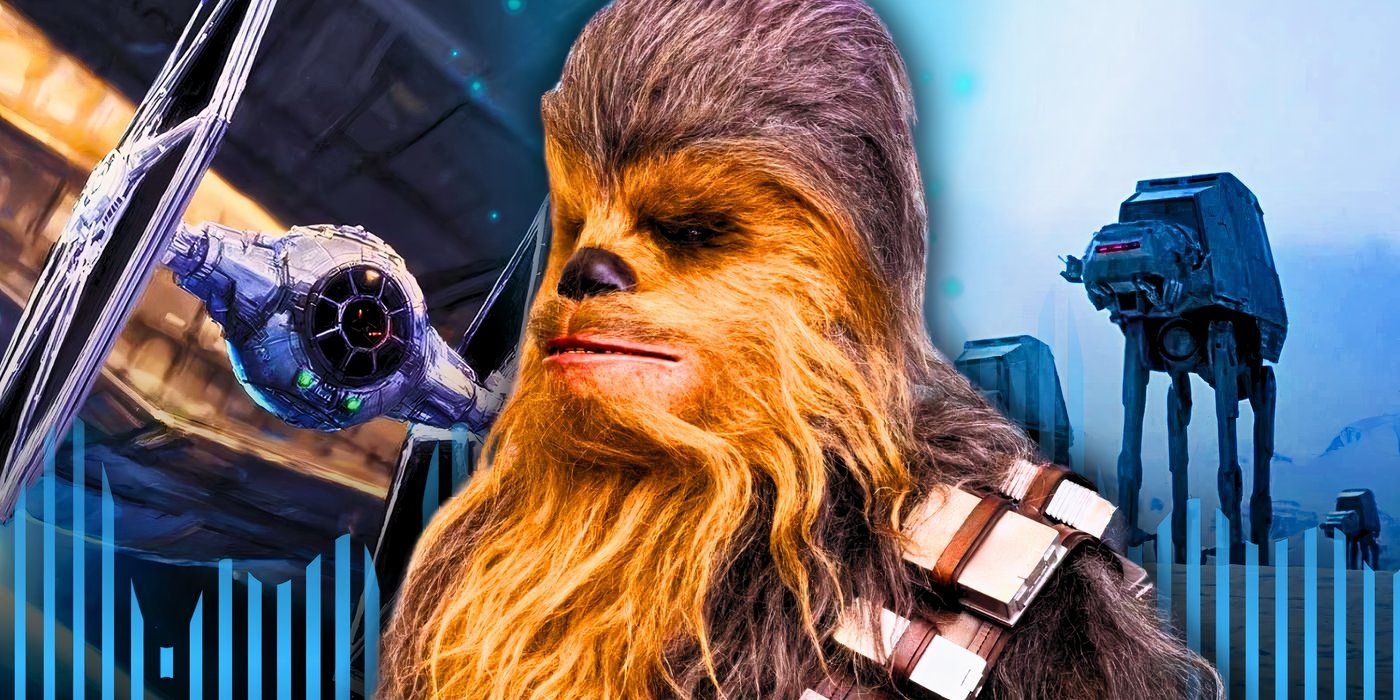
"I knew the sound was part of the foundation of what the movie was going to be," George Lucas observed in an interview released in Midge Costin's Making Waves: The Art of Cinematic Sound. In the end, Wookiee speech became a blend of recordings from four bears, a badger, a lion, a seal, and a walrus from Long Beach. The problem, according to Ben Burtt, was the need to create a sound that could believably come from a mouth like Chewbacca's.
Burtt wandered around obtaining recordings of different creatures, looking for anything that felt right. "Out of all these recordings you could extract little bits of sound, little grunts, moans, and ughs and arghs and purring sounds, whatever it might be. I collected and put all on one tape all these sounds that had emotional feelings associated with them," Burtt explained in one production video. "I had these categories of little sounds that each had an emotional tone associated with it. I began cutting those together to get a sense of speech out of Chewy."
3 R2-D2's Wonderful "Speech"
Why Star Wars' beloved droid took a year of hard work
Your browser does not support the video tag.
The "voice" of R2-D2 was Ben Burtt's hardest task - and took about a year of work and experimentation. For Burtt, the core problem was that this involved a performance, meaning he wanted the sounds to evoke a sense of character. Unlike Chewbacca, there was no moving mouth to match the sounds to, meaning viewers would engage with R2-D2 purely from his sounds.
George Lucas' script described R2-D2 as beeping, buzzing, and whistling, and it was clear that these sounds were supposed to be conversational - especially with C-3PO. Lucas himself toyed with the idea of a baby's cooing, but in the end Burtt hit upon it by playing notes on a keyboard and making vocalizations as he played; he combined his voice with the synthesizer, playing the sounds out on speakers and re-recording them so they had the quality of being in a real place and felt natural.
2 Darth Vader's Breathing
How Peter Pan inspired Star Wars' most iconic villain
Your browser does not support the video tag.
Darth Vader's breathing is one of the most iconic sound effects in Star Wars history - so much so that Star Wars: Episode I - The Phantom Menace's post-credits basically play that sound. The script described Darth Vader's life support suit, and Burtt thought about the ticking of the crocodile in Peter Pan when he was originally designing this. He wanted there to be a sound that told viewers Darth Vader was present, and considered beeping and clicking from the life support.
This proved to be too much, and Burtt reduced it to just the breathing. This was Burtt himself, recorded at a local scuba shop when he breathed into different tanks. He placed a recorder inside the regulators, close to the valves, and it was slightly slowed down from the original recording for effect.
1 Lightsaber Sound Effects
The sound that defines Star Wars
The lightsaber sound is one of the most famous in Star Wars. Even actors are unable to resist making the humming sound when they pick up a lightsaber - it's even caused problems with filming. They are the brainchild of Ben Burtt, who put them ahead of his tasks to create voices for R2-D2 and Chewbacca. He was wise to do so, because the lightsabers have proved to be the key to Star Wars' popularity.
The main noise is the hum of interlocking motors. But this is complemented by the strange humming noise made when Burtt moved a microphone close to an old television set's picture tube. This was then played through a loudspeaker, with Burtt swinging the microphone near to the picture tube. The clashing sound of lightsabers striking one another comes from another addition, a mix of a stick being forced into dry ice and a vacuum cleaner.




COMMENTS