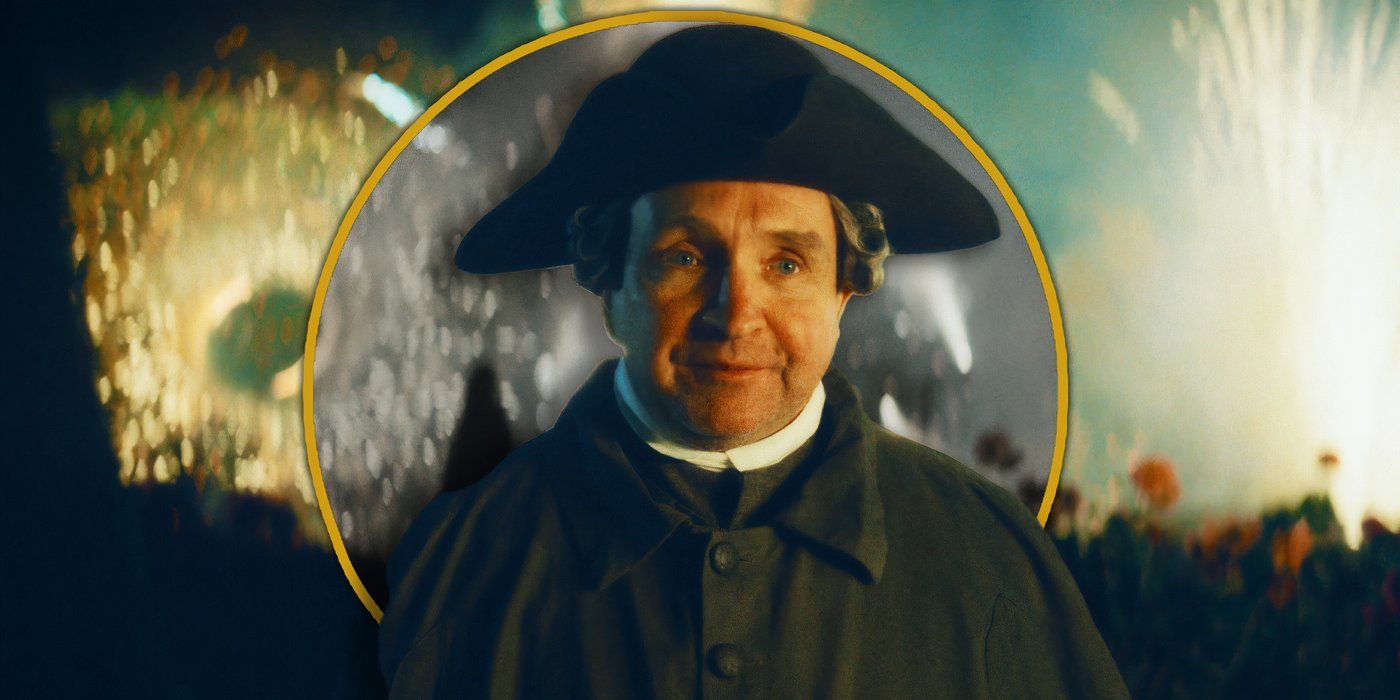
Eddie Marsan On Playing The “Pain In The Butt” John Adams On Franklin
Summary Screen Rant interviewed Eddie Marsan on playing John Adams in the Apple TV+ miniseries Franklin.
Marsan takes on the role sixteen years after auditioning for the same writer for the 2008 John Adams HBO miniseries.
The dynamic between Franklin and Adams comes to life on screen, showcasing complex characters striving toward a common goal.
The Apple TV+ series Franklin is an eight-part look into a key moment in American history and the life of one of its most consequential founding fathers. Michael Douglas stars as Benjamin Franklin alongside a cast which includes Noah Jupe as Temple Franklin, Daniel Mays as Edward Bancroft, and Ludivine Sagnier as Madame Anne-Louise Brillon. Largely set in France, Franklin details the founding father’s attempt to win the support of the French in the colonies’ fight against the British.
Douglas isn’t the only person playing a Founding Father in the series, as Franklin’s cast of characters also includes John Jay and John Adams. The latter is played by Eddie Marsan, known for a range of roles including parts in Back to Black, Edgar Wright’s The World’s End, and Guy Ritchie’s Sherlock Holmes series. Marsan came to the role in an interesting way—he auditioned for the 2008 HBO miniseries John Adams, which was created and written by Franklin writer Kirk Ellis. Ellis, struck by Marsan’s audition, invited the actor to play Adams sixteen years later.
Related Franklin Review: Michael Douglas Is Pivotal To Apple TV+'s Brilliant, Powerful Historical Drama Franklin navigates the story of America's journey into independence with a talented cast and a contemporary feel despite the period setting.
Screen Rant interviewed Eddie Marsan about his work on Franklin, his favorite onscreen argument with Michael Douglas, and more.
Eddie Marsan Says His Return To John Adams Is A Life Lesson
Screen Rant: I was amazed to find out that you were offered this role because you auditioned for the 2008 miniseries. I’m sure it hurts in the moment to not get something—how did it feel for the role to return to you?
Eddie Marsan: I think it's a great lesson of life that if you give 100%, it will come back in some shape or form. Just don't dictate how it comes back—it comes back when you least expect it. Acting is quite often like that. Sometimes you do a film and you think it's going to have massive repercussions, and it doesn't. [Then,] in retrospect, five or six years down the line, somebody saw it and they want you to do this. Paul Giamatti is a very good friend of mine. I think he was brilliant in the part. Kirk Ellis wrote to me and [asked if I’d] play Franklin now, opposite Michael Douglas, directed by Tim Van Patten, and I thought I got a good deal, to be honest. Six months in Paris, as well.
John Adams Is A Noble, Vain “Pain In The Butt”
You’ve played many contemporary Americans, and you’ve obviously played plenty of characters from the UK. Where do you find the sweet spot in terms of playing an American who begins his life as a British subject?
Eddie Marsan: The great thing about John Adams was that he was a man of such integrity, really. He came into prominence because he actually—in a court of law—defended a dozen British soldiers who were accused of killing people in the Boston Massacre. He thought that they needed a good defense, and he defended them. I always thought that that was a man of integrity, really. He's not really a man defined by where he comes from. He's more of a man who's defined by what he does. He's such a noble man. I think he's a bit of a pain in the butt, to be honest with you, because when we were making the series, Howard Korder and Kirk Ellis—the writers—said to me, "What you've got to remember about John Adams is, he's always right. Everything he says to Franklin is right, but he's a pain in the ass." And that's true, and I think that's how I played him.
One of my favorite parts of the series is the beginning of episode five. Adams is not very good at French, he says he doesn’t like music, he’s angry, and it seems as though there’s almost nothing redeeming about him. What was the first thing you could relate to so you could play him from a compassionate point of view?
Eddie Marsan: the vanity really, because I'm very vain. There's a vanity in me that's similar to vanity in Adams. When he's practicing the French and he's trying to be cool but he's not quite getting it right—that's me to a T. I'm always surrounded by really, really attractive leading men, and I think I sometimes get the job because I make them look better. There's an element of Adams that is similar to that in his relationship with Franklin. Franklin is effortless. Franklin is a great seducer, and Adams is not. Adams is like a blunt instrument, and that's similar to me in many ways, I think. So, that was my way into it. If Franklin was the libertarian, then Adams was the puritan.
On Working With Michael Douglas & The Most Beautiful Scene He’s Ever Performed
All of your scenes with Michael Douglas are so fun to watch, but did you have a favorite onscreen argument with him?
Eddie Marsan: The scene where Adams tells him why he hates him so much and lists what he hates about him, but then tells him, "But the one thing I wouldn't accuse you of is treason." I think it's probably the most beautifully written scene I've ever performed. I think it's an amazing scene because it sums up two men who completely disagree with each other but, because they're serving a greater good, they trust each other. They can disagree gracefully because they disagree with how to achieve the same end. I thought the writing in that was just amazing.
I imagine your relationship with Michael Douglas is different from [Adams and Franklin]. How is it to actually shoot those scenes together? How long does it take, and how much do you do back and forth in figuring it out?
Eddie Marsan: Michael is an incredibly generous actor. He takes responsibility. He knows he's Michael Douglas. He knows the weight that brings, so he goes out of his way to make sure that you are relaxed and calm and you feel confident. He's very, very generous to other actors—to the whole cast. He will make everybody feel like they had the liberty and the freedom to be as creative as they could be. He doesn't have any ego on set. He's very, very cooperative. I remember the only note he asked me—he said, "I love it when you go for me, Eddie. I love it when you go for me." That was a very generous thing to do. He loves the way that Adams goes for Franklin. He said, "Come at me, Eddie. Come at me," and it was brilliant. He's an incredibly generous actor.
Who Should Get The Next Founding Father Miniseries?
After doing this, which Founding Father do you think should get the Kirk Ellis treatment next? The next miniseries?
Eddie Marsan: I know that there's been the musical of Hamilton, but I'd love to see a drama of Hamilton without the music. I think that would be fascinating. I'd love to learn more about John Hancock, the guy who wrote his signature… but I think America has a whole history of these kind of people who wanted to live up to the ideal of the country and the ideals of the Declaration of Independence. I think that's the story of America, really. You're trying to live up to your ideals.
So you would not be interested in playing Adams in a Broadway musical.
Eddie Marsan: That would probably be more like The Addams Family, really.
Eddie Marsan On His Decision To Play Mitch Winehouse In Back To Black
I just saw Back to Black. The story of Amy Winehouse is so complicated, [in terms of] who were the influences in her life and whether they were good or bad influences. That sounds like it would be a lot to take on to play Mitch. How was that experience for you? I imagine it would be a careful subject to try to tackle.
Eddie Marsan: When they asked me to play Mitch, I knew they were going to approach me about a year before we started shooting. A friend of mine had worked with Amy and Mitch in the music industry, and I asked my friend—who had firsthand experience—what he thought of Mitch, because I knew that there was a prevailing narrative that Mitch had exploited Amy in some way. My friend said, "From my experience, Eddie, I liked the man. I thought he was a loving father, but he was in an impossible situation. His daughter was an addict. She was the most famous woman in the world. She had unlimited resources of money. Every drug dealer in London wanted to give her drugs.” He said, “And he tried his best. He made mistakes, but he loved his daughter, and he tried to save her.” The family did nine interventions. Nine times they tried to get her sectioned. I think when somebody like Amy dies—somebody so brilliant, whose talent affects us in such a way—there's a collective trauma. And part of trauma is [that] you have to find a narrative to help you deal with trauma, and one of the narratives is that you find someone to blame. And you blame the family. The truth is that all of us know people who have addiction. We all know people from our neighborhood—or brothers or sisters or wives or husbands or whatever—who have addiction. And one of the things you realize is that addiction is arbitrary, and it's cruel, and it's illogical. It's a very comfortable narrative—it's a narrative that sells, and [that] wins awards—that the world is full of villains and victims. But it's not a true narrative about addiction. You go to any rehab center, and it's full of addicts who have very loving parents and come from very loving families. That’s not a very comfortable narrative. It's very frightening, because your brother, your sibling, your husband, or your wife could become an addict. That's terrifying. The much easier narrative is, "If my daughter doesn't marry someone like Blake, or if I don't behave the way Mitch behaved, then that won't happen to me." That's a much more reassuring narrative. It's a narrative that wins awards, and it's a narrative that sells film tickets, but it's not a true narrative.
About Franklin
Image via AppleTv+
Franklin is a 2024 AppleTV+ mini-series focusing on Benjamin Franklin as he travels to France on a secret mission to engineer the Franco-American alliance of 1778. Starring Michael Douglas, Franklin is based on the book A Great Improvisation: Franklin, France, and the Birth of America by Stacy Schiff.
All episodes of Franklin are out now on Apple TV+.





COMMENTS