Fun Dog Studios CEO On Infusing The Forever Winter With "Absolute Anarchy"
Summary The Forever Winter is an upcoming looter-shooter with a unique twist of players being unallied civilians trying to survive a war.
The game draws inspiration from various sources like GTFO and Mamoru Oshii's works, incorporating survival, stealth, roguelite mechanics, and squad-based tactics.
Players will face dynamic encounters with unstoppable forces in the game, requiring strategic decision-making and incremental progress to overcome the odds.
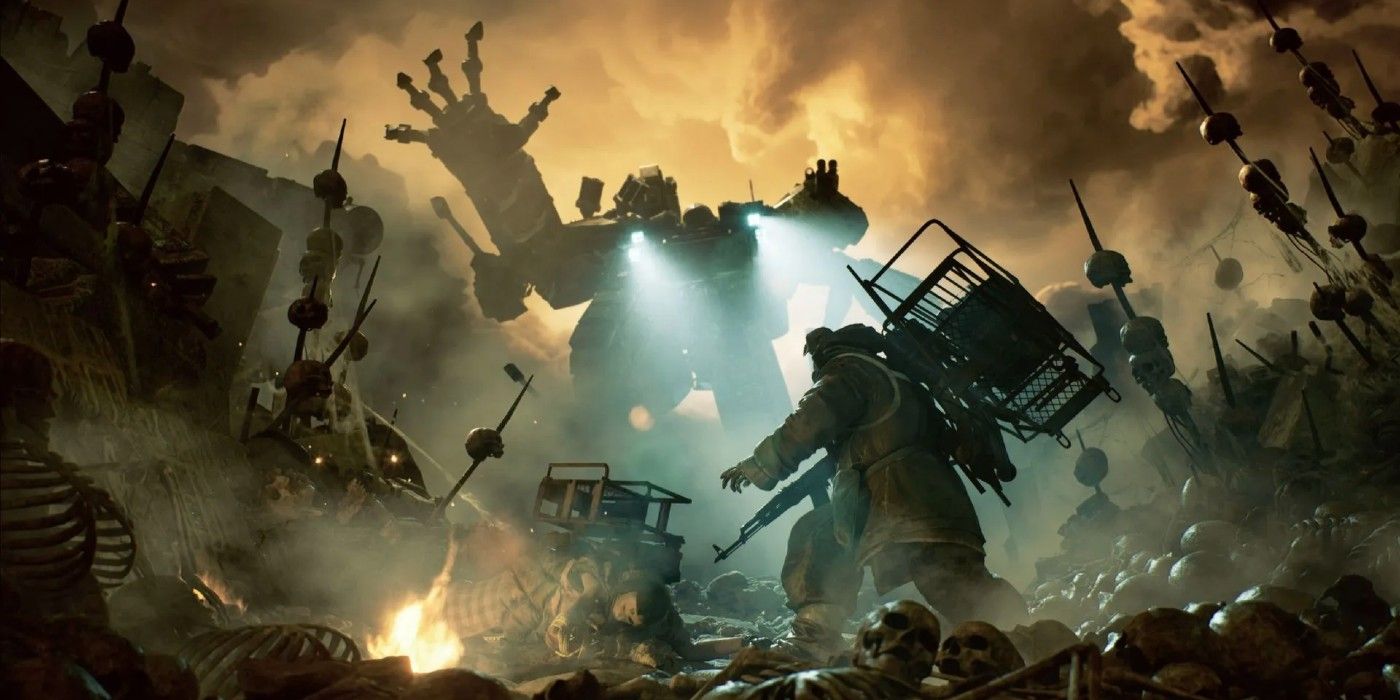
The Forever Winter is an upcoming looter-shooter that offers a twist to the typical wartime game, making players unallied civilians trying to survive amidst powerful war machines. It's the debut from Fun Dog Studios, a developer founded by industry veterans that have worked on titles like Mass Effect and Horizon: Zero Dawn. It's a title that can never truly be won - enemies will always have the upperhand, but players can do a bit better every journey.
The Forever Winter draws inspiration from a myriad of sources, from games like GTFO and FromSoftware titles to the works of Mamoru Oshii. The game incorporates elements of survival, roguelite mechanics, stealth, and squad-based tactics where players will journey out onto the battlefield to attempt resource collection. Finding things like new weapons and supplies to bring back to base will help make them stronger on the next run, but taking valuable items will also attract the attention of the world's warring sides who can attack with a much stronger arsenal.
Related Destiny-Style Tabletop RPGs Inspired By Looter Shooters Fans of Destiny, Warframe, and other video games in the "Looter Shooter" genre will enjoy the following science-fantasy tabletop RPG systems.
Screen Rant interviewed Fun Dog Studios CEO Miles Williams to discuss the biggest influences behind the game, designing an unforgiving world, and what players can expect from The Forever Winter.
Your browser does not support the video tag.
Enemies In The Forever Winter
Dynamic Encounters With Unstoppable Forces
Close
Screen Rant: Something that really interests me about this game is the idea of a dynamic encounter system. Can you tell me a little bit more about how that works and also just how building something like that goes from a behind-the-scenes perspective?
Miles Williams: Totally. That was super, super integral for the fantasy of our player characters being scavengers and very small in this super messed up combat ecosystem. And actually one of the core inspirations for us - because usually people think about a lot more of the horde-type systems they have in games like Left for Dead, where it's basically spawning units that are specifically just to intersect and disrupt the playe - our perspective was looking at more film inspiration. Obviously the opening scene of Terminator II and the future war sequence of the first Terminator, the Animatrix, and a couple of those, that fantasy seemed much more horrific and much more chaotic. And it was not necessarily, "We're specifically there for these small critters," basically the humans within that space, they were there primarily for each other. We took a lot of inspiration from more RTS games, so a lot of the Relic titles like Company of Heroes, Dawn of War, Homeworld, and much more of that perspective. And we also took a lot of inspiration from tabletop miniature games. When we were building out units, remember early 2000s, when you think of co-op shooters, you'd think of Army of two, Gears of War, et cetera. There were very archetypal definitions of a lot of the villains. We looked at it more from a world-building standpoint and how real military structure their stuff. It's more of a tug-of-war system where it'll be like, "Okay, these guys control this percentage of this sector, that means they have access to this library of bad guys and it will spawn units of those bad guys." And those bad guys will primarily be trying to go after each other. They'll basically be like bot-on-bot absolute anarchy. And the player's basically navigating their way through, and only if you steal something of value, then the ecosystem starts to turn and then it's like, "Oh s***, you just stole something. That means something to me. I'm going to send in a SEAL team or a killer robot or a spider tank to intercept and crush you before you make it out of the hot seat."
And what can you tell me about the sort of lore behind these warring factions that players are going to be caught in the middle of?
Miles Williams: At a really high level, we took a lot of inspiration from a lot of classic dystopic fiction. 1984 was a really, really nice background, and "I Have No Mouth, and I Must Scream," of course, and a bunch of other classics. Just looking at the fear of encroaching artificial intelligence, and then also that dynamic in a war situation where they would essentially be working hand in hand with human soldiers and just trying to crush each other. We basically took it from the perspective of these amalgam nation states that are closer to Ingsoc from 1984. It's a whole cluster of some of the countries that we can call back to today. And also just as a baseline inspiration, you look at popular films like Ghost in the Shell and a lot of Mamoru Oshii's work, a lot of in Blade Runner, all of that s***, they always talk about that big-ass war that happened, and now we have androids and everybody's just drinking Starbucks from flying cars, whatever. Our take was the pre-cyberpunk, which is that nightmare scenario that spawned all of that technology. That scene in Iron Man when they showed all the countries' failed Iron Man projects, you basically have a lot of countries that are trying to compete to stay technologically relevant. They're throwing everything they can put a gun on into the field, and that's kind of it at the most anarchic level.
In terms of the minutiae, did these factions also have a sort of more personal lore driven history with each other, culturally speaking and outside of a tech war?
Miles Williams: Yeah, somewhat, but it's kind of more like the equivalent of rivalry between warring generals. And one of the big elements that we played with in the lore is this thing called the Kepler syndrome, it's what the film Gravity was about, and also Planetes, the manga where basically if we were to take out 8% of the worlds satellites today, they've run the physics calculations, that would basically make it impossible for us to leave the atmosphere, period. We're stuck on the planet. And so that means no long-range communications, you have ground level comms like s***ty Vietnam War era radios. And so what happens when you have a chaotic situation like that is all of these groups are on their own. As far as we know, London might not exist, Moscow might be gone, maybe Africa's fine, maybe South America's totally chill, but then Canada's on fire, nobody knows, right? And because of that isolation of information, you have warlords and named villains that are basically like, "Okay, well I could work for my own faction, or I could just kill everyone in this district and run it like fricking Walking Dead style." It goes almost back to a feudal system just because of the lack of information.
Gameplay In The Forever Winter
Making Incremental Progress & Overcoming The Odds
And I know a big part of this is making the player feel like a small fry, what was the process like balancing that with not making it so insurmountable feeling that it's not fun and they don't want to play it at all?
Miles Williams: It's really interesting. I think if I were to give a good example of a similar comp, obviously that feeling that you get from Armored Core, the FromSoft games where it's insurmountable odds, but there's that very narrow window that you can navigate through. But actually a closer comp in some ways might even be something like Hotline Miami where it's live, die, repeat, where you're just like, "Okay, bam. This strategy that we tried didn't work. Let's approach it a different way. Let's try to sneak through there. Let's maybe kite these dudes. Let's get these two units to fight each other." And then when they're close to being dead, we smoke just the survivors and we run in and loot all the bodies before the reinforcements get here. It's very much looking at rewarding the player for basically fighting smarter, not harder. And so if you are actually spending more time and surveying your surroundings and really being aware of listening for stuff like, "Oh s***, I hear rotors, we should probably not be in the open," that kind of thing. That was a lot of cues that we were trying to educate the player and give them as much tools as they can. And the same thing goes for a lot of the equipment, it's built to have a range of options. We're giving you more lateral choices versus like, "Hey, I have a bigger gun with more ammo." Because then you start leaning into the more space marine power curve, which is you're dropping nukes on people. You're doing the Dune guy thing where you're reaching down someones throat and you're pulling out their heart. [Laughs] It started to put us away from the fantasy of it just being closer to the long cut in Children of Men, that last scene in the film where Clive Owen's character is running for his life. And the crux of it was like, because it's PvE, I feel like if you create a PvP scenario, it has to be fair, it has to be balanced. But if you're playing something like Little Nightmares, it doesn't actually have to be fair. And so you're approaching every single thing as a combat puzzle where it's like, "Okay, these are the things that are happening within this space. I have to be situationally aware enough of my teammates and what our plan is for us to be successful." I think GTFO did this brilliantly, where it was situational awareness and deciding when to go HAM was critical. If you don't, everybody's dead. That's extremely charming.
Can you talk a little bit more about the progress that players will be making in between runs? Like you said, there's a lot of different styles of tech and stuff that they can find, and then are they taking it back to a sort of home base area?
Miles Williams: Totally, totally. And the home base - I don't want to give away too much, 'cause obviously the team is really hard at work and building that up and making it as kickass, immersive as possible - but we can definitely dig into more detail on the specifics of that perhaps at a later time. But keeping it super, super high level, you have an underground facility that's basically one floor of a sewer. And the way that it works within the fiction is each player is basically managing that one floor of refugees. And the more prosperous your settlement is or the more prosperous your base camp, the more civvies you're going to see drifting through and more vendor opportunities. But also as you look up and down this massive silo that everybody's living in, you'll start to see more signs of life, like you see more campfires leading up here. And so it's designed to create that conceit of, "Hey, we're actually in this together." And at the very least, this world is incredibly oppressive and there's a lot of no hope situations, but you can be responsible for your own actions and do a little bit of good on a case to case basis.
And in terms of the resources you're finding, is it mostly all weapons and that sort of tech, or is it stuff like food and medicine also that you're bringing back?
Miles Williams: 100%, there's a huge variety of those types of components. And it's interesting because we also include a lot of personal items, because the reality is you've got a bunch of people that are living underground. If you find bits of lost entertainment or you find stuff for the kids that are living there, there's definitely a lot of trade value in that. And so we tried to make it much more of a communal supporting that group of survivors versus it just being like, "I got a level 12 shotgun, yeah." I mean, we have a lot of that too, but we didn't want it to be a situation where you're stacked with 500 different bits of specific, "Okay, I got Roman numeral five, Roman numeral six of whatever piece of kit."
Sort of going off that in terms of differentiation, obviously the overall framing device conceit of it, of not being a part of the war, just being a civilian is a big part of this, but how else would you say this game sets itself apart from others in the genre the most?
Miles Williams: We were definitely inspired by Escape from Tarkov and a lot of other super, super kickass PvE experiences. But at the crux it was: how do we capture that survivor fantasy? And so the game actually allows you to play - whether that's completely action-oriented, whether that's playing it like a speed runner, there's a lot of different ways to approach the problem. And you'll be rewarded for navigating the space successfully, not for just smoking a bunch of space marines. And so that was one of the key differentiators: it's not super aggressive PvP, it's actually got a lot more in common with a survival horror title. And so that for us was definitely something that we really wanted to explore. And the other aspect as well is, as much as we love that core PvP experience, there never really felt like something that really captured that survivalist future war terrifying experience because so many games lean into the power fantasy. And so we wanted to approach it from the David and Goliath complete inverse of that, where it's basically the enemy forces will always have more weapons than you. They'll always have more lethal ways to kill you no matter what. But if you're smart and you work together - like, case in point, when Nick [Shepherd] and I were playing in the last play test, he noticed the only time I was firing my weapon period was to either protect the homies or when we had a very, very narrow ambush opportunity. We're all trained as third person to shoot the first thing that you see on the spot with no variation, right? And even in survival horror games, especially post-RE4, which we f***ing love, you're going to have a bunch of zombies rushing you down a hallway almost 100% of the time. Your immediate reaction is to start dumping rounds. In our game, you start dumping rounds, that's going to ping the interest of the combat ecosystem, and so you're basically ringing the dinner bell. If you're going to do that, then you have to have a plan, and it has to be worth it, because if you get smoked, all your s*** is gone. It's one of those things where it's all about choices.
And what are you most excited to see players react to once they start getting their hands on the game?
Miles Williams: That's a tough one. I think we obviously put a lot of blood and pain into the immersiveness of the world, and obviously a lot of the enemies and a lot of some of the creepy crawlers that are going to be coming after people. But one of the things that I thought was really interesting was with some of the early people that we've been playtesting with, those moments of calm and those moments of essentially watching the battlefield ambiently play out and then sneaking in between those pockets, that was something where they were like, if I play this like a conventional shooter, I'm going to get my ass kicked. But looking at it a different way, that was really, really, really cool. It was just seeing the different ways that people approached the situation, that was super dope. I'm really excited to see what strategies people come up with and just crazy s*** that happens. Because it's a physics-based environment, right? There have been times when we've literally seen a T90 tank flying through the air because it got punched by something so hard that it literally threw the tank and it got stuck in a building, but it was not dead. [Laughs] It was still dumping rounds on people. It was like this giant turret that was literally stuck in a building three stories up. It's just moments like that where I'm like, "Yeah, it's got a chaotic charm to it, for sure."
The Forever Winter's Biggest Influences
Drawing Inspiration From Across All Mediums
Yeah, that sold me, I think, that sounds amazing. And you've delved into this a little bit throughout, but I'd honestly love to hear a sort of deeper dive on where you guys were finding the most inspiration for this game, either from other games or movies or comics or stuff like that.
Miles Williams: Definitely we were hugely inspired by Japanese model kitbash style. We took a lot of inspiration from the work of Kow Yokoyama and some other really prolific artists in that space, Nirasawa for sure on the sculpture end. And it's funny, these were some of the same inspirations that we had on Hawking as well. It was definitely trying to bring that eighties, nineties model kit magazine, that was definitely a big one. But also, honestly, some more obscure stuff as well. Dead Man's Letters, it's this Russian film. It's absolutely spectacular. It's very similar to Roadside Picnic and Stalker. It's an original inspiration, but it was just looking at what does fallout look like but from the East Block Russian perspective during the Cold War. Which I'm amazed he even got the film made, because I was like, "Damn dude, that's a lot of crazy s***." But that was a huge inspiration as well. And then obviously one of the big inspirations for us was actually just interviewing a lot of veterans and just talking with them about their experiences and basically what did they actually want to see out of games, because most of these games are about what they did for a living. I was like, "I don't know. What do you guys think about this?" And they're like, "Well, I enjoy playing Call of Duty." But one of the things that actually came up consistently was basically they wanted people to be put in situations where you have two s***ty choices and you literally have to pick one. And it was more about what are choices and choices in the moment, because it's very easy to be like, "Oh, well, I would never do this," or, "I would always do that." But putting people in a situation where it's like, "Okay, I literally have a choice. I could save Nick or Melanie. I have 17 bullets left, I can only stagger one enemy and that's it." You roll the dice, right? That's one of those things where you have two bad choices. And I thought those were actually - I mean, if anything, that was one of my most memorable moments from the Telltale series, The Walking Dead, where you literally - and they do it in a very storytelling manner - but that stuck with me even more than I would argue some of the more commercially successful post-APOC games in the space, because I was like, "That's a real-ass choice." That's like, "Dude, you have to live with the consequences of this." And the more you can capture that in an ambient setting with your friends, I find that stuff really inspiring, for sure.




COMMENTS