The Tattooist of Auschwitz True Story: What Happened To The Real Lali Sokolov & Gita Fuhrmannova
Summary Lali Sokolov and Gita Fuhrmannova's love story shines in the historical drama based on real Holocaust survivor memories.
Despite the horrors of Auschwitz, the couple's romance blossomed with the help of Lali's privileged role as a tattooist.
After the war, Lali and Gita built a life together in Australia, but Lali kept their story silent until Gita's passing.
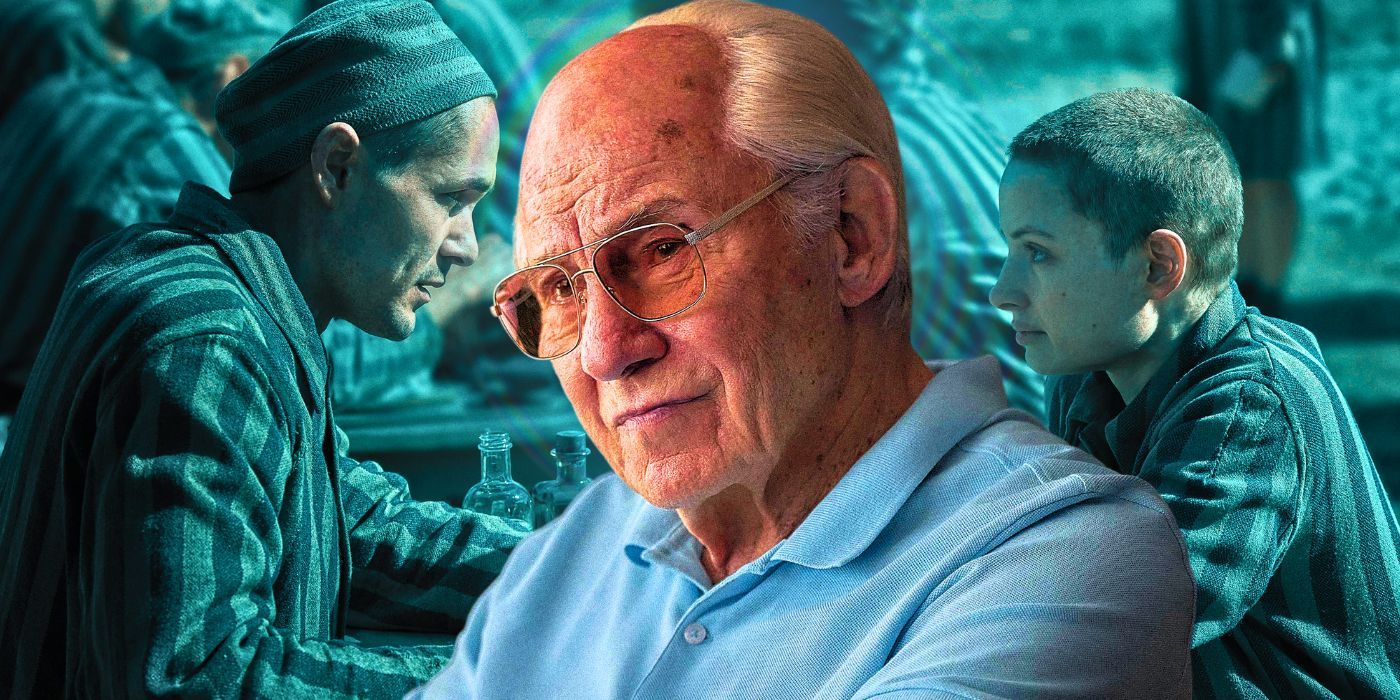
Peacock's new historical drama The Tattooist of Auschwitz is based on the 2018 historical fiction novel of the same name, but that source material is based on the memories of an actual Holocaust survivor named Lali Sokolov. Born Ludwig "Lali" Eisenberg in Slovakia in 1916, he is played by both Harvey Keitel and Jonah-Hauer King in The Tattooist of Auschwitz (as an older and younger version, respectively). The show and its source material chronicle both Lali's struggle to survive in Auschwitz concentration camp and the love he discovers with a fellow prisoner named Gita (Anna Próchniak).
Both Lali and Gita are kept alive with the help of other characters in The Tattooist of Auschwitz, but their blossoming romance lies at the heart of the story. While the original novel the Peacock show is based on was written based on the author's conversations with the real Lali Sokolov, it is still considered historical fiction given how she weaves the real Lali and Gita into events they weren't necessarily involved in. The ending of The Tattooist of Auschwitz provides some brief context on which parts of Lali and Gita's life story were accurate.
Related 10 Best Movies About The Holocaust The holocaust is an incredibly difficult subject, but there have been some beautiful, haunting, and moving films made about it.
Lali Sokolov & Gita Fuhrmannova Were Deported To Auschwitz In 1942
The Slovakian government helped deport their own Jewish population
Close
Per the BBC, Lali Eisenberg was deported in April 1942 as part of the Slovakian government's active participation in the Holocaust. The ruling Slovak People's Party declared independence from greater Czechoslovakia in 1939, and in 1941 began the process of deporting more than 58,000 Jewish citizens to the Auschwitz concentration camp. Lali voluntarily got on the train that took him to the camp, as he believed that he would be finding work for the Third Reich and sparing his family the same fate. In reality, it was a ruse to get people to the death camp easier.
Roughly 77% of all Jewish citizens of Slovakia in 1940 (like Lali and Gita) were murdered in the Holocaust.
Gisela "Gita" Fuhrmannova was deported in July 1942, when Lali was already established at the camp as a tattooist. Like Lali, she was a victim of her own government's participation in the Holocaust as a client state of the Nazis. Gita was only 18 years old at the time of her deportation, while Lali was 26.
Lali Sokolov Was A Tattooist At Auschwitz
As a tätowierer, Lali had special privileges
Close
As prisoner 32407, Lali worked at the camp building housing units until he contracted typhoid just a short while after arriving at the camp. He was cared for by a man named Pepan, who had in fact been the one to tattoo the number on his arm. After recovering, Pepan made Lali his assistant and taught him how to be a tattooist, and how to generally survive the camp. When Pepan disappeared (presumed murdered), Lali became the camp's main tattooist due to his ability to speak several Eastern European languages, including Slovakian, German, Russian, Hungarian, and some Polish.
As the main tattooist in the camp, Lali was afforded special privileges, including extra food, his own living quarters, and even free time and the ability to roam the camp. He used these advantages to establish a black market within the camp, smuggling valuables from the women in the camp who were tasked with sorting through the belongings confiscated from incoming prisoners. He used these valuables to trade with local villagers and non-prisoner workers in the camp for extra food, which he distributed to his fellow prisoners.
Lali and Gita did in fact send communication through Stefan Baretzki, the Nazi SS guard who essentially acted as Lali's handler.
Per CBC, that freedom also allowed him to directly help the young woman he had fallen in love with while tattooing her arm. Lali used his privilege to smuggle food to Gita and her friends, send messages to her, and even get her a better job within the camp. They were able to build a relationship thanks to Lali's mix of daring, intelligence, and luck.
Lali Sokolov & Gita Fuhrmannova's Separation & Reunion Explained
They were evacuated from Auschwitz at different times
In January 1945, Gita was among the women who were forced to leave Auschwitz on a death march through the frigid Eastern European winter. She marched for two days before she and two other girls decided to run rather than continue to march to their deaths. Eventually, she made her way to Bratislava, which had become a collection point for all those returning from the camps and various stages of the war.
All episodes of The Tattooist of Auschwitz are now streaming on Peacock.
Lali witnessed Gita being forced out of the camp, completely unsure if he would ever see her again given all he knew about her was her name. He was transferred out of Auschwitz a few days later, and after stops at different camps as the Nazis fled the oncoming Red Army, Lali eventually escaped and made his way back to his childhood home, which was still owned by his sister. He immediately resolved to find Gita, and traveled to Bratislava to search for her, knowing that many survivors were passing through there.
Lali waited at the train station for weeks, asking young women whether they were at Auschwitz or knew Gita, to no avail. He was advised to go to the local arm of the Red Cross instead, and on his way there his horse and buggy were stopped by a young woman. Gita happened to find him out of sheer luck, although the two had been looking for each other for some time at that point.
What Happened to Lali & Gita After World War II
They built a life together
Close
Lali and Gita were married in October 1945, just a few months after reuniting in Bratislava. They changed their last name to "Sokolov" in an effort to fit in better in Russian-controlled Czechoslovakia, and Lali opened a successful textile factory. However, as he had been collecting money to support the creation of the State of Israel, his business was seized and he was imprisoned once more. He and Gita escaped Czechoslovakia, and eventually settled in the Jewish community in Melbourne, Australia in 1948.
In Australia, Lali opened a textile shop again, and Gita designed dresses. They had a son, Gary, in 1961, but no other children. By all accounts, the two lived a happy life together in Melbourne until Gita's death in 2003 at the age of 78. Gita returned to Europe on several occasions, but Lali never went back to the continent.
Lali Sokolov Didn't Speak About His History Until After Gita's Death
Lali's guilt kept him silent for decades
While Lali and Gita's close friends and son knew that they had survived Auschwitz, Lali never told his entire story to anyone before Gita's death. Before then, Lali had remained relatively silent about his experience in the camp, as he feared he might be considered a collaborator given his position within the camp. Lali felt guilty about being a cog in the machine that perpetuated the atrocities at Auschwitz, even though his only choice was between doing as he was bid and certain death. After Gita's passing, Sokolov made the decision to share their story.
Lali & Gita's Life At Auschwitz Inspired Heather Morris' Book
Lali's memories are the basis for the historical fiction novel
Lali's son Gary found Heather Morris through friends, and Lali chose her to tell his story thanks in large part to her innocent perspective on the Holocaust. She and Lali met several times a week for three years, as she earned his trust and untangled the web of memories surrounding his experience in the camp. She did her own research alongside what he told her, and made the decision to create a work of historical fiction.
Heather Morris wrote a sequel novel to The Tattooist of Auschwitz titled Cilka's Journey, another work of historical fiction based loosely on a real survivor's story. The eponymous Cilka is a character who aids Lali and Gita in their survival.
The story was originally supposed to be a screenplay, and as a result the Australian government's film body agreed to fund international research to corroborate the story that Lali told Heather. That team was able to unearth important and relevant documents, including verification that Lali was in fact working for the Nazis Political Wing in the camp, which aligns with what he told Heather about his work as the tattooist. While the events that play out in The Tattooist of Auschwitz may not be entirely accurate, the romance of Lali and Gita and their time in the death camp was unquestionably real.
Source: BBC, CBC






COMMENTS