All Of Florence Pugh’s Outfits In Dune 2, Ranked
Summary Princess Irulan's wardrobe in Dune: Part Two is a mix of high fashion, medieval art, and sci-fi elements, reflecting her complex character roles.
Costumes like the Beaded Coif show Irulan's complicity in Bene Gesserit's plans, while the Gold-Crowned Dress highlights her political influence.
The Chainmail Dress marks a pivotal moment as Irulan becomes Paul Atreides' wife, symbolizing her position as a pawn in the Bene Gesserit's schemes.
Dune: Part Two features some incredibly creative and memorable outfits, especially when it comes to Florence Pugh's Princess Irulan, whose wardrobe stands out as particularly varied. Combining influences of high fashion, medieval art, religious garments and high-concept science fiction, the cast of Dune: Part Two got to show off some incredible looks, from the jagged, jet-black industrialist armor of the Harkonnens to the intricate fabrics and tubes of the Fremen Stillsuits. But few characters got as impressive a wardrobe as Florence Pugh's Princess Irulan.
Princess Irulan inhabits many different roles, at once a royal successor to the Golden Lion Throne and a pivotal member of the elusive Bene Gesserit. The many different costume changes of Florence Pugh's character reflect these positions, each outlandish ensemble having its own place reflecting Princess Irulan's character via wardrobe. The progression of increasingly elaborate headwear also suggests the arc of Irulan over the course of the sci-fi epic, becoming literally bound and blinded by her role as a pawn in the Bene Gesserit's scheming.
Of course, not every outfit for Princess Irulan is created equally. While the stunning work of Dune: Part Two's impressive costuming department is unfailingly great at subtly building the world of Frank Herbert's classic science fiction saga, some pieces simply stand out more than others for their meta-commentary, intricacy, and raw aesthetic appeal. Therefore, Princess Irulan's costumes are not created equal in terms of spectacle or storytelling, even if each outfit change serves a necessary and worthwhile narrative purpose.
5 The Diary Outfit
Princess Irulan's most simple ensemble
By far the most lackluster and forgettable outfit of Florence Pugh's character in Dune: Part Two is the one she begins the movie in. In the opening scene, Florence Pugh's Princess Iriulan reveals herself in a simple white evening gown, with no headwear to speak of and little in the way of embellishment or substance. This is the only time Princess Irulan's face is completely unobscured, as she wears by far the plainest piece her character seems to own. The only hint of a decorative function is the faint impression of a vaguely floral texture pattern worked into the dress's fabric.
Princess Irulan sits in this garment as she records one of her audio diaries, introducing herself as the film's narrator, her chronicling of the events of Dune: Part Two working as a sort of framing device. This mirrors her position as the narrator in the Dune novels, being the one whose words form the framework of the original story. Her love of history and nature as a documentarian of it is one of the aspects of Princess Irulan's character that often goes forgotten, overshadowed by her work as a princess and Bene Gesserit.
Unfortunately, compared to her later, more extravagant outfits, this simple design doesn't offer much. This gown is simply comfortable evening wear for Princess Irulan to inhabit while in her own quarters, or while speaking privately with her father, Emperor Shaddam IV. With none of the spectacle or memorable details of Irulan's later costumes, the diary outfit at the very least presents the character at her most self-determined, demonstrating so with a literal lack of inhibitions or restraints in her choice of attire.
4 The Beaded Coif
A daring exploration of Irulan's Bene Gesserit complicity
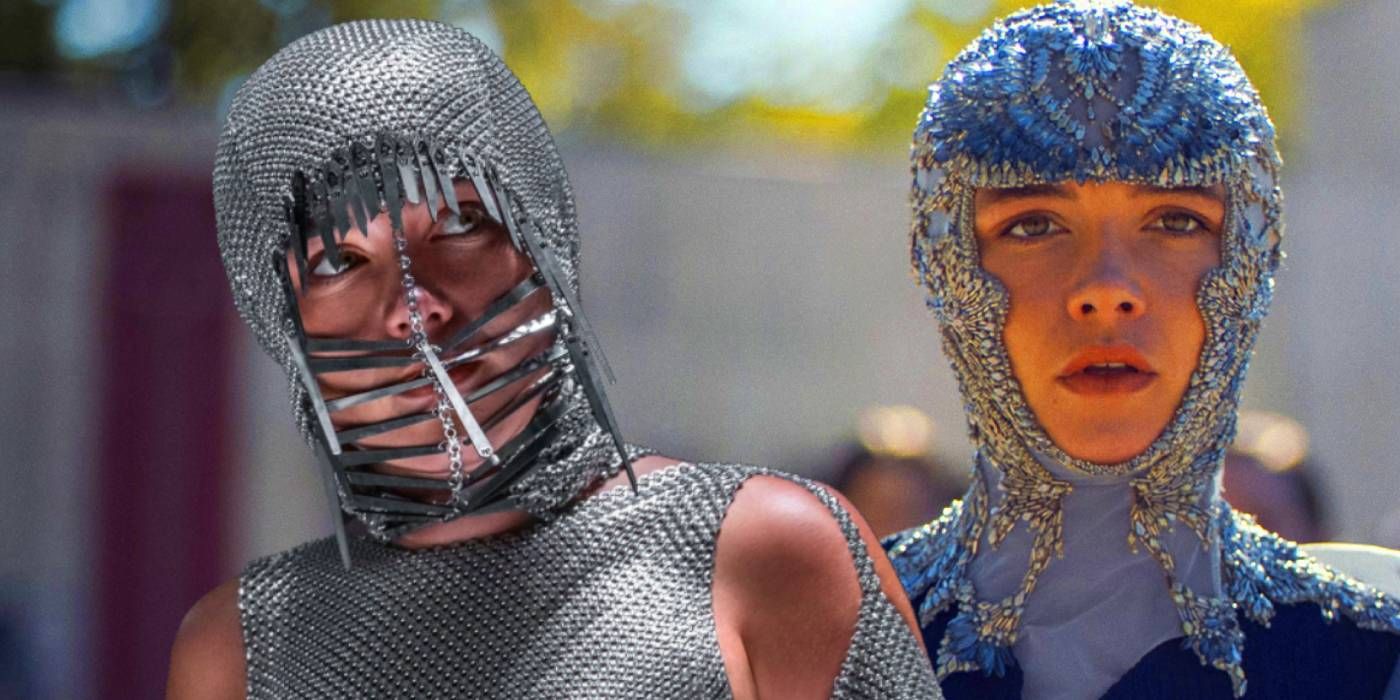
As the plot of Dune: Part Two marches onwards, Florence Pugh is given exceptionally intricate and eyebrow-raising outfits to wear with a straight face. One of the most standout costumes is the bizarre ensemble she picks up towards the beginning of the third act. Looking like something straight out of a medieval painting, Princess Irulan dons a dark blue and silver dress ending in a beaded coif concealing her head, giving the appearance of a knight or astronaut. During her talks with the Bene Gessirt reverend mother, it's shown that this outfit also has a removable dark veil that further accentuates its concealed look.
Most notably, Florence Pugh's Princess Irulan wears this ensemble during the scene in which her and her father, Emperor Shaddam IV, learn that Paul Atreides is still alive. This scene flows into another conversation with shadowy Bene Gesserit matriarch, Reverend Mother Gaius Helen Mohiam, who finally reveals to her the full extent of the order's meddling in the events of the franchise. For the first time, Princess Irulan recognizes the danger of the Bene Gesserit's scheming, and her own complicity in their machinations for power.
This costume does a great job visually explaining Irulan's learned helplessness, trapped in the constricting coif with her face barely visible just as she is trapped as a pawn within the Bene Gesserit's plans. The avian pattern of the coif's beads also may give passing reference to the hawk sigil of house Atreides, possibly hinting at her future marriage to Paul, something the Reverend Mother alludes to while Irulan wears this costume. While it may be thematically appropriate, it's hard to deny a certain element of silliness in Irulan's headsock, slightly undercutting the grave seriousness of her scenes in it.
3 The Gold-Crowned Dress
Has Princess Irulan leverage the full extent of her political power
In the second major scene she appears in, Princess Irulan wears yet another medieval-looking costume evocative of Princess Amidala in the Star Wars prequels. Straddling the middle-ground of elegance between Irulan's simple first costume and the elaborate pieces of her later appearances, this outfit shines with the brilliant gold colors of Irulan's House Corrino rather than the drab silver and dark hues of her other formal wear. Irulan's loose white linen dress is topped with a golden netted crown, a comfortable look that still maintains a certain air of royalty.
During the scene in which Princess Irulan wears this costume, she's at her most determined, actively advising her father and convincing him to change his tactics regarding the Fremen insurrection of Arrakis. While underneath the costume's golden crown, Irulan warns Emperor Shaddam of the power of faith and martyrs, urging him not to kill Paul Atreides until after the inhabitants of the desert planet have already grown weary of the raging war. Her intelligence and grasp of political maneuvers outshines her father as she flaunts a similarly bright dress and headwear combination.
This particular costume does a great job to highlight all the aspects of Irulan's character. She's intelligent, born into privilege but wary enough to understand how to wield it, able to influence even the headstrong will of her tyrannical father to more sensible paths of action. It might not have the garish flair of Princess Irulan's most intricate pieces, but the costume holds a simple elegance. It helps that Irulan is at her most self-determined while wearing it, her face free even if the restrictive nature of her lofty position begins to grow at the crown of her head.
2 The Chainmail Dress Unveiled
Princess Irulan takes her new place as Paul Atreides' wife
Towards the ending of Dune: Part Two, Princess Irulan modifies her most iconic costume to be different enough to be worth mentioning as a unique outfit. The striking chainmail dress, by far the most elaborate and exquisite costume Florence Pugh gets to wear in the film, is modified to be ever-so-slightly more practical. The metal chained veil is cast off of Princess Irulan's face, though the flowing hood of chainmail remains, and a silver shawl is thrown about her shoulders, resulting in a more modest, nun-like look.
Irulan makes this change just as Paul defeats his cousin, Feyd-Rautha Harkonnen, in a brutal knife fight, officially marking his ascendancy to the Golden Lion Throne via sheer force of will. In order to legitimize his claim, Paul takes none other than Princess Irulan herself as his bride, much to the dismay of Chani. This was all part of Reverend Mother Gaius Helen Mohiam's plan, hoping to continue the Corrino line via Princess Irulan even if the exchange of power from Emperor Shaddam to Paul Atreides must be made.
The changes in Princess Irulan's chainmail dress leading up to this pivotal moment may seem slight, but they are certainly deliberate when it comes to illustrating her ominous future as Paul's wife. For one, the removal of the chains caging her face creates the effect of a bride shedding her wedding veil, very literally signifying her change in marital status. The silver cloak thrown over her formerly bare shoulders, combined with the chainmail hood, also evokes the image of a nun, alluding to her chastity in Paul's marriage -- In the books, Paul keeps her as a wife in name only.
1 The Chainmail Veil And Dress
The most iconic of Florence Pugh's costumes for good reason
Competing with Midsommar's flower crown for the most iconic costume ever worn by Florence Pugh, the full beauty of the delicate chainmail dress' first appearance is by far the most arresting of all of Princess Irulan's looks. Truly evoking a sense of royalty, the elaborate outfit features intricately-forged mail with seductive cutouts on the abdomen and shoulders, an amazing display of craft on behalf of Dune: Part Two's art department. But by far the memorable element of the costume is the veil of dagger-like chains hanging over Irulan's face.
Princess Irulan wears this costume as the Fremen's final assault on the Emperor's compound on Arrakis rages, eventually coming face to face with her rebellious enemies while wearing the fascinating getup. Standing by her father's side, Irulan is all but motionless in the fancy, but restrictive formal attire, able to do little but watch. This tremendously reflects Irulan's position in the story by the end of the film, having become little more than a puppet for the Bene Gesserit's ambitions.
Incredibly ornate and decorative but just as restrictive, trapping Irulan's face behind a literal cage makes it clear in no uncertain terms how her sense of self-determination has eroded over the course of the story. This costume is a marvelous piece of visual storytelling that deserves praise for its ability to demonstrate Irulan's fate as a mere royal placeholder for her family's name. That's not to mention that the artistry of the costume is nothing short of spectacular, just one aspect of Dune: Part Two's tremendous visuals.





COMMENTS