Fallout’s 10 Best Songs That Play On The Radio, Ranked
Summary Fallout's radio is immersive and atmospheric, setting the tone for the entire series.
"Butcher Pete" is a standout example of Fallout radio, contrasting upbeat music with violent or risqué lyrics.
The radio system is as vital to Fallout as VATS or Stimpaks, adding human brightness to the bleak Wasteland.
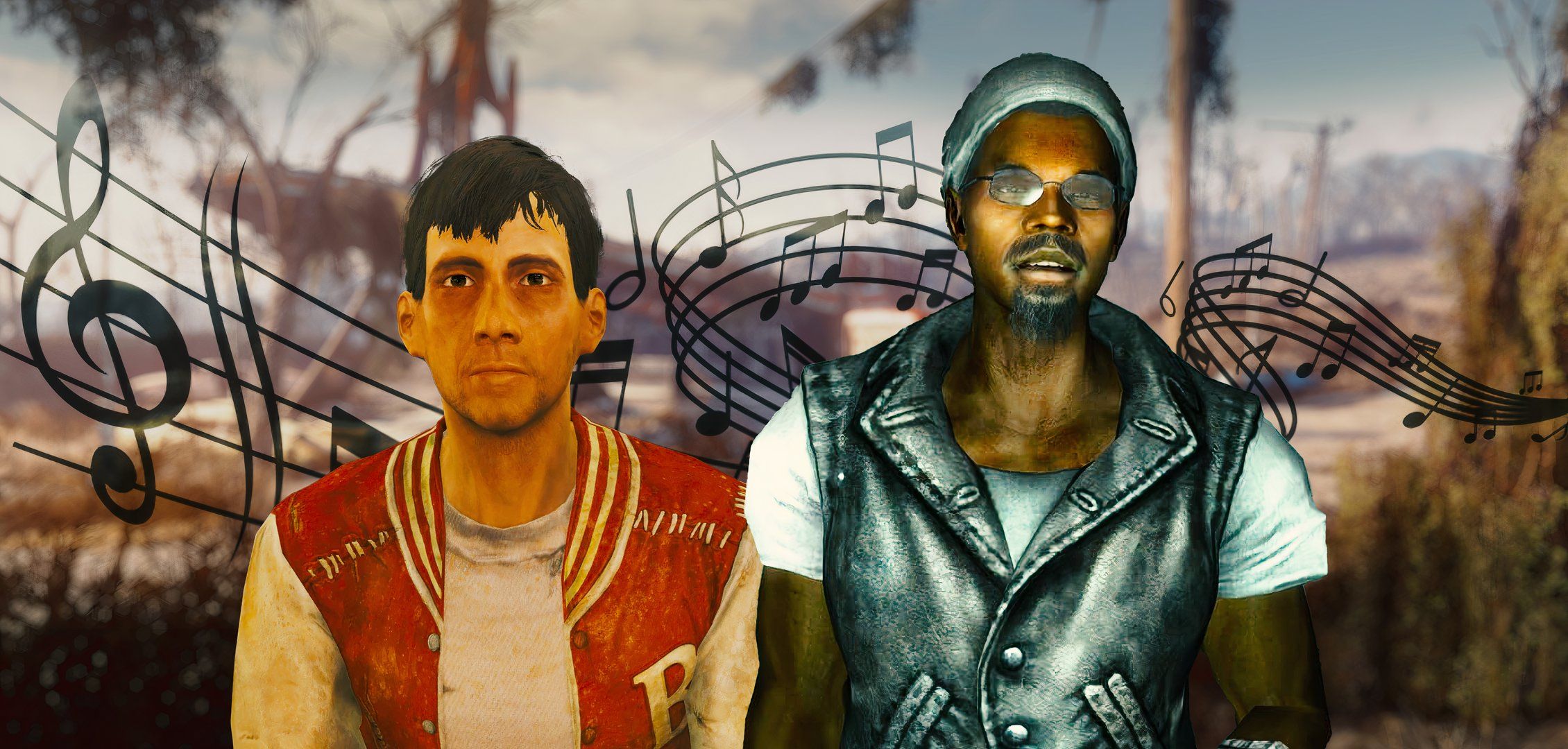
Ever since it went 3D, the Fallout series has been known for its immersive radio system. Fallout 3, Fallout: New Vegas, Fallout 4, and Fallout 76 each give the player access to a Pip-Boy radio, which allows them to tune into one or more stations that play period- or thematically-appropriate music. From the patriotic fife and drum of Enclave Radio, to the country twang of Mojave Music, to the big-city swing of Radio New Vegas, each station has something unique to offer, and contributes greatly to the atmosphere of the Wasteland.
But to be honest, not every Fallout radio song is as good as the last one. Some songs set a pitch-perfect mood for a little post-nuclear adventuring; others just inspire a change in station. That said, whether jumping into Fallout 76's limited events for the first time, or replaying New Vegas for the thousandth, there are some songs that instantly get the toes tapping and the VATS finger itching. These are ten of the best songs to grace the airwaves throughout the Fallout series.
Related One Fallout New Vegas Game Ending Makes The Most Sense After The TV Show Fallout’s TV show adaptation stays mostly canon-neutral, but it does seem to designate one New Vegas ending as canon. Here’s why it makes sense.
10 Roy Brown's "Butcher Pete" Is The Perfect Example Of What Fallout Radio Is About
From Fallout 3, Fallout 4, & Fallout 76
"Butcher Pete" is a 1949 song by blues singer Roy Brown. It's a narrative song, telling the story of a drifter named Butcher Pete who chops his way through an entire town. While the immediate connotations are those of a serial killer, some have interpreted Butcher Pete not as a violent figure, but an amorous one. That's particularly apparent in the lines, "All you fellas gotta watch your wives/'Cause Pete don't care whose meat he chops."
The metaphor is further explored in "Butcher Pete (Part 2)", which only appears in Fallout 4.
"Butcher Pete" is a microcosm of Fallout radio as a whole: it contrasts upbeat, jaunty music with violent (or at least risqué) lyrics, much as the rest of the jazzy soundtrack contrasts the stark violence of the Wasteland setting. It's also just really catchy. With a swinging band and a ridiculous refrain ("He keeps hackin' and whackin' and smackin'"), it's hard not to tap one's feet to "Butcher Pete." It also ends with a great little fourth wall break - Brown addresses the listener directly, encouraging them to "turn this record over, you ain't heard nothing yet."
9 The Five Stars' "Atom Bomb Baby" Plays On Pre-War Nuclear Anxiety
From Fallout 4 & Fallout 76
Close
Fallout's many radio stations feature many songs that explicitly reference the threat of nuclear devastation: "Uranium Rock," "Uranium Fever," even "Crawl Out Through the Fallout." Most of these are novelty songs that trade musical complexity for cutesy or clever lyrics, but that's not the case with The Five Stars' 1957 "Atom Bomb Baby." Featuring non-stop piano riffs and some nice little harmonies from its five singers. (And honestly, its lyrics are lacking a bit in the cleverness department, rhyming "bomb" with "wigwam.")
The central conceit of this song is a metaphor, comparing the speaker's love to an atomic bomb in terms of heat and explosive potential. It portrays a very real threat through humorous comparison, making it a perfect example of the Cold War obsession with mutually-assured destruction. That culture is what Fallout's entire worldview is based on. In a post-nuclear world, the song even takes on a shade of irony.
8 "Into Each Life Some Rain Must Fall" Is A Rare Collab
From Fallout 3 & Fallout 4
Many songs by the Ink Spots grace the soundtracks of the Fallout series. The recurring structure of their songs - the arpeggiated chords, the turn-based solos, the harmonized riffs in the background - are as much a part of Fallout's soundtrack as the gunfire and the grunts of Super Mutants. Their 1944 song "Into Each Life Some Rain Must Fall" follows the Ink Spots archetype pretty closely, but breaks it by including a rare collaboration with jazz legend Ella Fitzgerald.
Fitzgerald fits seamlessly into the formula, showing off her improvisational skill and tonal purity right between Bill Kenny's and Hoppy Jones' solos. It's also a bit more upbeat than the typical Ink Spots song, with a little jaunty piano riff underscoring the whole affair. That helps send home the message of the lyrics, which acknowledge the inevitability of tragedy in an otherwise happy life, while lamenting the overabundance of it in the singer's.
Related 10 Weirdest & Strangest Fallout 4 Side Quests That You May Have Missed Fallout 4 has tons of places to explore and side quests to keep players busy, and some of them can end up being truly bizarre experiences.
7 Dean Martin's "Ain't That A Kick In The Head" Is Emblematic Of New Vegas
From Fallout: New Vegas
Close
As far as Fallout music goes, "Ain't That a Kick in the Head" is a little anachronistic. It was released in 1960, not in the '40s or '50s like most of the other songs on the radio. That said, it has every right to be featured in New Vegas. It was originally written for the film Ocean's 11, which prominently features a series of casino heists. It's also sung by legendary crooner Dean Martin, who starred in the film, and was known for his Las Vegas residencies.
Every bit of that comes across in the song, which pairs a boisterous, big-city brass section with Martin's seductive dulcet tones. Its lyrics tell the story of a lovestruck man who grapples with the abruptness and intensity of his feelings. It's also the perfect pun on the prologue of Fallout: New Vegas, in which Courier Six narrowly survives a bullet to the head.
6 "Jingle Jangle Jingle" Is Fallout's Greatest Earworm
From Fallout: New Vegas
Every Fallout: New Vegas player recognizes the opening notes of Kay Kyser's 1942 "Jingle Jangle Jingle." It may have originally been written for the film The Forest Rangers, but "Jingle Jangle Jingle," but in the modern day, it's more closely associated with New Vegas. Although performed by a big band, it could almost pass for a simple country song but for those first few horn hits, and the short instrumentals that punctuate the verses.
If "Ain't That a Kick in the Head" represents big-city New Vegas, "Jingle Jangle Jingle" perfectly represents the rural Mojave. It's full of nostalgia for a bygone era of individualist cowboys, which may not have ever actually existed. It'll inevitably get stuck in the player's head every time they hear it, and even sometimes when they don't. It's inherently whistle-alongable, and with such a simple chorus and a call-and-response lyrical structure, very easy to sing along with.
5 Cole Porter's "Anything Goes" Is Extra Ironic In The Wasteland
From Fallout 3, Fallout 4, & Fallout 76
Close
Cole Porter's "Anything Goes" was the title song for his 1934 musical of the same name. It's almost like a Depression-era "We Didn't Start the Fire," lamenting the pitfalls of modernity through a series of socio-cultural-historical references. It counts increasingly scant clothing, radical shifts in wealth distribution, and the brain-draining effect of radio among its all-star cast of societal upheavals. It's a clever song with lyrics that bear closer examination, with lots of biting, if now obscure, references to icons of its day.
But when played in the post-apocalyptic wasteland of Fallout, "Anything Goes" is recontextualized with a new kind of irony. Now, the greatest threat to a comfortable, well-examined life isn't Rockefeller's money hoarding - it's the feral ghouls at the door. Also, as a pre-war song lamenting the pitfalls of modernity, it shows how little things have changed - no matter how society is altered, there'll always be someone to complain about it.
4 Nat King Cole's "Orange Colored Sky" Is The Perfect Soundtrack For Fallout's Combat
From Fallout 4 & Fallout 76
The version of "Orange Colored Sky" that plays in the Fallout games was recorded by Nat King Cole in 1950. The lyrics are about love at first sight, the suddenness of which is portrayed through the onomatopoeic refrain, "Flash! Bam! Alakazam," each word of which is punctuated by a powerful blast from the horn section. That's offset by the sweetness of Cole's voice, the dichotomy of which he even acknowledges directly in an ad lib near the end of the song: "Wow, I thought love was much softer than that. What a most disturbing sound."
Although meant to represent the shock of sudden love, the punchy brass and explosive lyrics also make the perfect soundtrack for Fallout's combat. The song's title could equally refer to the sky's hue at dawn, at sunset, or after a nuclear explosion. It may not always be perfectly timed, but when the chorus comes in at just the right moment, it adds a lot of excitement and cinematic flair to the average Fallout firefight.
3 The Events Of Fallout Prove "Civilization" Right
From Fallout 3, Fallout 4, & Fallout 76
Custom Image by Glenn Bunn
"Civilization" features Fallout soundtrack staple The Andrews Sisters alongside triple threat Danny Kaye. Its lyrics tell a satirical story of a Christian missionary visiting an uncontacted group in the jungles of the Congo. He attempts to sell them on the idea of western-style society, but with each new advancement he introduces - cars, guns, capitalism - his audience grows increasingly horrified. This eventually leads them to declare they have no interest in "civilization," preferring instead to remain where they are.
This song's inclusion could be interpreted ironically - in the aftermath of Fallout's Great War, there really is no such thing as civilization in the sense that Danny Kaye and The Andrews Sisters sang about. But it works just as well played straight. The song ends with the words, "They have things like the atom bomb/So I think I'll stay where I am." The total nuclear destruction of Fallout's setting proves, beyond a doubt, that they were right to be skeptical of civilization.
2 The Ink Spots' "I Don't Want To Set The World On Fire" Is Fallout's Unofficial Theme Song
From Fallout 3, Fallout 4, & Fallout 76
The Fallout series has a long history with "I Don't Want to Set the World on Fire," a 1941 song by The Ink Spots. The NPC Dane references its first line in the original Fallout, it appears in the intro of Fallout 3, and it even plays in a trailer for the Fallout TV show. It also appears on the radio in all three Bethesda Fallout games.
And it's easy to see why. Besides its period-appropriateness, the song's title puns on the central conceit of the Fallout series, set in the afterglow of a world on fire. Of course, at the end of the day, it's another love song, about people who have lost all motivation to do anything in the shadow of love. But its slow tempo and somber vocals give "I Don't Want to Set the World on Fire" a slightly funereal sound, as if mourning the world's destruction.
1 Marty Robbins' "Big Iron" Is The Best Fallout Radio Song
From Fallout: New Vegas
Custom by Kate Bove
Marty Robbins' 1959 country ballad "Big Iron" is the best song on any of the Fallout series' radio stations. It's a narrative song, telling the story of a gunfight between an Arizona ranger and an outlaw named Texas Red. It's a simple morality tale: the ranger's arrival gets the people talking, especially when they notice the "big iron" he carries. Word gets around that he's after Texas Red, who, on hearing the rumors, is confident of an easy victory. But when they meet for a mid-morning duel, the ranger outdraws Texas Red, ending his reign of terror instantly.
Besides its story, "Big Iron" is a beautiful song. Marty Robbins' clear voice comes across as both mournful of Texas Red's folly and reverent of the ranger's swiftness. Twangy guitar riffs fill the spaces between the lyrics, which are carefully metered and perfectly rhymed. The whole thing plays out, like most of Marty Robbins' gunfighter ballads, as a chapter of an epic poem. It perfectly encapsulates the western setting of Fallout: New Vegas, and is also generally a delight to listen to.
As much as it may seem like a bit of set dressing, the radio system is as important to Fallout as VATS or Stimpaks. It's an important element of atmosphere in the Wasteland, and a small spot of human brightness in an otherwise bleak and dangerous world. For these reasons among others, the radio is vital to the Fallout series, and it'd be a lot less enjoyable without its greatest hits.




COMMENTS