Altered Carbon: The Awesome Meaning Behind Takeshi's Tattoo Explained
Summary Takeshi Kovacs' ouroboros tattoo symbolizes everlasting life on Earth in the futuristic world of Altered Carbon.
Changing bodies but keeping the same tattoo, Takeshi's ouroboros represents the eternal nature of humans in the series.
The ancient symbol has been found in various cultures and symbolizes the repeating nature of time and life's everlasting cycle.
In Altered Carbon, Takeshi Kovacs sports a forearm tattoo that has a deeper significance to the show's themes than it may appear at first glance. Based on the novel by Richard K. Morgan, the 2018 Netflix series Altered Carbon is set in the year 2384 where a person's consciousness can be transferred between bodies. The series primarily focuses on Takeshi Kovacs, a soldier turned investigator who is released from prison to solve a mysterious murder case. Takeshi uses a variety of bodies, or "sleeves", across two seasons of Altered Carbon.
Because Takeshi constantly changes bodies, he's been recast multiple times in Altered Carbon. Joel Kinnaman, Will Yun Lee, Anthony Mackie, Byron Mann, and Jihae Kim have all taken up the mantle of Takeshi Kovacs throughout the Netflix show. Takeshi was formerly an Envoy, an elite soldier, and part of a rebellion that was defeated centuries before the series' events. He's taken out of prison and given the chance of a new life if he solves a murder, which leads him into a conspiracy. While he frequently changes bodies, there's one thing Takeshi keeps the same.
Related Altered Carbon: 10 Takeshi Kovacs Facts That The Netflix Show Left Out Altered Carbon's Takeshi Kovacs is a complex character that leaves out much of his story from the Netflix show. Here's all the facts fans should know.
Takeshi's Altered Carbon Tattoo Is An Ouroboros
Every Sleeve Has The Snake Tattoo As A Reminder By Takeshi
Close
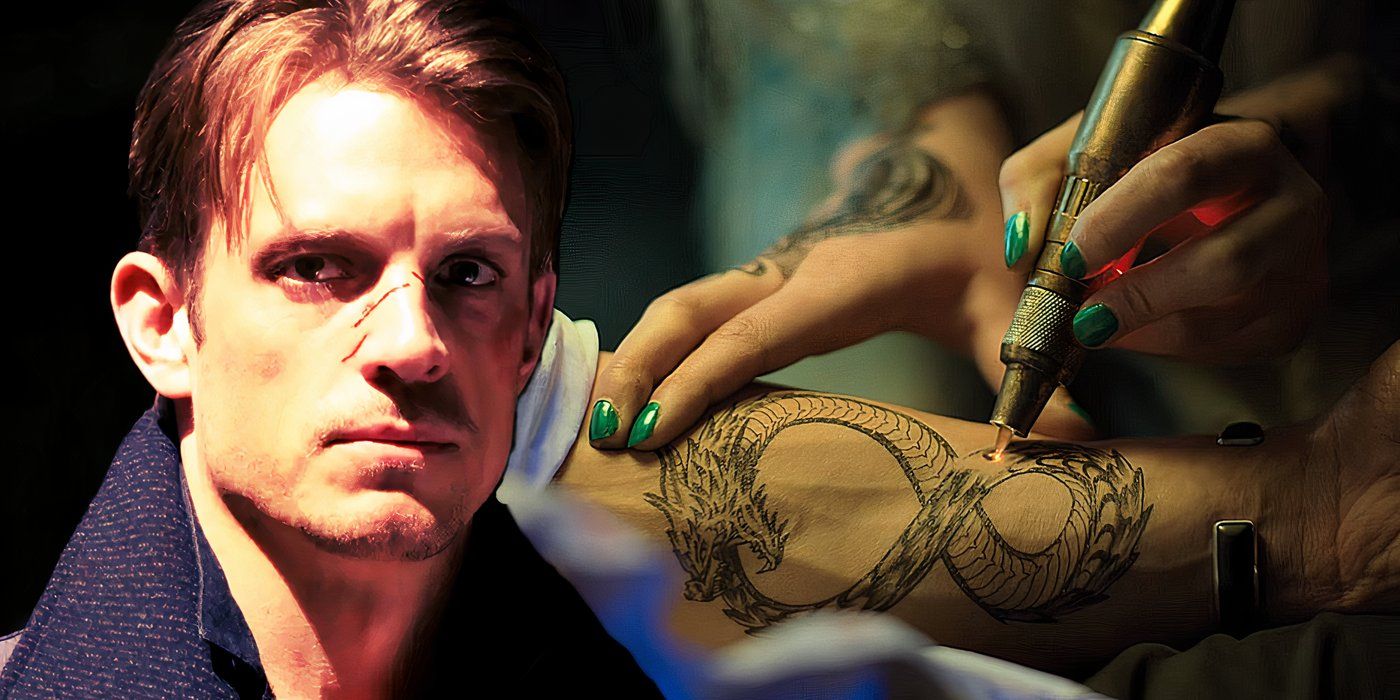
In the first episode of the series, Takeshi is given a new "sleeve" (Joel Kinnaman) after years of imprisonment. To get his bearings and start feeling more like himself again, Takeshi gets his previous body's tattoo printed on his inner forearm: an ouroboros, an ancient symbol that depicts a snake or dragon devouring its own tail in an endless cycle. Every time Takeshi gets a new "sleeve", the first thing he does is tattoo himself with the symbol in the same spot. It's a symbol that figures heavily into the show's imagery.
Takeshi's sister Reileen (Dichen Lachman) also has the tattoo, and she wears a necklace shaped like an ouroboros. It's also the focus of the Altered Carbon title sequence, highlighting its importance. Generally, ouroboros are circular (via BBC), but many are also designed as infinity symbols, making plain the meaning of the symbol as something infinite. Takeshi's is in an infinity rather than a circle, likely because it's the one thing about him that will physically always stay the same.
So Takeshi is literally altering his already "altered carbon" with an ouroboros tattoo, a symbol that has been altered to indicate something unnatural like everlasting life on Earth.
The tattoo represents the everlasting lives humans in Altered Carbon have in the future. They are eternal. Tattooing involves a certain amount of alteration to the human body, much less than transporting one's consciousness to another, but it's an alteration still. The chemical element of carbon is one of the fundamental building blocks of life. So Takeshi is literally altering his already "altered carbon" with an ouroboros tattoo, a symbol that has been altered to indicate something unnatural like everlasting life on Earth.
The Ouroboros Origin & Meaning Explained
Ouroboros Comes From Ancient Egypt And Has Been Found All Over The World
Custom Image by Zach Moser
"Ouroboros" literally means "tail-devourer" in Greek, though it isn't originally from Ancient Greece, it's in fact much older. The first example was found on Tutankhamun's "King Tut's" tomb in Egypt from the 13th Century BC. There are also examples from Norse mythology, Hinduism, and Mesoamerican cultures. They all generally mean the same thing, the repeating nature of time, not necessarily life. Ouroboros was how many ancient people understood the repeating passage of days and seasons.
Later, it came to mean more things to more people. German chemist August Kekulé had a daydream of the ouroboros which led him to discover the circular structure of benzene, a molecule critical to human life. Kekulé wrote (via MIT),
"Again the atoms were flitting before my eyes. Smaller groups now kept modestly in the background. My mind's eye, sharpened by repeated visions of a similar sort, now distinguished larger structures of varying forms. Long rows frequently close together, all, in movement, winding and turning like serpents. And see! What was that? One of the serpents seized its own tail and the form whirled mockingly before my eyes. I came awake like a flash of lightning."
Filled with hydrogen and carbon atoms, it seems that ouroboros and the fundamental building block of life, carbon, are inextricably linked — just as Takeshi's ouroboros tattoo and Altered Carbon are.




COMMENTS