Disney's Obi-Wan Kenobi Arc Shows Why Luke Skywalker's Last Jedi Story Didn't Work
Summary Obi-Wan's development onscreen was more natural and consistent than Luke's offscreen changes.
Obi-Wan was an active protagonist with a clear goal, while Luke lacked active involvement in his arc.
Obi-Wan's story shows how adjusting the sequels' timeline could have made Luke's arc more impactful.
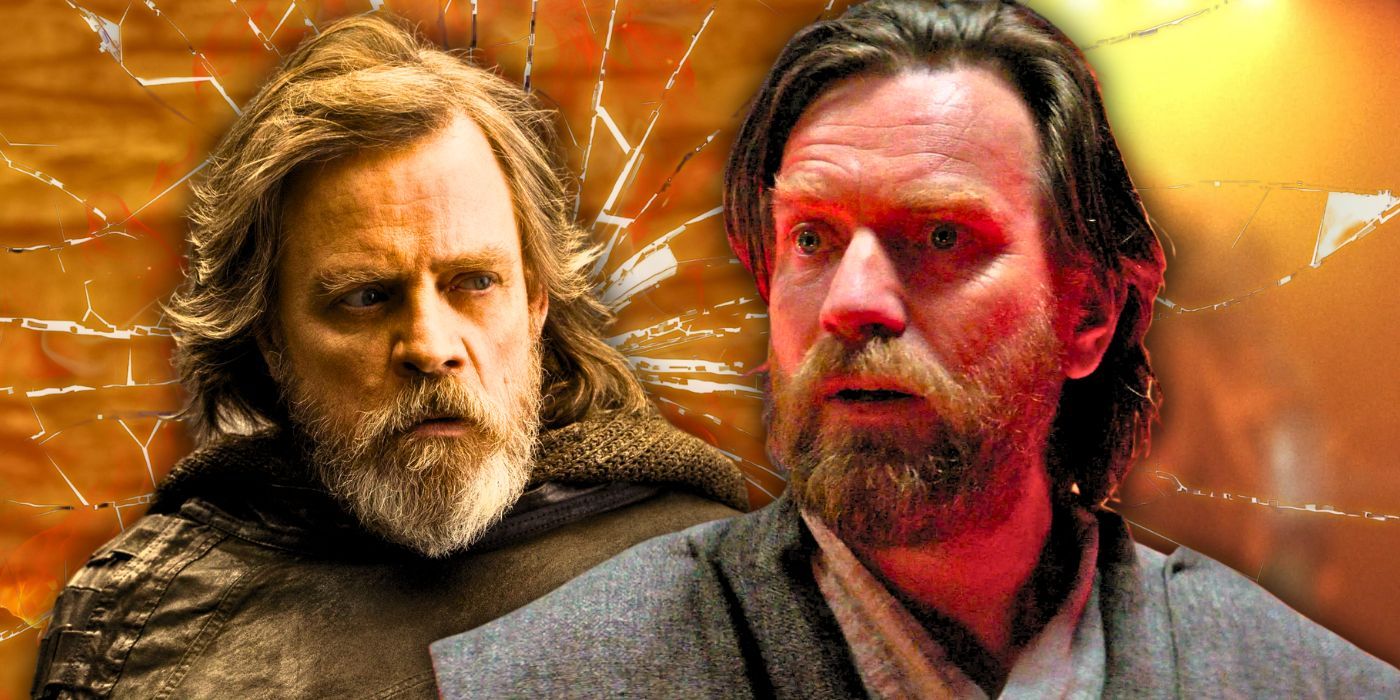
Obi-Wan Kenobi's character arc under Disney was similar to Luke Skywalker's in Star Wars: The Last Jedi, but the former was far more effective than the latter. While the Star Wars sequel trilogy had a largely positive reception at the beginning with Star Wars: The Force Awakens, the reaction to The Last Jedi was far more divisive, thanks in no small part to the characterization of Luke. This aspect of the film has been hotly debated ever since, with detractors claiming that Luke's portrayal is inconsistent with the previous movies and a disappointing direction to take the character.
The Obi-Wan Kenobi series on Disney+ also received its fair share of criticism, but while Obi-Wan's story was similar to Luke's, it had much better execution. Each story took a different approach in building off what came before, making one feel like a natural continuation and the other a sudden change in direction. There were also a few key differences that made Obi-Wan's story feel more satisfying, and this reveals how Luke's arc could have been a lot more compelling. Upcoming Star Wars movies and TV shows can learn from this comparison to avoid making similar mistakes with their characters.
Related Star Wars Movies In Order: How To Watch Release Order, Chronologically & With The TV Shows What's the best way to watch Star Wars? Here's everything you need to know to watch in release or timeline order, and how to include the TV shows.
Luke Skywalker Became A Completely Different Character... Offscreen
30 years of character development was condensed into exposition and flashbacks.
Close
After waiting 34 years to see Luke Skywalker in a starring role again on the big screen, many viewers were shocked by how radically he had changed since his last film appearance. Luke is an optimistic young man at the end of Return of the Jedi, but the next time audiences see him, he is suddenly a broken, nihilistic man at the beginning of Star Wars: The Last Jedi. Where once Luke threw away his lightsaber because he intended to die a Jedi, now he throws his lightsaber away because he's waiting to die so the Jedi can end.
The problem is not that Luke changed, as there is a 30-year gap between movies, but rather because it doesn't feel natural. Sequels are designed to build off each other, so if circumstances change between movies, it must make sense based on the previous film's ending. Star Wars: The Force Awakens already had this problem before The Last Jedi, immediately establishing that the destruction of Luke's Jedi Order sent him into exile. A few brief explanations in one movie and a handful of flashbacks in the next don't provide enough connective tissue between these two versions of Luke.
Obi-Wan's Character Development Happened Onscreen
From a stubborn young man in Episode I to a broken Jedi Master in Obi-Wan Kenobi.
Close
Obi-Wan Kenobi was given a similar character arc to Luke Skywalker, but his development happened onscreen. In Star Wars: Episode I - The Phantom Menace, Obi-Wan is a stubborn, highly orthodox, 25-year-old Padawan, a little older than Luke in Return of the Jedi. By the first episode of Obi-Wan Kenobi, he is an older, weary Jedi Master scarred by his past, much like Luke in Star Wars: The Last Jedi. The difference is that audiences can see Obi-Wan's gradual transformation throughout the prequel trilogy, so there is no sudden jump between the young Jedi apprentice and the exiled Jedi Master.
Of course, Obi-Wan does change between Star Wars: Episode III - Revenge of the Sith and the first episode of Obi-Wan Kenobi, but this makes sense because of how the prequel trilogy ended. Obi-Wan lost everything he knew, was forced to fight his closest friend, then went into exile with a clear purpose. Obi-Wan Kenobi quickly establishes that Obi-Wan has spent 10 years waiting, and with no opportunity to correct his mistakes, he has gradually lost hope. He has also been haunted by the memories of what happened in the prequels, and watching over Luke constantly reminds him of Anakin.
Obi-Wan's Show Did Luke's Last Jedi Story Better
An exiled Jedi Master who has left the fight behind
Close
On top of having a better setup than the sequel trilogy, Obi-Wan Kenobi also executes a better version of Luke Skywalker's arc. Obi-Wan has lost faith in himself and given up on the Jedi, carrying a huge weight on his shoulders everywhere he goes. Even so, Obi-Wan still has some of his old personality when interacting with certain characters, and he has a purpose in protecting Luke. He initially rejects the call to adventure, but while Luke doesn't leave his island until the end of Star Wars: The Last Jedi, Obi-Wan leaves Tatooine in the first episode of his series.
This is the biggest advantage that Obi-Wan has over Luke: one is an active protagonist while the other is not. Obi-Wan has a goal he is pursuing and participates in the main plot, whereas Luke only agrees to train Rey to convince her that the Jedi are no longer needed. It makes Obi-Wan's story more engaging as he finds his way again and recommits to the Jedi path. Luke found his way by the end of The Last Jedi but was immediately killed off, limiting his role in the next movie after sitting out so much of the first two.
In Colin Trevorrow's original Star Wars Episode IX script, Luke's Force ghost would have trained Rey and haunted Kylo Ren.
Obi-Wan's Story Shows How The Sequels Could Have Fixed Luke's Arc
Episode VII could have been the bridge between each version of Luke
Close
Instead of starting with Luke already missing, Star Wars: The Force Awakens should have been a prologue focusing on Ben Solo's fall to the dark side.
Even though Obi-Wan Kenobi has three movies and a TV series, the execution of his story shows how a few changes could have drastically improved Luke Skywalker's arc. Instead of starting with Luke already missing, Star Wars: The Force Awakens should have been a prologue focusing on Ben Solo's fall to the dark side. This would be a more natural transition between trilogies and allow viewers to connect with Luke's Jedi Order before its destruction. Star Wars: The Last Jedi would then jump forward five to ten years to Luke's exile on Ahch-To after he failed in the previous movie.
However, while Luke's new characterization makes more sense in this version, he doesn't need to be a completely different person. Ewan McGregor was allowed to act like the old Obi-Wan when necessary, and Mark Hamill should also have been given the same treatment. Luke should also have survived until the third movie, giving him greater redemption by fighting alongside the Resistance. Obi-Wan Kenobi's story built on what worked with Luke Skywalker's, and future Star Wars stories can similarly learn from the past when creating new character arcs.




COMMENTS