Fallout 4 Characters' Sad Fates Share One Thing In Common With The Fallout TV Show
Summary Fallout 4's Vault-Tec rep and the TV show's Cooper share a tragic backstory, showcasing common themes in Wasteland.
Both characters survived the Great War as ghouls, cursed with immortality & eternal loneliness.
Cooper & Vault-Tec rep offer unique perspective on pre- & post-War world attitudes, contrasting other ghouls in the series.
A prominent character in Fallout 4 shares an uncommonly tragic fate with one from the Fallout TV show. Although the Fallout video games and TV show don't share any major characters, they do share lore. That means they feature a lot of the same concepts, and characters with similar backgrounds. These tenuous connections reveal which kinds of stories are common in the Wasteland, which in turn helps characterize the world of Fallout's setting.
But, in a rare coincidence, two characters from Fallout 4 and the Fallout TV show share similar backstories, in more ways than one. The similarities further extend to how they're portrayed in their respective pieces of Fallout media. This speaks not only to the nature of the characters themselves, but also to their place in the wider Fallout universe, and also hints at the future of the franchise.
Related One Fallout New Vegas Game Ending Makes The Most Sense After The TV Show Fallout’s TV show adaptation stays mostly canon-neutral, but it does seem to designate one New Vegas ending as canon. Here’s why it makes sense.
Fallout 4 & The Fallout TV Show Both Feature Ghouls Pre- And Post-Ghoulification
The Vault-Tec Rep & Cooper Howard Explained
Close
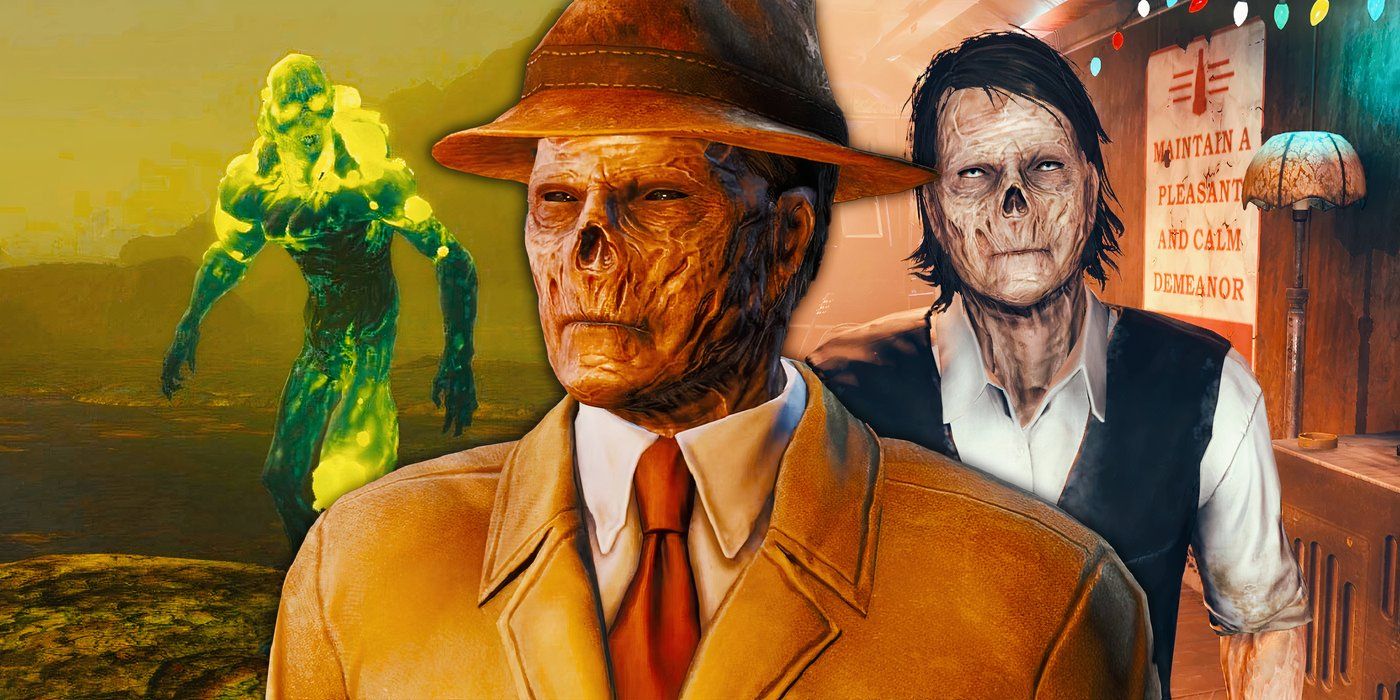
Fallout 4 and the TV show feature ghouls depicted both before and after ghoulification, making them some of the most tragic figures in the series. In Fallout 4, the nameless Vault-Tec representative who knocks at the Sole Survivor's door during the introductory sequence eventually becomes a ghoul. He sells them the membership that allows them to take up residence in Vault 111. But as the bombs fall and the Sole Survivor prepares to enter the Vault, the sales rep can be seen arguing with one of the guards.
But despite exposure to deadly levels of radiation, the Vault-Tec rep manages to survive the war, if not unscathed. The Sole Survivor later finds a ghoulified Vault-Tec rep living at the Hotel Rexford in Goodneighbor, at which point he can be invited back to the rebuilt Sanctuary. Once the Sole Survivor comes to visit him, the Vault-Tec rep can be recruited as one of Fallout 4's settlers. He can use his hundreds of years of sales experience to run any settlement's trading post.
Meanwhile, the Fallout TV show stars a character known simply as The Ghoul. Pre-War, he was better known as the actor Cooper Howard. Much like Fallout 4's Vault-Tec rep, Cooper also worked as a representative for Vault-Tec, in the capacity of celebrity spokesperson. His prominent position in the company might've gained him a spot in one of their Vaults, but he had a falling out with its executives following their proposal to use the Vaults as social experiments. By the time the bombs dropped, Cooper was divorced and disillusioned, performing at a child's birthday party to make ends meet.
The TV show also confirms that Howard was the inspiration for Fallout's mascot Vault Boy, even pioneering his signature thumbs-up gesture.
Per Fallout lore, ghouls are created by gene-obliterating exposure to gamma rays, which Cooper and the Vault-Tec rep both experienced during the Great War. This radiation not only causes burning and scarring - it also rewrites their DNA. Ghouls are functionally immortal. They can't die of old age, and possess regenerative healing powers that allow them to recover speedily from most injuries. These abilities allow both Cooper and the Vault-Tec rep to survive the war.
But the ghoul's blessing is also their curse: ghouls are doomed to eternal loneliness. As immortals, they're cursed to watch every single human they've ever known or loved age and die, while they remain alone with their grief. This loneliness is part of both the Vault-Tec rep's and Cooper's characters. Both of them are embittered by the loss of their loved ones. Cooper misses his daughter Janey specifically, although deep down, he believes she's still alive somewhere. The Vault-Tec rep doesn't have any named family or friends, but like many ghouls, he's been ostracized from many smoothskin communities.
Related Fallout 5 & Fallout TV Show Have One Interesting Problem To Contend With The Fallout TV show has proven popular with longtime fans and series newcomers alike. But it creates a serious problem for Fallout 5’s future.
Cooper & The Vault-Tec Rep Suggest A New Direction For Fallout's Ghouls
Pre-War, Post-War, & Feral Ghouls
Close
The way Cooper and the Vault-Tec rep are portrayed marks a significant departure from other ghouls in the Fallout series. These are some of the first ghouls to appear in both pre- and post-War capacities, which allows both of them to serve in audience surrogate roles. Few Fallout characters can act as firsthand sources for life before the war. This is even played for comic effect by characters like Moe Cronin, from Fallout 4, who insists that baseball was actually an ultraviolent blood sport. It can be hard for modern audiences to relate to characters who live in a setting so different from their own.
But these two pre-War ghouls are in a unique position. They can comment on the ways the world has changed - and the ways it hasn't, as they've seen it happen. This is indicative of Fallout's shifting focus; in recent years, the wider story has explored contrasts between pre-War attitudes and the post-War world. Cooper and the Vault-Tec rep aren't the only pre-War ghouls, but they have some of the most intriguing perspectives on history.
Certain ghouls, like Penelope Hornwright and Eddie Winter, do keep photos of their pre-ghoulification ones around. Fallout: New Vegas features Jason Bright, a pre-War ghoul-turned-cult-leader. There are interesting characters in their own right, but not historical ones: their lives before the War are never portrayed directly.
Related You Can Now Play As The Ghoul In Fallout 4 Fallout 4 players desperate to get into the leather boots of Walton Goggins' Cooper "The Ghoul" Howard can now do so with an impressive new mod.
Contrast them with the Sole Survivor's other neighbors, for example. Many of them also underwent ghoulification; these ghouls, with names like Mr. Sumner or Ms. Rosa, can be randomly encountered in the area around Sanctuary. But the gamma rays turned them feral, so they don't remember anything of their pre-War lives. And even if they do, they're not inclined to talk about them. Feral ghouls are basically mindless zombies, and mostly serve as cannon fodder for the player. They don't have scrutable personalities or perspectives, so aren't able to opine on the shifting tides of history.
Some characters in previous Fallout games appear both pre- and post-ghoulification, but only undergo the process after the war. For example, if the player decides to detonate Megaton's atomic bomb in Fallout 3, several of its residents may become ghouls in the aftermath. Their characters do change slightly as a result, but it's not like they're suddenly granted historical knowledge as a result of their newfound immortality. This kind of real-time ghoulification does make the player's decisions feel more impactful, but doesn't lend any depth to the affected characters.
Cooper and the Vault-Tec rep's lived experience both pre- and post-War is part of a wider effort by the Fallout series to connect its setting more closely to the past. The protagonist of Fallout 4, the mystery of Moldaver's survival, and the ever-expanding influence of Mr. House are also part of this trend. These elements all echo Fallout's tagline, which opens every game by cautioning the player that, as much as material conditions change, the inherent violence, hatred, and greed of war never changes. The renewed portrayal of ghouls in both Fallout 4 and the TV show helps the series further explore these themes by directly contrasting pre-and post-War life.




COMMENTS