The Alters Imagines How Harrowing It Would Be To Have A Beer With Yourself
Summary The Alters combines sci-fi concepts and emotional depth, offering a unique gameplay experience.
Lead developer shares insights on game development challenges and narrative construction.
The Alters features complex decision-making, emergent narrative, and engaging exploration mechanics.
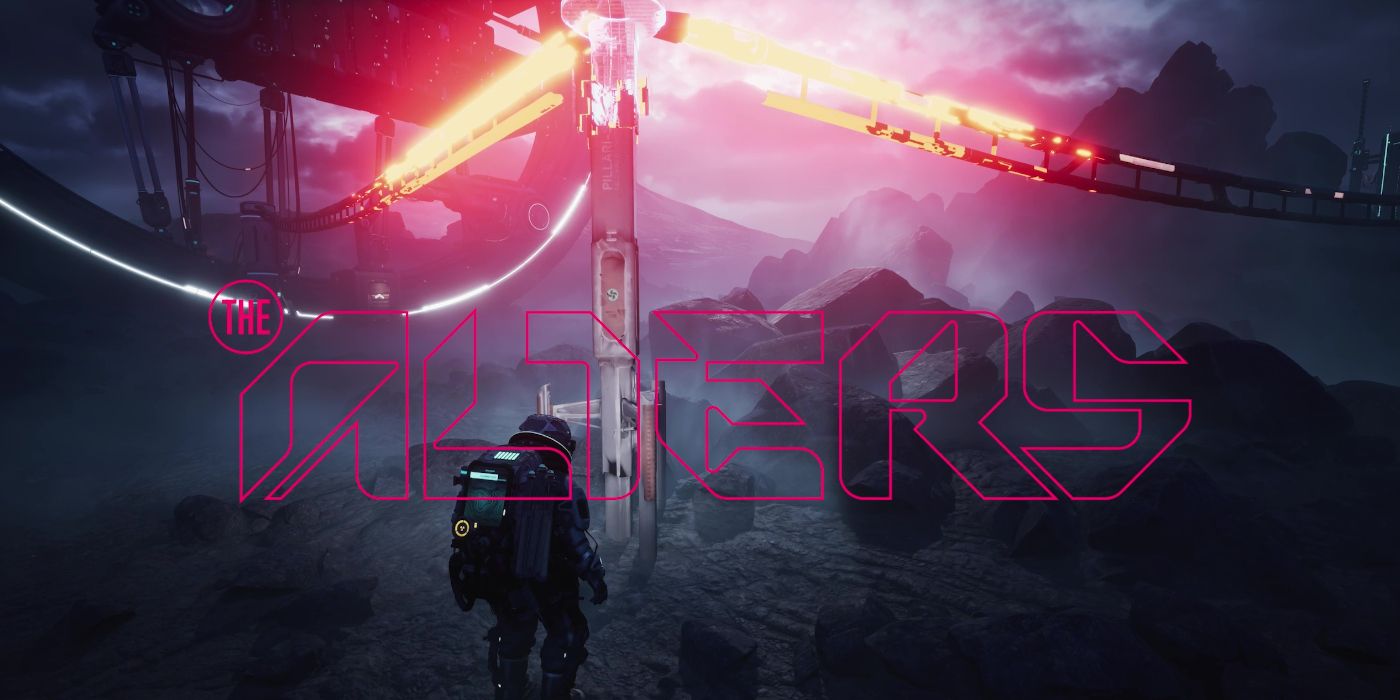
11 Bit Studios' upcoming The Alters is shaping up to be a satisfying sci-fi oddity this year, an adventure-sim mining game that's also, somehow, a game about regret. When Jan Dolski crashes onto a strange alien planet and begins drumming up duplicate selves to help with the job, he comes face to face with his could've-beens and - arguably more disturbingly - his should've-beens, a collection of identical entities who simulate versions of his life lived under different choices made along the way.
Screen Rant's recent preview found The Alters to be a beautiful, thrilling, and undoubtedly strange experience, a blend of exploration, adventure, colony sim, and choice-based narrative, all of which is tied to these curious identical entities. Rather than simple clones, these Alters are something like split-dimension duplicates, with varying personalities, moods, and interests. There are echoes here of director Duncan Jones' hit debut Moon - which Screen Rant's interview touches on below - but there's still more than meets the eye for this multitude of Jans.
Related The Alters Is So Much More Than A Game About Clones: Our Preview The Alters features gameplay ideas and sci-fi concepts to spare, but its emotional core elevates the project, which comes out later this year.
While on location, Screen Rant had the opportunity to sit with lead developer Tomasz Kisilewicz to tease out more of The Alters' many mysteries. Forming one of 11 Bit Studios' largest teams for the purpose of the game, Kisilewicz steers this boat into uncharted development waters, navigating the challenges of emergent narrative construction and sticking to his guns on the game's base-simulation mechanics. In short: it could never have been just a simple menu.
The Movie Moon and The First Alters Of The Game
The Origin of The Alters and a High-Five From Duncan Jones
Close
Screen Rant: How big a fan of Moon are you? You have to be a huge fan of Moon, right?
Tomasz Kisilewicz: You know, that's funny, because Moon is mentioned a lot, obviously. Especially after the first announcement teaser we had, which was all-CGI, and it was sort of showing a situation from the game, where there is an Alter dead on the table. Maybe you've seen that announcement teaser. At that stage, we didn't really talk much about the Alters and the differences between them. So, we see where the similarities with Moon come from. But the funny thing is, when we released it, Duncan Jones, the director, he sent us this GIF on Twitter of us high-fiving. Like, “good job, bros!” So, it was great. It was so nice, because I started fanboying. It's a big thing for us when he [wrote] something like that. I definitely saw Moon way before The Alters, closer to when it came out. And I think it definitely had to be on our minds.
There's some thematic references there, but the game does seem to be doing something totally different.
Tomasz Kisilewicz: Exactly. Because we never really wanted to quote it, and we never said, like, let's make "Moon: The Game," right? This was never the case. But, definitely, it's such an effective movie that it had to be on our minds when we were first describing it. But when we started concepting for the game, we didn't really know [if] it was going to be on the planet, or if it [was] going to be specifically in this setting. We wanted to see this theme, this topic of, what if? How could we see the different decisions? But then, when we knew what we wanted to talk about, we thought, okay, this is an abstract idea, so it's supposed to be sci-fi. And then, okay, we need this tension, this danger that's actually justifying what he's doing, that’s pushing Jan to [make] these Alters. And we wanted to have this constantly growing tension of the sun being behind his back, and all of the survival elements and the danger of the planet came into play. So, gradually, we were adding those layers, creating the world of The Alters. But usually [when] concepting new projects we start with the topic. Even in the pitches at first, [we consider] the message, the topic, the insight, and then we can add some other elements. But it should come from the message. Like, we need to make a new survival [experience]; how could it be cool? We need this topic, what tools are we using? And then, of course, we were like, yeah, we know how to make a good survival [game]. We have people who worked on This War of Mine and Frostpunk, so we're using that experience. But then, for example, going into fully-voiced dialogue was so new for us, and so difficult. We’re still a very small team, and having so [much] dialogue with the Alters was a huge challenge. But we felt, you know, what we really want to do [was not] just read how this life could be. We wanted to have conversations. Like, I'm hanging out in a bar with different versions of myself, and I'm really curious. You know, maybe after three beers I'm like, just tell me, how was it? To do the things that I couldn't do? The things I was so close to, but I never did. And then, having this conversation throughout the game, they're adding more and more, they're getting deeper into their backgrounds with each other. That was the core for us. That's what we were so curious about.
I'm fascinated by how that evolved. Because, for one, I love that part of it. And I love how there is something kind of artificial about the first conversation with an Alter, which I think they call out. Like, "Have a conversation with me. I'm not happy about it, but go ahead and do it."
With what you were saying about the pillars of design, about what if someone could live their life differently. Is that the central topic at the heart of The Alters?
Tomasz Kisilewicz: That's something you discover throughout the game, so I don't want to go into it too much. But we focused on this thought, that we have this tendency to dwell on our past choices. And think, yeah, maybe I could be better off, maybe I could be richer, happier, healthier, or whatever. But the truth is, you wouldn't be better or worse. You would just be different, with different consequences to that, both good and bad. And that's something that we're gradually learning throughout the game. In the very first pitch for The Alters - it was not [under] the name “The Alters” at this stage – but four years ago, I even had this logline [about] how each decision in your life actually makes you a different man, so you are becoming different with every little decision. So, if each decision makes you a different man, what would happen if you met them all? And how would it affect you? So, to me, going through the game, learning this message of just handling the consequences, instead of maybe dwelling too much on the best choices, that's the main thing. Because Jan is a character full of regrets, and he's really unfulfilled; that was one thing we knew about this character. He's basically a person who is unfulfilled, who feels like, "I've made a few bad choices, and that's why I am where I am, and where I am is a bad place. I just went on this mining mission because I wanted to sort of put my s--t together. And, of course, it went bad. It was another terrible decision. Just my luck, right?" And now he's forced to do that, because he needs help to survive. So, he needs to make another choice. And, again, live with its consequences. And you probably noticed, with the pierogies scene, we were having this nebula of the tree of life. Because, throughout the game, what you're doing is you're actually shaping the next part of his tree of life, right? And you're making new branches with your decisions, in either the main storyline or the Alters’ storyline. You're just expanding on his life in the future.
Related Cast Of BOTW Discuss Their Thoughts On A Playable Zelda The cast of The Legend of Zelda: Breath of the Wild shared their thoughts on a game led by a playable Zelda at MCM London Comic Con 2024.
I felt different paths for the story hinted at in the gameplay, potentially. That it would be a different experience if you played it again and made different choices. Is it safe to say that this is the case?
Tomasz Kisilewicz: Yes, that's safe to say. When it comes to narrative, we have three layers; I always drew it like a triangle. So, we have the main storyline, which is, it's a little like an RPG, with different choices. It can go on different courses, you can change the course of the events. But, more or less, it has a similar structure every time you go through some story bits, landing on the planet, moving to the next location, charging to the next location. And, within this, this is the first decision space where you make choices changing the course of the game. Who do you side with? How do you handle some conflicts in later chapters, etc.? Underneath that, you have the layer of the Alters’ storyline. So, each Alter you create, after the first one, you have this freedom [to create] new Alters, depending on your strategic decisions, or maybe just your curiosity.
Even the second Alter made it seem like there were a lot of different approaches which I could have gone with in their creation. Is that right?
Tomasz Kisilewicz: Yeah. Because throughout the game you're upgrading the Quantum Computer, so it opens new branches, and it enlarges the slots you [already have]. At first you have three slots, then you can expand. And you decide what Alters you create, and the Alters, they bring over their storylines. Because they have some things hidden in their backgrounds, their backstories. You don't see it at first; you need to draw it out. And you start with the technician, the pierogies are just opening up his storyline, and you can make decisions within that. So, there's the second biggest decision space. And then there's the layer [underneath] the emergent narrative of the events that can happen, [with what] occurs because of your economic decisions, your decisions [about] what Alters you have. They come into conflicts. They have different ideas about how to manage the base. And this is really emergent stuff, so it can be totally different in different places. It was a headache!
It sounds like it.
Tomasz Kisilewicz: But I think that's what really makes it different, unique. And, even if sometimes it doesn't come together perfectly, at least I feel like it's a very fine line, a fresh decision-making space for the players. I really want them to see it, experience it, and see that, yeah, you can have a strong narrative, but it doesn't have to be a linear story you just walk through once. You can also have a lot of the sandbox-y play for just pure gameplay fun with the systems.
The Alters May Be 11 Bit Studios' Biggest Game
New Perspectives Meant New Challenges For The Growing Team Behind The Alters
But have you guys worked before in – for lack of better term – a 3D/action space like what we see on The Alters? That’s also brand new ground, no?
Tomasz Kisilewicz: Totally. I mean, I'm coming off of This War of Mine and Frostpunk... And both games were 3D, but Frostpunk is top-down, just city-building. This War of Mine was 2.5D…
It had that bisected view.
Tomasz Kisilewicz: Exactly. And, of course, it's 3D when you look at it from the side, but you're just moving in a single line, it’s very simple. This War of Mine was made by 14 people; The Alters is getting bigger, but it's still a very small team in comparison.
What's the size of The Alters’ team?
Tomasz Kisilewicz: Right now it's 50 people. We started with around 10 people four years ago. So, building from 10 to 50. Building a game and building a team at the same time, it was crazy. But we have a really amazing team, of really very interdisciplinary people. We have three animators on board. Go figure, right? With the facial animation and the movements.
It looks fantastic. The exploration, the 3D exploration stuff looks fantastic for a first time. The base stuff feels a little more like the games that you've previously made, but it's very tactile and has a nice feel to it, too. It's not just a menu, which it could have been the case.
Tomasz Kisilewicz: It was so important for us. At the beginning, we were like, we don't want to be an abstract overseer, it has to be very personal, it has to be seen through the lens of a single person. So, even though we have this sectional view in the base, we're very close to the action. You're freely running around the base and following a single person running around. So, it's like a mix between the third-person side on the inside, and then, only with some management tasks, you zoom out to see the full [picture] And even when you're inside the base and [viewing it] from the side, we still decided to tilt the camera a little, so it looks like industrial cameras.
It's so good. It's like CCTV or something.
I like that I had to go look for one of the Alters to talk to, to physically be around him, you know? I didn't have to just press a checkbox and jump into it. I feel like that would have been a decision that, if another of your Alters who would have made this game, they would have made it differently. They might have said: you walk into the base and enter a menu, and then you walk out, and you're live and active in the space again. I do like that.
Tomasz Kisilewicz: Exactly. These are some decisions that we also made very early on, and then we had to live with those consequences. We first thought that the outside would be more top-down, because it would be easier, but it [felt] frustrating. We're on a planet, we want to see these wide landscapes, you know? And that, of course, opened up new design problems.
Not that the top-down view can mess that up, necessarily, but the pitch of the camera does change the feel. In this, there are cool vistas, and you can position yourself to see some of them.
Tomasz Kisilewicz: Exactly. We needed to immerse [the player] as much as possible. Of course, you can argue whether the first-person or third-person [perspective] is more immersive, there are two ways to look at that. Some people say we really live more in third-person than first-person games, because we get a sense of our body. So we decided to go this route, and it was a challenge. But then I have an interview like this, and you say it looks cool, and I'm like, damn, that's awesome!
And I could see this being made in first person, but I think there is something about watching Jan run around the base, and watching Jan run around the Alters, where you see everybody on the screen. That would be very different in first person, being unable to see them standing next to each other. That’s the thing.
Tomasz Kisilewicz: What we said is, if I have to talk to the technician, I have to go to him. That was very intentional for us. Let's say you have four Alters. You go to one but, on the way, you see two Alters arguing about something, or maybe just having a fluffy conversation about their pasts. And that's something that also is not very ready yet, because we're adding a lot of complimentary interactions between each [of them], the game is still in the making. These are things we're still adding. So, we really wanted to have this feel. We have a whole design division called “Life In Base.” It's just focused on creating a life in the base, how they work out, how they hang out, things like that. And, again, in a small team, it’s a big challenge, the AI of the Alters. But I think it has – even if sometimes it's a little buggy – it has a lot of charm. I'm happy about these guys.
It feels exciting and sort of unpredictable. I can tell that that's what you guys are going for.
Sound Design and Composition in The Alters
Last thing: the music is so good.
Tomasz Kisilewicz: Piotr Musiał is a genius. He did This War of Mine, he did Frostpunk, The Witcher 3: Blood and Wine. He's a genius, but he's a very classical musician. He works with an orchestra. So, for Frostpunk, it was obvious. The violins, all of this. And then, we sat down and we were like, Piotr, we love working with you, do you want to do this? Because it's going to be very different. We want you to experiment, we want to make the out-of-this-world sounds of Rapidium. He’s like, "Yeah, definitely. I'm so excited, I didn't work on something like this before. I really want to do it."
So he's handling the overall sound design as well?
Tomasz Kisilewicz: No, he's handling the music, and we have great sound designers otherwise. But there are things that sort of [combine their talents]. So, for example, Rapidium is a mutual [product] of our sound designers and Piotr.
When you first run into it, it's such a great moment. And the sound of it is really interesting. Where you're coming closer and it's emitting from beneath the ground.
Tomasz Kisilewicz: We really wanted for this to feel like something you don't know, you can't name, you can't recognize. But, visually, we've always said that it's a different-state matter. It's not gas, it's not liquid, it's not solid. It’s something different. We call it “glitch crystal.” So, it sort of glitches everything around you. It's both organic and synthetic, and that's how we [explained it] to Piotr. Let's make a sound that's very organic. There are some pipes and things like that, but then let's synthesize it a lot, so it feels out of this world. And it's so funny, because usually people don't notice this stuff so much, it's more in the subconscious. But, today, you're the second person that really spoke up about the sound design, so I can't wait to tell the guys about it!




COMMENTS