Why Anime Is More Relevant Than Ever, Despite Live-Action Adaptations
Summary Disney should consider embracing 2D animation like anime to capture the magic of classic stories and appeal to a wider audience.
Anime's impact extends beyond just fandom; it proves that 2D animations can be thoughtful, compelling, and appeal to all ages.
The desire for realism in 3D animation has led to disappointing live-action adaptations, highlighting the enduring relevance of 2D animation.
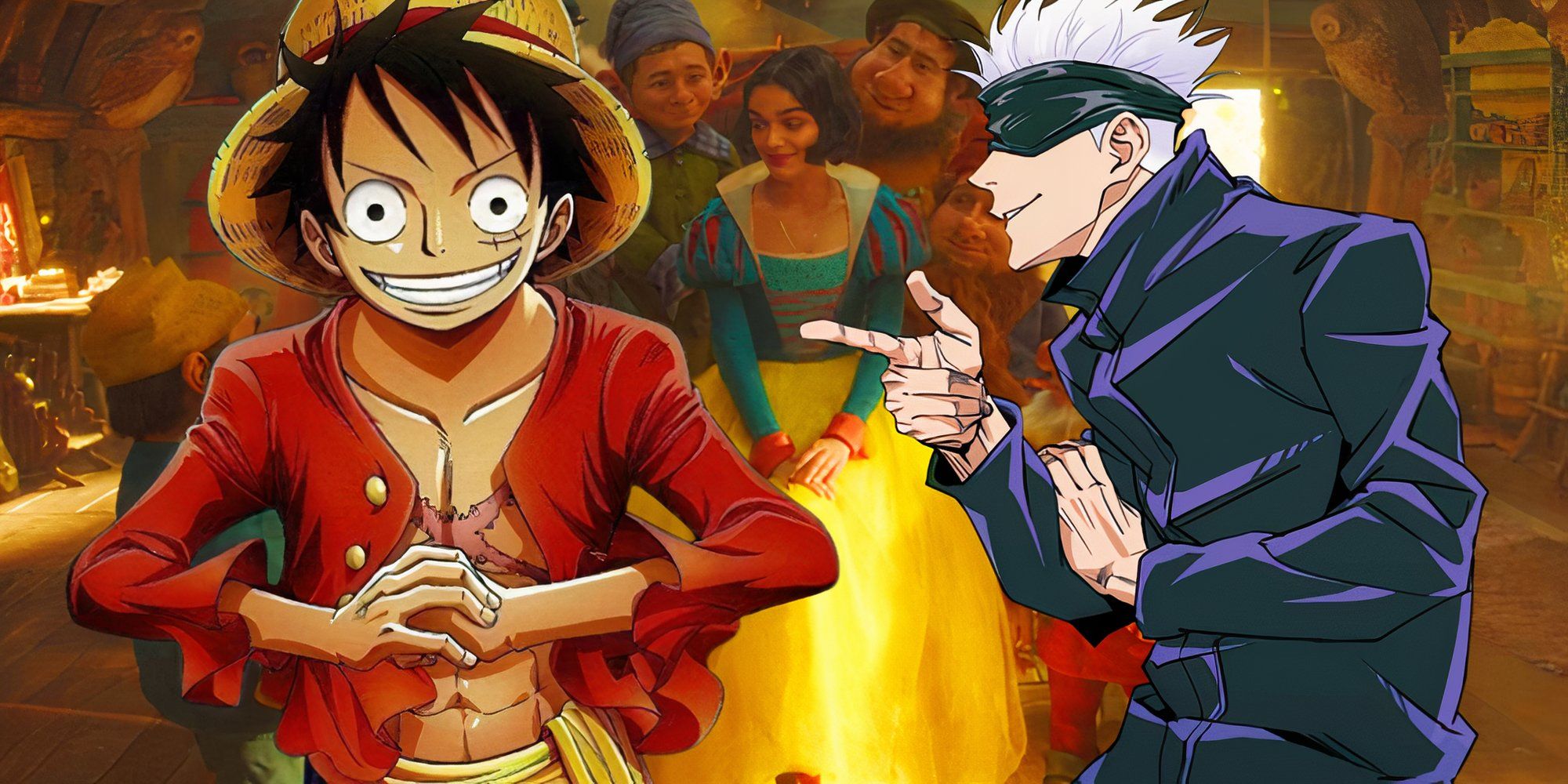
One of the most unique aspects of the Japanese entertainment industry is its dedication to the 2D animation format, known as anime. While Japan has produced ground-breaking live-action features like the 2023 Oscar-winning film, Godzilla: Minus 1, they are primarily known for their contributions to animation. Over the years, anime has conquered international markets with astonishing projects such as One Piece, Neon Genesis: Evangelion, and Chainsaw Man. Aside from the fantastical storytelling and engaging voice acting, anime continues to prove that 2D animation is not only for children but also for a multi-generational audience.
Walt Disney Pictures is one of the most prominent media companies of all time. While the company was once known for its incomparable films of fantasy and wonder, appealing to children and adults alike, it has recently turned a corner. Many Disney fans complained that the company’s live-action movies adapted from their beloved animated classics lack depth and often serve as a cheap cash grab aimed at younger audiences.
Close
Instead of embracing the beauty of animation, film studios such as Disney continue to completely alter the style of classical films until they are almost unrecognizable. Fans have advocated for the return of Disney’s 2D animation style, which was last seen in The Princess and the Frog. However, studios have yet to deliver, proving that anime is more relevant than ever.
Related Live-Action One Piece Spinoffs At Netflix Look Inevitable Now Live-action One Piece was very successful among long-time fans and new audiences alike, with potential spinoffs at Netflix looking inevitable now.
Japan’s Colossal Contributions to 2D Animation
Anime’s Impact on Entertainment Media Goes Far Beyond Fandom Culture
Thanks to anime, the cosplay, convention, and fan-fiction communities have grown immensely in the past few years, rising steadily since the early 2000’s. In 2020, with the onset of lockdown protocols, anime gained a new generation of fans as they began exploring the plethora of stories the medium had to offer. Since then, the anime community has gone global. In 2023, the largest anime convention in the U.S., the Anime Expo in Los Angeles, reported astronomical numbers of attendees: over 392,000 from more than 60 countries.
However, anime’s impact on entertainment media goes far beyond fandom culture; it continues to prove that 2D animated films and TV shows can be well-rounded, thoughtful, and enticing to a wide range of audiences. Sailor Moon and Detective Conan appeal to younger audiences with bright color palettes and light-hearted messages. At the same time, Berserk and Attack on Titan contain complicated plotlines and adult themes, including violence and bloodshed. Time and time again, anime has proved that 2D animations are not only targeted at children.
The 7 Eras of Disney: Golden Age Animations to Live-Action Flops
The Strive for Photo-realism in 3D Animation May Be to Blame for the Influx of Live-action Adaptations
From 2D fan favorites like Cinderella (1950) to unnecessary adaptations like The Lion King (2019), Disney’s lineup of live-action films proves anime’s relevancy. There are 7 recognized eras of Disney’s legacy:
Era Duration Notable Films The Golden Age 1937-1942 Snow White and the Seven Dwarfs, Pinocchio, Fantasia, Dumbo, Bambi. The Wartime Era 1943-1949 Saludos Amigos, The Three Caballeros, The Adventures of Icabod and Mr. Toad. The Silver Age 1950-1959 Cinderella, Alice in Wonderland, Peter Pan, Lady and the Tramp. The Bronze Age 1970-1988 The Aristocats, Robin Hood, The Many Adventures of Winnie the Pooh. The Disney Renaissance 1989-1999 The Little Mermaid, Beauty and the Beast, Aladdin, The Lion King, Pocahontas. Post-Renaissance Era 2000-2009 Home on the Range, Chicken Little, Meet the Robinsons, Bolt. The Revival Era 2010-Present Princess and the Frog, Tangled, Winnie the Pooh, Wreck it Ralph, Frozen, Big Hero 6.
While most of Disney’s films were 2D animated during its first 75 years, things changed in 2010 with the release of Tangled. Disney had multiple 3D animated successes, such as Bolt and Meet the Robinsons, but none quite compared to the adoration of Disney’s adaptation of the story of Rapunzel. Disney and Pixar continually developed new animation techniques to make their 3D films appear more “lifelike.”
For example, during the production of The Incredibles, Pixar’s animators were uncertain that the technology needed to animate Violet’s hair even existed. Through a complicated series of steps, it was accomplished. However, since Tangled, Frozen, and Moana, the standards for realistic appearances have risen.
Fun Fact: The animators for Finding Nemo made the ocean waves appear so photo-realistic that their superiors told them to lower the quality. Otherwise, competing studios might have believed they used live footage as a shortcut.
With the desire for “realistic” environments came the experimentation with live-action adaptions. At first, these adaptations were not failures. Cinderella (2015) stuck closely to the original story, maintaining the wonder and beauty of the classic tale. In contrast, The Lion King (2019) is a shot-for-shot remake of the original film, with CGI renderings that appear cold and unimaginative. On the other hand, Disney’s upcoming film Snow White (2025) has faced severe backlash after news of significant changes to the beloved story.
Disney and Other Film Studios Should Re-embrace 2D Animation
Since The Princess and the Frog, very few 2D films have been released by Disney. Instead, most classic stories (and even some video games) receive live-action adaptations. While some are successful, such as Amazon Prime’s recent series, Fallout, most are heartless cash-grabs attempting to ride the coattail of well-known fables. While some of Disney’s live-action films are remakes of their source material with few changes, they lack the magic that 2D animation brings. Such as in the case of Snow White, other remakes pay little homage to their original stories, removing the very elements audiences look forward to seeing.
There is still a stigma surrounding 2D animation. Many fans have heard others say that anime is “for kids” simply because of the animation style. In some onlookers’ minds, anime is nothing more than a cartoon aimed solely at younger audiences. However, this could not be farther from the truth. Anime is a storytelling medium, not a genre, and Western film companies should follow in Japan’s footsteps. In a world full of economic collapse, financial distress, racial tensions, and gender wars, meaningful stories wrapped in a brilliantly executed animated display can bring new life to the entertainment industry.
Disney is so caught up with bringing their classic stories “to life” that they forget why these tales are loved in the first place; they bring imagination, wonder, and a child-like joy to a multi-generational, global audience. In the same way, anime allows viewers of all ages, with varying interests, to enter worlds beyond their own. When asked a question that contained the word “realistic,” John Lasseter, the former chief creative officer of Pixar, replied in an interview with Charlie Rose:
“I never want to produce a world that people think exists.” – John Lasseter
While there is beauty in countless live-action films, anime fans can attest to the specialized components that only 2D animation can cultivate. Capturing relatable, real-world issues in media is essential, but ultimately, audiences are drawn to their favorite films and TV shows to escape reality. Furthermore, many anime provide viewers with the best of both worlds: real-world issues wrapped in a 2D animated universe.
Close
There are a few reasons to dull the colors of a 2D animated series and turn it into something audiences see in everyday life. It seems that this issue is not only affecting 2D animation, but live-action adaptations as well, considering the Wicked film has received some backlash for its drained color palette. In the end, while film studios continue to produce soulless live-action adaptations that neglect their original source material, anime is proven again and again to be more relevant than ever.




COMMENTS