The Dungeon Run Cast Explain How The Audience Helps Shape The Story
Summary Audience interaction shapes The Dungeon Run story, with viewers engaging as "Gods" and directly influencing the characters and narrative.
New cast members were carefully chosen to ensure table chemistry, with a focus on inclusivity and creating a safe space for exploration.
Characters like Yuri and Otto have evolved through romantic tension, grounded in past experiences, adding depth to the story and character development.
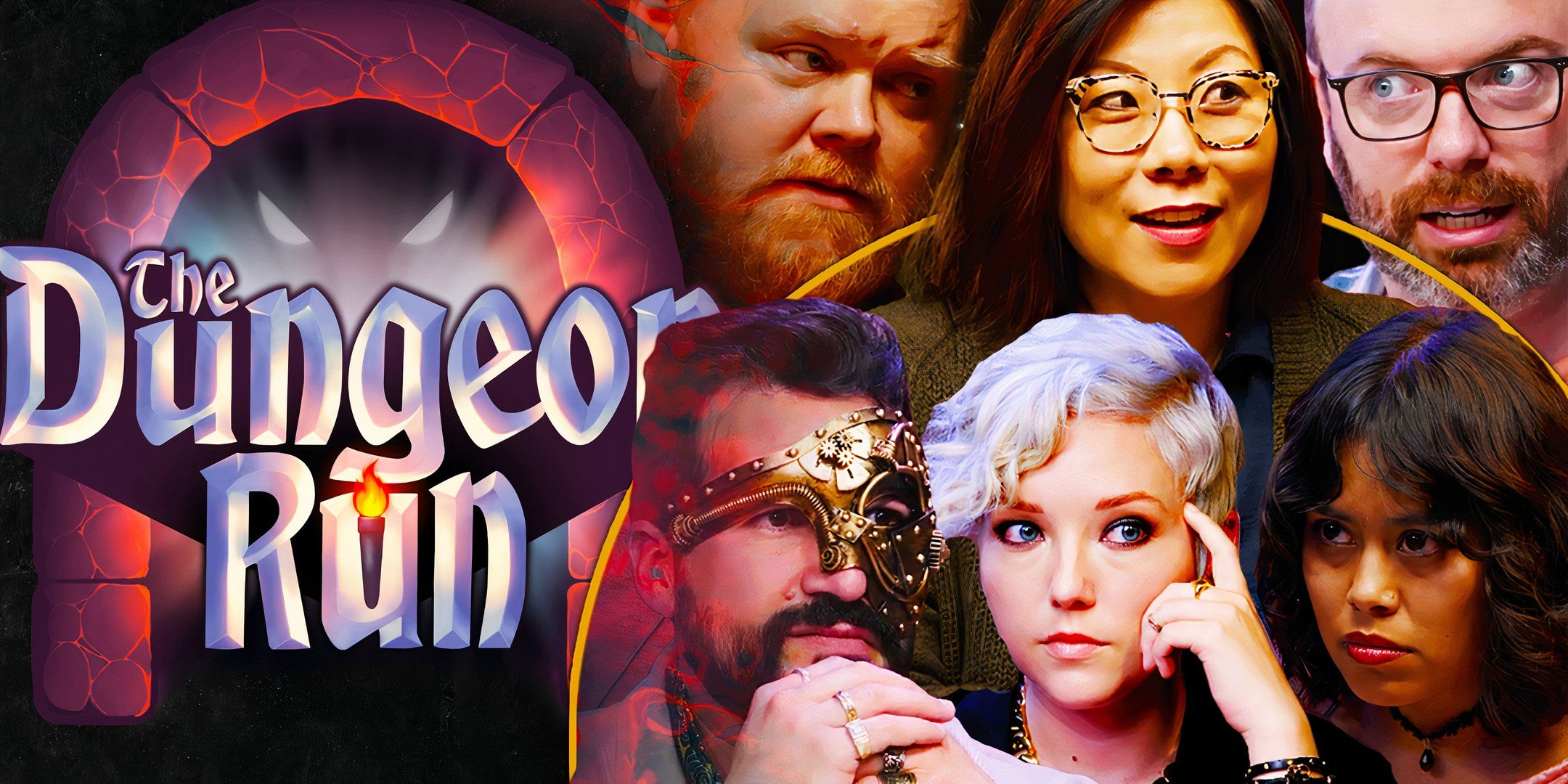
The Dungeons Run is a Dungeons & Dragons actual play that follows a group of adventurers that are brought together by a twist of fate as they battle to not only discover truths about the world, but themselves. The latest season of The Dungeon Run stars Morgan Peter Brown, Ron Ogden, Adam Slemon, Kari Lee Cartwright, Surena Marie, and Josephine McAdam. The new season also tackled McAdam's character departing the show.
The Dungeon Run was launched just over five years ago with its own original world and story. The audience interaction is one of the elements that sets this series apart from other Dungeons & Dragons actual play because the audience is able to help shape the story as "Gods" of this world. Ogden, as the Dungeon Master, is able to find a balance between allowing the audience to help weave the tale, shape the story he has created, and adjust to the choices made by the players that change the direction of each season.
Related 10 Best Fantasy Book Series Based On Dungeons & Dragons (Including Drizzt) Plenty of novels have taken inspiration from Dungeons & Dragons, with settings ranging from the foundational Greyhawk adventures to Faerûn.
Screen Rant interviewed the cast of The Dungeon Run. They explained how their audience helps to guide the story through interaction and how the chapter format makes it easier for new viewers to immediately jump into the adventure. They also shared how their own journeys with Dungeons & Dragons on The Dungeon Run have mirrored their characters in many ways.
"The Audience Is Established In Lore As The Gods Who Watch"
The audience interaction is an important part of The Dungeon Run and has been refined over the years to allow the cast the freedom to tell their story while the audience still feels actively involved as, to a degree, characters within this world. It has once again changed with the series now pre-taping instead of streaming live, but the audience interaction is still a key piece of The Dungeon Run.
Morgan Peter Brown: That's another fun thing we've established, the interactivity within the story. Whether in Campaign One it was an amulet or for most of the first part of The Stormborn Campaign it was a skull that we had. Then the audience is established in lore as The Gods Who Watch, as beings from another realm who can basically affect things. Ron Ogden: So, as they reach levels, the levels increase and then reset. So, we started at one through five. And when they reach five, it jumps up to six and it resets. Then when they get to six, seven, so on and so forth. So right now, each force is on their seventh bucket. Level five is, God Level interactivity in the world. Something major happens. So when you get to six and seven, you're talking about multi-planar changes that the watchers are instituting in the world, through the focus of a DM story structure of these players. Surena Marie: So that's a big thing. A thing I want to talk about too, to scale back a little bit without getting into the nitty-gritty of how the tier system works. We have such a dedicated community, who, because they have that opportunity to submit their story, submit their magic items, submit their plot beats, they have, again, that more ownership of it. And so, at the end, we do an improv thing, that I used to hate, by the way, because it would just stress me out. It would just stress me out because I'm like, "Oh God, we're doing improv?" But it really feels, on our end too, that we also know our community very well. I think that it's really easy for a lot of APs to have a disconnect between their community and their show. We know our communities by name. When we're given disadvantages or advantages, we thank them, for better or for worse. And so, I think that also creates a really interesting piece of engagement, and it did feel like they're part of it with us. Ron Ogden: It makes sense that our community is so kind. Since I can remember, probably Episode One of Season One, Jeff [Cannata] led us in always closing out, and we continued to do that with "Humankind, be both." I've always taken that to heart. Hearing Jeff able to say that at the table every time we shot, I think that really helped us realize that we're all just people, trying to understand, and trying to help each other tell stories. I think our audience really loves that.
Ogden and Brown who have been involved with The Dungeon Run since the beginning explained how they brought in new cast members during the second campaign. They broke down the casting process and why they were nervous after the lightning-in-a-bottle feel of the first campaign.
Morgan Peter Brown: APs and TTRPGs, in general, it's so much about table chemistry and every table is different. Every story is different. If you told this story with another table, it would be wildly different, I guarantee you. But also, the dynamic of this group has been so amazing, and so cozy, and so chaotic, and so emotional, and violent, at times. It's scary. I think we have fallen into, and this is one of the best things about D&D, in general, or about TTRPGs in general, is finding the roles within the group. I was gun-shy because our casting process for the show, originally, because Ron and I were cast in the show, was some of the craziest. I still talk about it as one of the craziest casting experiences. Jeff by the end of that day was like, "I don't know anything anymore." He's not even exaggerating. It was so crazy. When we were starting a new campaign, starting a new story, looking for new players. We've worked with everyone, so that's why I was a little hesitant to call it an audition because everyone who we've worked with I'm like, "We're interested in you, it'll just be a matter of how and when." Ron Ogden: And in that process, after our chemistry read audition, we had a long conversation because we're inviting new people to the table. Morgan Peter Brown: Campaign One was luck. We had an amazing cast, but again, none of us knew each other beforehand. We saw what worked, which was everyone coming to the table, heart wide open, "Let's do this. Let's grab hands and jump into the abyss."
The Dungeon Run utilizes a chapter format that allows new viewers to jump in without feeling overwhelmed by the lore and an astronomical number of episodes. Ogden shared how he balances his love of lore with making the show accessible, but credits audiences being able to engage with complex stories.
Ron Ogden: I'm a lore monkey for sure. That lore sometimes forces us to be able to tell a story that still has impacts outside of the one in the chapter that we're in. I try my best even if you know nothing about the characters when you come in, the story is engaging right away. Ultimately, I want to inspire you to go watch what isn't in this chapter. So it benefits me to sprinkle in Easter eggs. Sometimes I do recaps and the recaps are just to help people, "Where are we? Where did we start? Why are we here?" So that's one thing, I can always go back and watch the videos. I always do them at two times speed and just re-watch what happened, just to familiarize myself with what's going on. So that it's easier to deliver that story to our audience. And honestly, I've learned, especially with modern audiences, and anime, and all that stuff, large, complex stories, people love. It gives them things to dig into and discover. And because our community is actually so interactive, they discover things before I do sometimes.
Brown further explained how each new chapter is designed to be a new jumping-on point for the audience, comparing it to television shows like X-Files. This isn't a new struggle, welcoming new audiences while rewarding long-time fans, in long-form storytelling, but by keeping the audience experience at the forefront of their minds, The Dungeon Run cast is able to find that balance.
Morgan Peter Brown: To go back to what you were saying about the chapter format. One of our strengths is keeping that audience experience in mind, whether it's through direct interaction with them, or just knowing ourselves. I watch actual play. I really enjoy it. Doing the chapters, which allows us to, we try to make the beginning of each chapter a new jumping on point, if you can. So it's almost like a new season of a television show. You could start X-Files at season four and probably still get it and catch up. But then, if you were from season one, you'll still get all the good stuff, too. So it is that constant battle that's been going on in media, television, and entertainment forever, which is, welcoming the new, but also satisfying to everyone that's been following you this whole time.
The Dungeon Run Cast On How Being A Safe Table Gives Them Freedom As Players
Cartwright shared how she leaned into her character, Coco, having amnesia which made it easier for her as someone newer to Dungeons & Dragons to get her footing as a player and develop the relationships between her character and the others at the table. This gave viewers who are newer to Dungeons & Dragons the perfect conduit to learning the game with Cartwright revealing that she has only recently begun to realize how well she has learned the rules.
Kari Lee Cartwright: My character, Coco, has memory loss at the beginning. It was good to play at the beginning, because it was like, "I don't know what I'm doing. And I don't know what anything is." So, to play a character with, basically, amnesia, was great. Except then at some point, I can't remember what number episode it was, but at some point I realized, I was like, "Oh, I am not learning this game because I have taken on this idea that I don't know anything." I was just like, "Wow, why can't I learn this?" And then I realized it was that. Morgan Peter Brown: You were being too method. Kari Lee Cartwright: Yeah. Well, also D&D, you guys, it's complicated. I realized, I think maybe it was even last week, where I was like, "Oh, I kind of know how to play." And I think that that's also symbiotic with Coco's journey.
Slemon explained why he wanted to play a character, Cristobal, that wasn't built for the adventuring lifestyle. Slemon also shared how Cristobal's relationship with his family has caused him to reflect on his own relationships, both with his family and his friends around the table.
Adam Slemon: I play Cristobal de la Cruz, who is a wizard. The whole idea behind Cristobal was to come in and be like, "I don't know what I'm doing. Why are we in the wild? There's so much dirt." That was the whole idea. So Cristobal's whole idea is, he doesn't have scars. He hasn't experienced life. While everyone else has come in with these tragic backstories, Cristobal was like, "I've lived in the courts, everything's great." My point being that Cristobal has just grown because he's been forced into it. He's been forced to evolve. Morgan Peter Brown: Which is what you want for your heroes. Adam Slemon: There's no fun for me playing someone who's half-baked. I'd rather start with nothing. And as I've grown with Cristobal, and just like Cristobal has this whole thing with his family, and his father, and this weird relationship there. It causes you to analyze your own familial relationships. As well as your interpersonal relationships with the people at the table. Because Cristobal is someone who has no close friends. He has no close connections. So, to now be thrust into a world where you're utterly dependent, on the people around you, you're forced to create these connections.
McAdam reflected on how feeling sage at The Dungeon Run table opened the door to explore gender and identity through their character Yuri, who is a Changeling. McAdam also explained why they were careful in deciding when Yuri would change their face and, with it their personality, needing a reason to trigger the shift.
Joephine McAdam: Yuri is literally a Changeling, right? So change is inevitable throughout the story that they were going to be a part of. But I think, Kari, you were saying this earlier, it's such a safe table. It's one of the first places where I've felt safe to explore gender identity and fluidity. Not to say I haven't done it at other tables. But I felt like I could really explore and I didn't feel like I was tiptoeing around it or anything like that. That was really nice to feel. I am someone who has also moved a lot growing up. So I've started over a lot of different times, and maybe reinvented myself a little bit each time. Or you also adapt to whoever's around you in the situations. What was nice is that, in the game, anytime I would change forms, I didn't play a Changeling where it would happen all the time. Very distinct things would happen. There was a reason that a change was happening. It was triggered by something. And every time the group just accepted it. Not treating them with any apprehension, or, I guess, distrust, or that they were a totally different person. Like, "Oh, it's still you, even if you look a little different." I just think that's such a wonderful thing to hear, especially in this world, and as actors, where we're constantly changing who we are a little bit, and performing, and being told that, "Oh, well, if you look like this, you have to be this. If you look like this, you're in this box." It's really nice to just have an avenue where you can be whatever feels right to you, it's true to you in that moment, and be accepted around it. It's really nice and made me feel very, very happy and safe.
Marie discussed how Otto evolved over the course of the series beginning as a teenager, with the idea of a more family-friendly feel, before growing up to be in their twenties. She explained what inspired this decision and how Otto growing up has allowed her to reflect on her own life.
Surena Marie: When I first started, because the premise was it was a family-friendly show, my character Otto was younger. I think I was playing him 15-16 when I first started. So he was pretty young at first. But then I realized with the stakes that the story was having. I put myself in a place where I was very conscious of making sure that everybody at the table is comfortable, but also that the audience is comfortable. And so, having this child in a lot of danger all the time was potentially triggering. So I made the conscious choice, I think, towards the earlier episodes, to gradually age him up. Every episode, I'm just a little older, until I use the gauntlet to be like, "Now I'm a man. Now I'm a full adult. I am in my 20s. Let's go." I think there's a lot of us who choose creative professions that, it's almost like some of us have a Peter Pan Syndrome thing, where we're like, "Oh, we're an adult now, what does that mean?" And so, I wanted to explore that with Otto. I think in my life, too, I've been exploring. I'm like, "Oh, I'm an adult now. I have my apartment. I have things that I need to do, like fix my washing machine." Stuff like that. So, yeah, that was a fun challenge to get older.
Josephine & Surena Break Down The Romantic Entanglement Of Their Characters
McAdam and Marie discussed what inspired the romantic tension between their characters Yuri and Otto. McAdam also touched on how the prequel, The Broken Ring II, shed light on Yuri's past while Marie teased how difficult they wanted to make it if their connection ended in tragedy.
Josephine McAdam: Early on, I came in, they already had a story. I'd only watched a few episodes to get an idea of each character and how I might want to interact with and mess with them. One of the first things, I was just looking at, that I wrote down about Otto was that they're sheltered and that I wanted to essentially show them the world. That would be fun and it has been. It is so cute because Serena is so giving at being flustered in these moments. It just makes you want to keep interacting with her because you're just like, "Oh my gosh, it's so much fun." Otto is so full and is so likable. That was also something that I had to think about. I was like, "Okay, how much do you mess with someone who's so likable?" Is this something that starts as a joke and does it end up like, "Oh wait, am I joking still?" Navigating that and trying to figure that out when you have, Yuri's insane romance backstory of their own, which people saw on The Broken Ring II. That, probably, for the audience, I assume, colored their perspective once we came back. I was talking to Otto because they would've realized that it's not a very unique way that Yuri approaches people kind of all the same way. Surena Marie: We weren't allowed to watch Broken Ring, so I don't know what happened. No, I think it's been such a fun game of push and pull between our characters, too. Because I usually, as a default, a lot of my characters, when I start playing, they're mostly ace-presenting, until I feel comfortable enough to be like, "Okay, romance is fine." It's usually harder for me to do that. So, it was easy to be a little flustered, because Otto was just leaning into that side of my brain that's just like, "Oh, a pretty girl's talking to me." But Josephine is really good at finding those moments of, I don't want to say conflict, but, because I told Josephine at the beginning, because we were talking, "Maybe this ends in a really tragic way?" Josephine McAdam: Oh yeah, we checked in a lot. Surena Marie: We checked in the whole time. And I'm like, "If it ends in a tragic way, I'm going to make it so hard for you." And I hope we do it. But I'm going to make it so hard for you to, not only hurt Otto, but it's going to have real stakes. So it's going to mean more if it happens.




COMMENTS