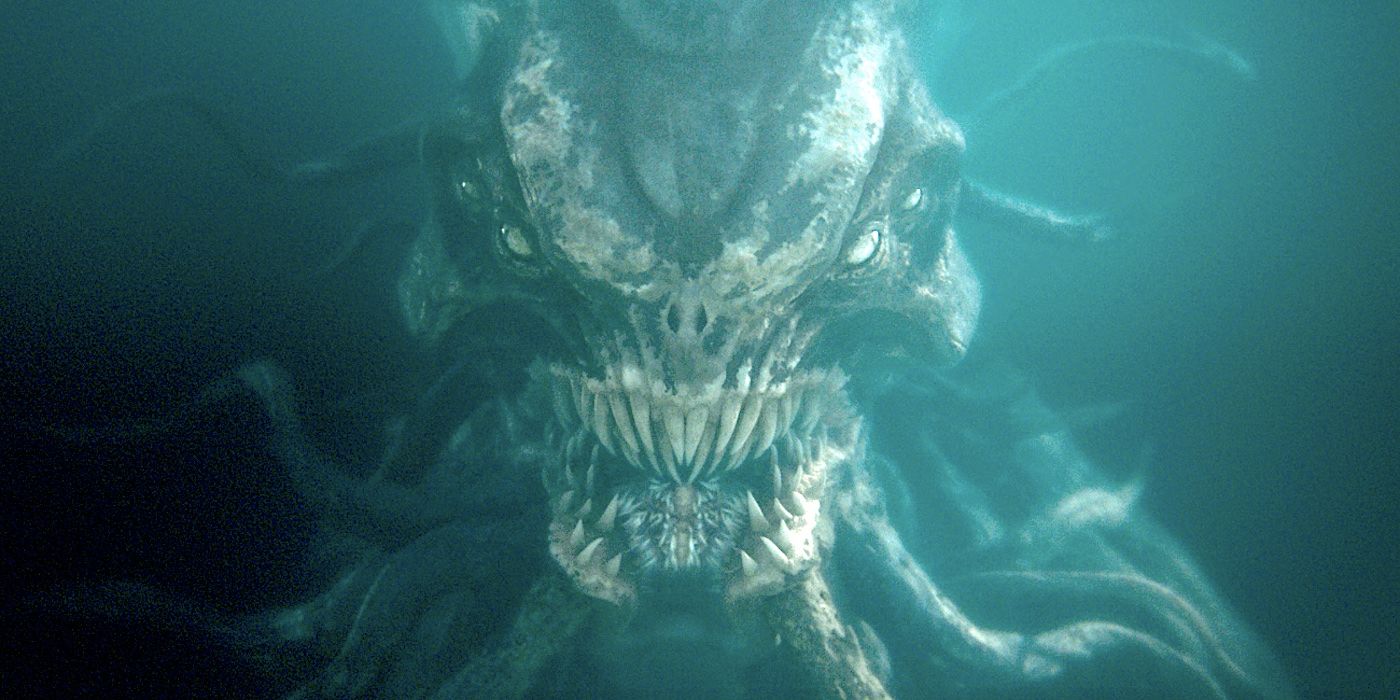
James Wan's H.P. Lovecraft Movie Risks Following Another Adaptation Into Development Hell
Summary James Wan faces challenges in adapting Lovecraft's The Call of Cthulhu due to its complex cosmic horrors and limited commercial potential.
Lovecraft's stories, including Cthulhu, have not been fully realized on screen due to their unimaginable cosmic entities and non-traditional storytelling.
Wan's blockbuster success with Aquaman and trendsetting in horror may give his Lovecraft adaptation a better chance than Del Toro's failed attempt.
Horror legend James Wan would need to use all of his considerable clout to ensure that his ambitious H.P. Lovecraft adaptation The Call of Cthulhu ever made it to cinema screens, but even this might not be enough to make the project happen. Although his racism tarnished his literary reputation, the author H.P. Lovecraft remains one of horror literature’s most important figures. Lovecraft influenced everyone from Stephen King to Neil Gaiman, but his unique stories have rarely been adapted to the screen. Many of Lovecraft’s stories still need screen adaptations since the author’s style doesn’t translate easily to film.
Many of the prolific writer’s stories, particularly those that include Lovecraft’s most famous monster Cthulhu, haven’t been brought to life. Although a 2005 experimental short movie did adapt The Call of Cthulhu, Lovecraft’s monsters are unimaginably awful cosmic entities whose appearance alone can drive characters to insanity. This poses a problem for filmmakers trying to bring them to life. The few great Lovecraft movie adaptations are either only loosely inspired by his work (like In The Mouth of Madness), or adapt Lovecraft's more conventional stories (like 1985's wild horror-comedy Re-Animator).
Why James Wan's Call Of Cthulhu Movie Will Be A Very Hard Sell
Lovecraft’s Most Famous Story Is Tough To Realize Onscreen
Close
Despite these issues, legendary horror director James Wan recently told Empire that he wants to make a movie of Lovecraft's short story “The Call of Cthulhu.” Although Wan is an incredibly successful horror filmmaker, he was quick to concede that The Call of Cthulhu’s limited commercial potential and large budget could be a problem. Per Wan, the movie is a passion project but “Very esoteric,” and even the director of Saw, Insidious, and The Conjuring isn’t sure whether he could get a studio to back this ambitious adaptation. Even James Wan’s many great horror movies may not solve this project’s problems.
Entire cities of impossible non-Euclidean geometry, monsters that bend the fabric of reality itself, and mind-warping cosmic horrors all ensure that it would be tough for The Call of Cthulhu’s adaptation to capture what makes Lovecraft’s writing work.
Lovecraft’s infamous racism aside, there are many more reasons that “The Call of Cthulhu” would be tricky to realize onscreen. For one thing, many of the story’s creepiest moments take place in the protagonist’s mind and rely on subtle implications rather than anything concrete. On the flip side, when Lovecraft’s story does offer tangible horrors, they’re the sort that wouldn’t be easy to visualize on-screen. Entire cities of impossible non-Euclidean geometry, monsters that bend the fabric of reality itself, and mind-warping cosmic horrors all ensure that it would be tough for The Call of Cthulhu’s adaptation to capture what makes Lovecraft’s writing work.
James Wan's Lovecraft Movie Could Mirror GDT's At The Mountains Of Madness Project
Wan’s Ambitious Lovecraft Movie Could End Up Like Guillermo del Toro’s Canceled Adaptation
Sadly, Wan wouldn’t be the first notable horror director to struggle with getting funding for an ambitious, big-budget movie adaptation of a famous Lovecraft story. Guillermo Del Toro’s At The Mountains of Madness adaptation was first announced back in 2010 with Tom Cruise attached to star in the project. Although Cruise is Hollywood royalty and Del Toro is both an award-winner and a financially successful filmmaker, At The Mountains of Madness never came to fruition thanks to its perceived lack of commercial prospects. The adaptation would have been a $150 million, R-rated Antarctic adventure horror story.
The original short story is surprisingly low on plot, with the biggest action beats occurring during the finale. Like “The Call of Cthulhu,” most of the horror in “At The Mountains of Madness” takes place off-screen. This wasn't ideal for potential investors, and the fact that many big-budget horror movies have flopped over the decades (including Cruise’s own The Mummy remake) made this project a risky proposition. Since then, Lovecraft’s mainstream recognition has grown thanks to shows like Lovecraft Country, movies like The Color Out of Space, and references to his work in the likes of Rick and Morty.
Why James Wan's Lovecraft Movie Could Happen When Del Toro's Didn’t
Wan’s Blockbuster Credentials and Aquaman Make His Lovecraft Movie Possible
As Wan himself conceded, the likelihood of his Lovecraft movie ever happening seems pretty minimal. However, the project does have a better chance than Del Toro’s At The Mountains of Madness for numerous reasons. For one thing, Wan’s gory, gruesome Saw franchise became a massive moneymaker at a time when PG-13 horror dominated multiplexes, so it's clear the director is a genre trendsetter. For another, Wan’s blockbuster hit Aquaman features Lovecraft-inspired villains in the Cthulhu-esque Karathen and the Trench’s monstrous inhabitants. Alongside Del Toro’s earlier Pacific Rim, this huge hit introduced some of the author’s themes to the multiplex.
Furthermore, like Wan’s proposed remake of Stephen King’s worst book, this project might find a home on streaming. Lovecraft’s extremely weird style is well suited to the more permissive landscape of streaming and Del Toro's Netflix series The Cabinet of Curiosities featured numerous Lovecraft adaptations and Lovecraft-inspired tales that proved the author’s work could be brought to life with a more modest budget. Only time will tell if James Wan's adaptation of The Call of Cthulhu takes this route, but there is still hope for the project.





COMMENTS