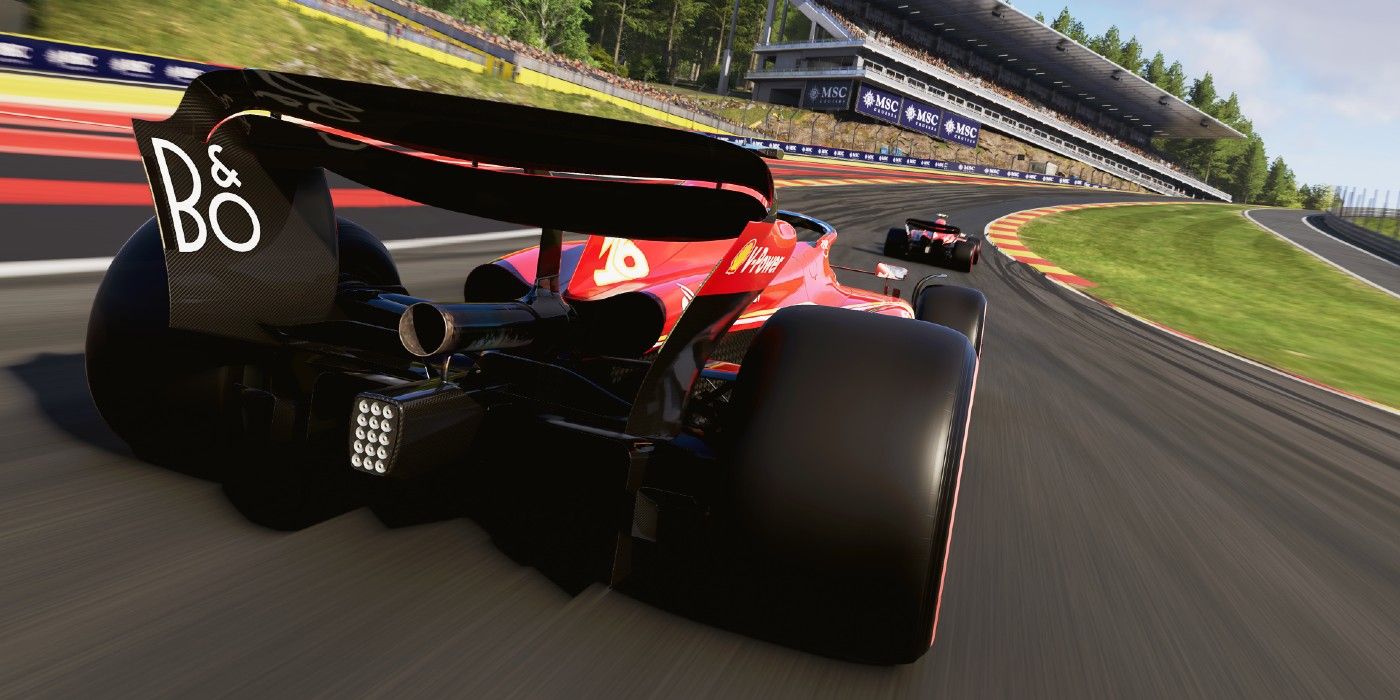
Lee Mather On Making "A Significant Shift Forward" With F1 24
Summary F1 24 boosts realism with EA Sports Dynamic Handling, driver immersion, and improved Career Mode.
New features include better car handling, a recognition system in Career mode, and an asynchronous Challenge Career.
Collaboration with F1 drivers like Max Verstappen for feedback influences game development for more authenticity.
F1 24 is the latest entry in a long line of high-speed releases going back over a decade. The newest addition comes from long-time franchise developer and EA subsidiary Codemasters, which largely specializes in racing titles. The game aims to integrate more Formula One accuracy than ever before, improving the way cars handle and adding new mechanics and modes.
While the last title in the F1 series received favorable reviews, the team has been at work this year to create something even more realistic for fans of the sport. A new technology called EA Sports Dynamic Handling will make driving more detailed than ever before, with input given from current world champion Max Verstappen. There are also several new ways to play - players can step into the shoes of real drivers from the 2024 season, the Career mode has been given more depth through a recognition system, and a new Challenge Career mode allows for asynchronous competition.
Related F1 24 Release Date, New Drivers, Pre-Order Bonuses, Editions, & Gameplay Details F1 24, the upcoming installment in the Formula One racing game franchise, now has an official release date. Here’s what to know about the next F1.
Screen Rant interviewed Lee Mather, the creative director at Codemasters, to discuss the biggest handling changes, the game's improved career mode, and what fans of the sport can expect from F1 24.
Your browser does not support the video tag.
The Biggest Changes Coming To F1 24
Car Handling Intricacies & Improved Careers
Close
Screen Rant: First of all, I'm really curious about the biggest ways that you feel the physics have improved this time around.
Lee Mather: So one of the things that we felt we were lacking was really that feeling of weight transfer in the car. It's not something that's so easy to convey when you're sat stationary in a seat. So you want the player to understand when the car's accelerating and it's leaning back, when it's breaking and it's moving forward. And then what the car's doing through the corners. So we wanted to improve the suspension system to really model that more effectively. And that's where we built in the suspension kinematics, which allows for the anti-dive and the anti-squat. So again, the way the car pitches and rolls is more representative of a Formula One car. It feels more believable to a player and it looks more believable. And we always say that when we build these things, it's not necessarily about making anything difficult, it's about making it more approachable. So if we model the car to be more realistic and more accurate, it naturally feels better and more approachable to a player as well. So it gives us the opportunity then with a really stable platform to build out more depth into the handling model as well, which is what we've done this year.
And outside that new physics modeling, what do you feel differentiates this one the most from previous entries in this series?
Lee Mather: The new career this year is a really big step again for us. So when you look at the fact that we did a career in 2010, 2016, it's been overdue for us to actually refresh one of the most popular game modes. So we've had, obviously, calls from the community to refresh the career, and this year was the year that we thought was ideal. The big change being that you can actually race as one of the F1 drivers and not just as yourself as we did in previous years was, again, another decision we made based on how F1 fandom's changing, how the community around the sport's changing. And we wanted players to be able to represent themselves as a Formula One driver in the game. So that's a really big change. And then obviously all the associated systems that we're able to build off that fundamental change at the start of career. So the way rivalries develop, the multiple levels of rivalry, the way the contract system works and the way that you move around teams. All of those things are fundamental to a career, but they've all been re-imagined differently in F1 24.
Yeah, in fact, I actually had a question about the new recognition system in careers and how that's going to switch things up.
Lee Mather: Yeah. So obviously we want to always find a way to represent a player's progression and how they're doing within the game world. And we want that to be something positive as well. So your recognition within the paddock is something that gives you not only the impact within your own team, so how you can manipulate the R&D of the car, how you develop the performance of your vehicle, how you work with your specialists. They're the team of people who give you team objectives that you want to achieve over the course of the year. But also the weight that you have when you go into the negotiation phase with your team or with other teams as well. If you've got strong recognition, that puts you in a better position. And then just quickly going back to how the research and development now plays out, if you are not the number one driver, then your teammate could be spending the resources in the team on the things that they want to develop, not necessarily the things that you want to develop. So your recognition and your rating in the paddock, especially within your own team, is really important.
And there's also the new challenge career, which is an asynchronous competition. Where did the concept for that mode first come from? And what's it like developing a system like that where not everybody is playing at the same time, but still keeping that feeling like an engaging competition?
Lee Mather: Yeah, that's really cool. So basically, the thinking behind it was we knew we wanted to recreate driver career, but we know driver career is a solo experience. And we wanted to find a way for players to not only be able to experience driver career in a slightly different way, so it's a slightly shorter form of play as opposed to the time commitment that you can put into driver career, but to allow players to know that other players are actually doing the same as them. They're playing the same game mode as them and they can see the progression and the way that they're achieving. So the concept being we create little chapters, segmented versions of the driver career into challenge career. We choose the driver, we choose the team, we choose the circuits, we choose the rules, we choose all of the things that we have in driver career to create these chapters that players will play. And then they'll choose a difficulty level and you'll compete. So we'll all start in exactly the same place, but the scores that we've got at the end will all differ based on how we've performed, the decisions we've made along the way. And we thought that would be really fun to be able to share that with other people and to see the decisions and the progression that people are making based on what they've done.
Collaborating With Formula One Drivers
Gaining New Perspective From Real-Life Racers
And what is the collaboration process like when you guys are working with F1 drivers? Both in terms of talking to them about gameplay elements and also, as you said, you've incorporated the real life drivers as playable characters this time around as well. I'm curious how much those drivers had a say in, "This is what I look like, this is what my stats are." That sort of thing.
Lee Mather: Yeah, it's interesting. There's several levels to it. So how they look, they obviously have sign off on those. They want to make sure that we represent them effectively, as we do. And this year we were able to take full advantage of EA Sports' fantastic facial scanning equipment. They've got an amazing rig that's got hundreds of high quality digital SLR cameras that we can take to the paddock. And literally the drivers, they don't need to give up any time. They can just literally walk in, sit down, snap, they're done, it looks amazing. So how they're represented visually is really important. Even more so this year, as you say, because you will be able to play as one of them. Their stats is something which we derive from performance. And we work with Formula One themselves to ensure that we think we've given fair stats for the drivers. We really try and dissect into that so that we try and get as much data to support the stats as possible. It's really important that they're backed in data so it's not just subjective. Because obviously, people have a favorite and we want to try and make sure that there's less subjectivity in those stats. And then we do also speak to professional commentators who give feedback as well. Because sometimes the story of the season sometimes betrays the level of the stats as well where you think a driver's doing better than they are. And the drivers do comment on them at times. And when Formula One do the driver stats reveal, there's usually some banter across the socials there where they see what they've been given. So those are major areas. And then, as you mentioned as well, the other layer of collaboration is we do get the drivers to play the game. And last year I took my laptop down to Red Bull and Max Verstappen sat there and gave us 30 minutes of his time just chatting. And it was just really great for him to just play and just give constant feedback as to what he was feeling, what's right, what's wrong, what we need to consider for the future. So that's really helpful for us.
And when you're getting that feedback from a driver, are there any moments that stick out to you of them pointing out something that maybe as non-F1 drivers never even occurred to the team at all?
Lee Mather: There was one that stood out a few years ago, where Lando [Norris] pointed out the way that we'd implemented the energy recovery system wasn't how they use it in real life. And we just wouldn't have known that because we see the rules and how it's implemented, we understand the technology behind it. We didn't understand at that point how the drivers utilized it. And then obviously that's changed again this year, we've continued to grow that system. But yeah, I think the one thing that we really will probably never comprehend unless we ever get in a Formula One car is something which the drivers have raised several times recently is the sheer level of traction that they have. Those huge sticky tires when they're hot are just unbelievable. And then the forces that are generated through the corners, again, we'll never be able to experience that or cope with them, I would imagine.
The Challenges Behind F1 24's Huge Scale
Looking To The Future Following Development Hurdles
And you touched on a little bit, difficulties getting the physics right and stuff and not being super familiar with the stats in the way that commentators are, those things can trip you up. Are there other major difficulties that you feel are big challenges when it comes to making an F1 game?
Lee Mather: So I think in terms of things that could wrong-foot us or catch us out, we've been doing this for quite a long time now and we're pretty good at knowing what's coming. We can really hedge our bets quite effectively when things are likely to change. We've got a great relationship with Formula One, so we know a long way out when significant things are going to change. The big challenge for us is always: it's a massive game. It's a huge game now with a lot of content, a lot of game modes. And we grow it year-on-year and it's trying to find the time to actually concentrate on the areas that we think the players will really appreciate. And that's why this year the driver career is one that has been called for updates for several years and we really wanted to focus on that. And the same with the updates to both Spa and Silverstone, they were big player-requested updates.
What new elements are you most excited to see fans react to when the game comes out?
Lee Mather: I always think that the handling this year is such a significant shift forward. I think it'll be really interesting to get people's reaction to that. But then also the way that they engage with the new driver career. I love the concept of the rivalries and the fact that we have the three rivalries now and the different intensities of rivalry. I think that really adds to the drive to get you through the season. But also the contract system and how people will engage with that and move around. So I think that's a really big thing is, firstly, the on-track experience, how they drive the cars, how they engage with the new ERS system because that does play a big part in how effective you are and able to win races. And then of course, the new career mode.
And do you have a driver and car that you like to main in the game when you're testing?
Lee Mather: I've been mixing it up through the testing to be honest. But when I do my play through, once we're out and the game's in the wild and I can sit down and play it without looking at things and criticizing and feeding back, I generally pick Lewis Hamilton because I'm a Lewis fan. But yeah, it's always difficult. But Lewis is normally my go-to, so that's cool.
F1 24 will release for PlayStation consoles, Xbox consoles, and PC May 31.






COMMENTS